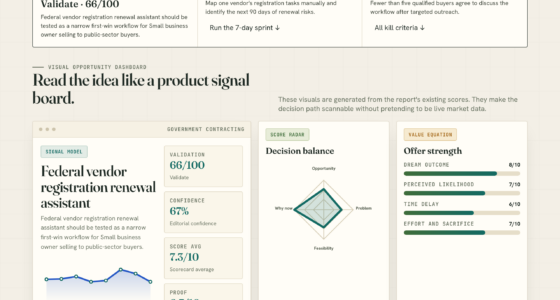

📊 Full opportunity report: The European Union: Rules First, Cushion Always on ThorstenMeyerAI.com — validation score, market gap, and execution plan.
Open a free Amazon Business account
Business pricing, bulk buying and tax-exempt orders.
Create a free accountAs an affiliate, we earn on qualifying purchases.
TL;DR
The European Union is deploying a regulatory and institutional framework to manage AI and labor transitions, emphasizing rules, worker voice, and social protections over ownership. This approach aims to cushion economic shifts but faces challenges as policies tighten.
The European Union is implementing a comprehensive set of regulations and social policies to shape the impact of artificial intelligence and economic shifts, emphasizing rules and social protections over ownership or capital redistribution. This approach aims to preemptively manage technological change and protect workers, with the AI Act reaching its high-risk rules phase on August 2, 2026.
The EU’s AI Act, in force since 2024, classifies AI used in employment—such as hiring and worker management—as high-risk, imposing strict obligations like risk management, transparency, and oversight, with penalties up to €35 million or 7% of global turnover. This reflects Europe’s strategy of regulating AI to protect workers directly, rather than relying on market-based ownership or profit-sharing mechanisms.
Alongside AI regulation, the EU maintains a robust social safety net: a minimum income floor, strong labor protections, and institutions like co-determination and short-time work (Kurzarbeit). These policies are rooted in the social market economy exemplified by Germany, prioritizing worker voice, job preservation, and income stability.
Rules First, Cushion Always
Europe’s instinct is to regulate a force before it builds it. Pair the AI Act with the social market economy and you get the European bet: pull four levers hard — and barely touch the fifth.
Independent commentary, produced with AI assistance under human editorial oversight. The views are the author’s own and may change. This is analysis, not policy, economic, investment, or legal advice. The EU AI Act timeline, Germany’s Neue Grundsicherung reform, Kurzarbeit, and labor data reflect publicly reported information as of mid-2026 and may change as implementation evolves. This phase maps differing approaches and endorses none; contested reforms are presented with competing views, not a verdict. Country and program names are referenced for analysis and imply no affiliation.
The EU’s focus on rules and social protections over ownership reflects a distinct approach to managing technological change and economic shifts. It aims to safeguard workers and maintain social stability through regulation and institutional strength, potentially serving as a model for other regions. However, the emerging economic strains and policy reforms highlight the limits and tensions of this strategy, raising questions about its long-term sustainability and adaptability in a rapidly changing global economy.

AI COMPLIANCE AND GOVERNANCE FOR TECHNOLOGY LEADERS: EU AI Act & ISO 42001 Implementation, Risk Frameworks, and Building Auditable AI Systems (2026/2027 Deadline Update)
As an affiliate, we earn on qualifying purchases.
As an affiliate, we earn on qualifying purchases.
The EU’s approach is rooted in the social market economy, with Germany as a key exemplar—emphasizing worker representation, job preservation, and income security. The introduction of the AI Act and recent reforms in Germany illustrate how this model seeks to shape technological and economic change through regulation and social institutions rather than capital redistribution or ownership sharing. The strategy reflects a preference for rules and voice over market-based gains.
“Faced with a new force, the EU’s first instinct is rarely to build it. It is to write the rules for it.”
— Thorsten Meyer

Palmer Safety SRD 100 FT. Self Retracting Lifeline I SRL Device Swivel Top Galvanized Cable with Small Steel Snap Hook I OSHA ANSI Industrial Roofing Tool Personal Fall Arrest Protection Safety Yoyo
- Durable Composite Housing: Robust plastic casing for longevity
- Swivel Eye Anchorage: Allows flexible movement and positioning
- Load Indicator Snap Hook: Secure connection with load monitoring
As an affiliate, we earn on qualifying purchases.
As an affiliate, we earn on qualifying purchases.
Uncertainties About Policy Effectiveness and Economic Impact
It remains unclear how effective the EU’s regulatory approach will be in balancing innovation with worker protections as AI adoption accelerates. Additionally, economic indicators such as rising unemployment and the tightening of income support suggest potential strains on the social model, but long-term impacts are still uncertain.

TimeRalo Cloud Time Clock for Small Business, 3-in-1 Mode, Remote Access
- Self-Service Attendance Viewing: Staff access timesheets via phone
- Remote Attendance Management: Manage and correct attendance remotely
- Easy Setup: Set up in just 3 minutes
As an affiliate, we earn on qualifying purchases.
As an affiliate, we earn on qualifying purchases.
The AI Act’s high-risk rules will fully take effect from August 2026, with ongoing monitoring of compliance and impact. Simultaneously, reforms in Germany and other member states’ social policies will continue to evolve, testing the resilience of the EU’s social market approach amid economic and technological pressures. Further policy adjustments and evaluations are expected in the coming months.

HIPAA Compliance Poster, 2020 Edition – Labor Law Center Laminated Poster (English)
- 100% COMPLIANCE GUARANTEE – Our federal and state…
- COMPREHENSIVE INSTRUCTIONS – This notice provides clear and…
- POSTER DIMENSIONS – This laminated poster is 18"…
As an affiliate, we earn on qualifying purchases.
As an affiliate, we earn on qualifying purchases.
Key Questions
How does the EU’s AI regulation differ from other jurisdictions?
The EU’s AI regulation is more comprehensive, classifying certain AI uses as high-risk and imposing strict obligations like transparency, oversight, and penalties, aiming to directly protect workers.
Europe emphasizes a minimum income floor, strong labor protections, co-determination, and short-time work schemes to cushion economic shocks and preserve jobs.
Are there criticisms of Europe’s approach?
Yes, critics argue that tightening income support and economic strains could undermine social stability and that regulation may stifle innovation or create compliance burdens.
Will the EU’s model adapt to future technological changes?
The EU plans ongoing policy evaluations and reforms, but how effectively the model adapts remains uncertain as new challenges emerge.
Source: ThorstenMeyerAI.com
Pool season Picks
robotic pool cleaners
As an affiliate, we earn on qualifying purchases.