
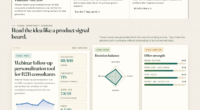
📊 Full opportunity report: The Nordics: Protect the Worker, Not the Job on ThorstenMeyerAI.com — validation score, market gap, and execution plan.

Get business pricing on tech for your team
- Business-only prices and quantity discounts
- Tax-exempt purchasing
- Multiple users, one account, clear invoices
TL;DR
Nordic countries employ a ‘flexicurity’ model that emphasizes safeguarding workers rather than jobs, fostering resilience to automation. This approach reduces resistance to change and supports economic transition.
Nordic countries are adopting a model that prioritizes protecting workers over preserving specific jobs, a strategy that facilitates smoother transitions amid automation and economic shifts. This approach, rooted in the concept of ‘flexicurity,’ is gaining attention as a potentially more effective way to manage technological change.
The Nordic model, particularly Denmark’s ‘flexicurity,’ combines flexible employment laws with generous unemployment benefits and active labor market policies. Employers can quickly reconfigure their workforce, while workers receive high replacement rates and support for retraining, reducing resistance to automation and layoffs.
This system is underpinned by strong unions, collective bargaining, and significant investment in active labor policies, including retraining programs that are eight to ten times more extensive than those in the United States. Norway’s sovereign wealth fund exemplifies a unique approach to ownership and capital, providing a collective financial buffer that benefits future generations.
Experts note that this model encourages a societal mindset where technological change is viewed as an opportunity rather than a threat, enabling more rapid adaptation and innovation.
Protect the Worker, Not the Job
Where Germany saves the job, the Nordics let the job go and catch the worker. The counterintuitive result: unions that welcome automation — because the person is protected even when the role isn’t.
Independent commentary, produced with AI assistance under human editorial oversight. The views are the author’s own and may change. This is analysis, not policy, economic, investment, or legal advice. Descriptions of flexicurity, Nordic active-labor spending, Finland’s basic-income experiment, and Norway’s sovereign wealth fund reflect publicly reported information as of mid-2026 and may change. This phase maps differing approaches and endorses none; contested questions are presented with competing views, not a verdict. Country and program names are referenced for analysis and imply no affiliation.
Why Protecting Workers Over Jobs Changes Economic Transitions
This approach matters because it addresses the core challenge of technological disruption: fear and resistance. By ensuring that workers are supported through transitions, Nordic countries reduce societal and political resistance to automation and economic change. This fosters a more resilient, adaptable economy that can embrace innovation without widespread hardship.
For readers, understanding this model offers insights into alternative policy frameworks that could better manage automation’s impact, potentially serving as a blueprint for other nations seeking sustainable economic growth amid rapid technological change.
retraining programs for displaced workers
As an affiliate, we earn on qualifying purchases.
As an affiliate, we earn on qualifying purchases.
Nordic Flexicurity as a Response to Automation and Labor Market Changes
The Nordic countries have long pursued social models emphasizing social protection and economic flexibility. The ‘flexicurity’ concept emerged in Denmark in the 1990s, combining loose employment protection with high income security and active labor policies. This approach contrasts sharply with more rigid European models, such as Germany’s Kurzarbeit, which aims to preserve existing jobs during downturns.
Recent discussions focus on how this model supports technological change, with unions and policymakers viewing automation not as a threat but as an opportunity for economic renewal. Norway’s sovereign wealth fund exemplifies a different dimension of the model, providing collective ownership of capital and buffering against economic shocks.
While admired, critics note that the model’s effectiveness depends on strong institutional support and high levels of public investment, which may be challenging to replicate elsewhere.
“By making unemployment survivable and brief, we remove the fear that fuels resistance to automation and economic shifts.”
— Danish labor economist
As an affiliate, we earn on qualifying purchases.
Unanswered Questions About the Nordic Model’s Scalability
It remains unclear whether the Nordic ‘flexicurity’ approach can be effectively implemented in larger, more diverse economies with different institutional frameworks. Additionally, the long-term sustainability of high social spending and the impact of global economic shifts on sovereign wealth funds are still subjects of debate.
Further research is needed to determine how adaptable these policies are outside the Nordic context and whether they can be scaled without losing their effectiveness.
flexicurity model training courses
As an affiliate, we earn on qualifying purchases.
As an affiliate, we earn on qualifying purchases.
Next Steps in Policy and Research on Worker-Centric Models
Policymakers worldwide are increasingly examining Nordic strategies, with some experimenting with similar active labor market policies and income support schemes. Future research will likely focus on evaluating the long-term impacts of these policies on economic resilience, social cohesion, and technological innovation.
Additionally, debates around ownership structures, such as sovereign wealth funds, are expected to intensify, especially as nations seek sustainable ways to benefit from capital generated by automation and resource extraction.
As an affiliate, we earn on qualifying purchases.
Key Questions
How does the Nordic ‘flexicurity’ model differ from traditional job protection policies?
It combines flexible employment laws that allow easy hiring and firing with strong income security and active labor market policies, supporting workers through transitions rather than preserving specific jobs.
Can this model be applied outside the Nordic countries?
It is uncertain. The success depends on institutional strength, social trust, and high public investment, which may be difficult to replicate in countries with different political or economic systems.
What role does Norway’s sovereign wealth fund play in this system?
It provides collective ownership of capital, buffering the economy against shocks and enabling future generations to benefit from resource wealth, though it does not distribute regular dividends to citizens.
Does this approach discourage automation or innovation?
No. The system’s support for workers reduces fear and resistance, making it easier for societies to adopt automation and technological advancements.
Source: ThorstenMeyerAI.com
Halloween Picks
halloween
As an affiliate, we earn on qualifying purchases.