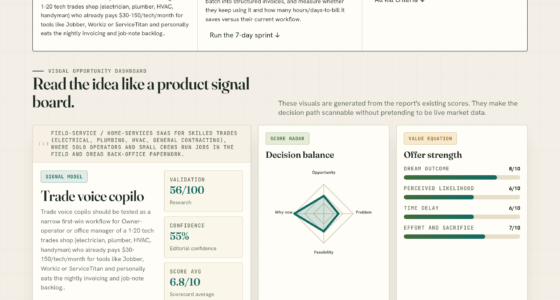

📊 Full opportunity report: IdeaClyst: The Validation Council on ThorstenMeyerAI.com — validation score, market gap, and execution plan.

Get business pricing on tech for your team
- Business-only prices and quantity discounts
- Tax-exempt purchasing
- Multiple users, one account, clear invoices
TL;DR
IdeaClyst has announced a new AI-driven validation council that uses two models—Claude and Codex—to critically evaluate ideas through a structured, five-step process. This aims to improve decision quality and reduce costly failures.
IdeaClyst has launched a new AI-driven validation council designed to rigorously evaluate ideas before they are added to product roadmaps. This process involves two AI models—Claude and Codex—cross-examining each idea through a structured five-step deliberation, emphasizing disagreement as a tool for more trustworthy decision-making. The initiative aims to reduce the risk of advancing weak or untested ideas, potentially saving companies time and resources.
The validation process begins with a comprehensive research pre-step, gathering relevant context, prior art, and existing signals about the idea. Following this, the council conducts five deliberation steps: framing the idea, steelmanning it, red-teaming it, evidence-checking, and synthesizing a verdict. Unlike simple yes/no judgments, the output is an auditable recommendation with detailed reasoning, highlighting strengths, weaknesses, and assumptions.
IdeaClyst’s architecture is provider-agnostic, requiring multiple models that can be run locally on owned hardware, making the process cost-effective and repeatable. The system is designed to identify weak ideas early, preventing costly investments in unviable projects. However, the creators acknowledge that models can still be confidently wrong and that the process does not replace market validation or real-world testing.
IdeaClyst — the validation council
Most ideas don’t die from being bad — they die from being plausible and untested. A research pre-step, then two models cross-examining the idea before it earns a roadmap slot.
Independent commentary, produced with AI assistance under human editorial oversight. The views are the author’s own and may change. IdeaClyst is developed privately and is not publicly available. The council’s research, deliberation and verdicts are produced by automated models and may contain errors or shared blind spots — a verdict is auditable reasoning, not validated demand; verify independently before committing. Product and company names are trademarks of their respective owners; mention does not imply endorsement.
Why Structured Model Disagreement Matters for Decision Quality
By formalizing a process where opposing AI models debate an idea based on evidence, IdeaClyst aims to improve the quality of early-stage decision-making. This structured disagreement reduces the risk of approval bias and helps companies avoid investing in ideas that seem plausible but are fundamentally flawed. The approach offers a low-cost, repeatable method to filter out weak concepts, potentially saving time and resources in product development and strategic planning.
As an affiliate, we earn on qualifying purchases.
Background on AI-Based Idea Validation and Decision Processes
Traditional idea validation often relies on subjective judgment or isolated AI assessments that tend to agree due to training biases. IdeaClyst builds on recent trends toward AI-assisted decision-making but emphasizes the importance of disagreement as a feature, not a bug. The concept of using multiple models to challenge each other has gained traction in AI safety and robustness contexts, but IdeaClyst applies it specifically to early-stage idea vetting. The platform is developed privately and is not publicly available.
“The council’s purpose is to force ideas to survive a fight, not just to get nodded through. Disagreement is the core of trustworthy decision-making.”
— Thorsten Meyer, founder of IdeaClyst
As an affiliate, we earn on qualifying purchases.
Limitations of Model-Based Validation and Remaining Challenges
While IdeaClyst emphasizes disagreement to improve decision quality, it remains uncertain how well the system performs in real-world scenarios. Models can share blind spots and confidently endorse flawed ideas. The process does not replace market validation or user testing, and the effectiveness of the approach in diverse domains is still being evaluated. Additionally, there’s a risk that the formal process could lend unwarranted legitimacy to weak ideas if not carefully interpreted.
As an affiliate, we earn on qualifying purchases.
Next Steps for Adoption and Evaluation of IdeaClyst
IdeaClyst is developed privately and is not publicly available. Future developments include integrating more models, refining the five-step process, and conducting empirical studies to measure its impact on decision quality. Companies interested in early validation are expected to pilot the system, and feedback will inform further improvements. The creators also intend to explore broader applications beyond idea vetting, such as strategic planning and risk assessment.
As an affiliate, we earn on qualifying purchases.
Key Questions
How does IdeaClyst improve idea validation?
It uses two AI models—Claude and Codex—to debate each idea through a structured five-step process, emphasizing disagreement and evidence-based reasoning to filter out weak ideas early.
Can this system replace human judgment?
No, IdeaClyst is designed to augment human decision-making by providing a rigorous, auditable process. It does not replace market validation or user testing.
Is IdeaClyst open source?
No, IdeaClyst is developed privately and is not publicly available.
What are the limitations of using AI models for idea validation?
Models can share blind spots, confidently endorse flawed ideas, and the process may lend unwarranted legitimacy to weak concepts if misinterpreted. It cannot replace real-world testing or market validation.
What is the future plan for IdeaClyst?
The team aims to expand model integration, refine the process, and conduct empirical evaluations. They also plan to promote adoption among organizations seeking low-cost, rigorous idea vetting.
Source: ThorstenMeyerAI.com
Halloween Picks
halloween
As an affiliate, we earn on qualifying purchases.