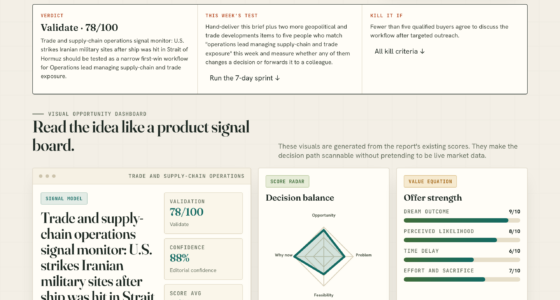

📊 Full opportunity report: Outcome-First Decisions: Keep, Change, or Kill on ThorstenMeyerAI.com — validation score, market gap, and execution plan.

Get business pricing on tech for your team
- Business-only prices and quantity discounts
- Tax-exempt purchasing
- Multiple users, one account, clear invoices
TL;DR
The Outcome-First framework offers a structured approach for organizations to evaluate ongoing initiatives by focusing on current outcomes rather than past investments. It emphasizes killing projects that no longer justify their costs to improve portfolio health.
The Outcome-First decision framework is designed to help organizations determine whether to keep, change, or kill ongoing initiatives based solely on their current outcomes and costs. This approach shifts focus from past investments to present performance, aiming to improve portfolio efficiency and reduce resource drain.
The framework revolves around a decision mechanism called the Worth Filter, which evaluates each initiative by its current outcome and whether it justifies ongoing costs. It produces three verdicts: keep, change, or kill. The primary goal is to prevent organizations from continuing projects that are neither succeeding nor being actively terminated, which often silently consume resources without delivering value.
Outcome-First is designed to be provider-agnostic, running on local infrastructure, and is open source under the AGPL-3.0 license. It emphasizes that decisions should be made based on forward-looking outcome assessments rather than past effort or sunk costs. The framework aims to formalize the difficult process of stopping projects, which is often avoided due to emotional or organizational biases.
Outcome-First Decisions — keep, change, or kill
The hardest decision isn’t what to start — it’s what to stop. Judge every initiative by the outcome it produces now, not the effort already spent.
Independent commentary, produced with AI assistance under human editorial oversight. The views are the author’s own and may change. Outcome-First Decisions is open source under AGPL-3.0, provided “as is” without warranty; see the repository LICENSE. The framework’s verdicts are reasoning aids based on the inputs given and may be wrong — decision support, not decisions; verify independently before acting. Product and company names are trademarks of their respective owners; mention does not imply endorsement.
Why Outcome-First Matters for Portfolio Management
This approach encourages organizations to adopt a disciplined method for pruning their project portfolios, freeing up capacity for more valuable initiatives. By systematically evaluating whether ongoing efforts still produce worthwhile outcomes, companies can avoid resource drain from projects that no longer serve strategic goals. The framework also promotes transparency and objectivity in decision-making, potentially leading to more agile and responsive organizations.
project portfolio management software
As an affiliate, we earn on qualifying purchases.
As an affiliate, we earn on qualifying purchases.
Background and Rationale for Outcome-First Decisions
Many organizations accumulate a long tail of ongoing projects that are neither actively successful nor intentionally terminated. These ‘zombie’ initiatives drain attention, capital, and focus, often justified by sunk costs or organizational identity. Traditional decision-making processes tend to favor continuation due to emotional attachment or reluctance to admit failure. The Outcome-First framework addresses this by providing a structured, outcome-based approach to portfolio pruning, emphasizing that the most cost-effective growth strategy is often to stop low-value initiatives.
“Outcome-First is about making the hardest decision in any portfolio: what to stop, based on current outcomes rather than past effort.”
— Thorsten Meyer, source developer
decision-making tools for business
As an affiliate, we earn on qualifying purchases.
As an affiliate, we earn on qualifying purchases.
Uncertainties Around Implementation and Metrics
It is not yet clear how organizations will measure outcomes accurately across diverse initiatives, or how they will prevent gaming the system. The effectiveness of the Worth Filter depends heavily on the quality of the outcome metrics fed into it. Additionally, there is concern that the framework could lead to premature killing of slow-start projects or valuable innovations that need more time to mature. The emotional and cultural resistance to stopping projects remains a significant challenge.
outcome-based project evaluation tools
As an affiliate, we earn on qualifying purchases.
As an affiliate, we earn on qualifying purchases.
Next Steps for Adoption and Validation
Organizations interested in Outcome-First are expected to pilot the framework in select portfolios to evaluate its impact on resource allocation and decision transparency. As open-source software, it can be adapted and integrated into existing portfolio management tools. Further validation will depend on case studies demonstrating its effectiveness in reducing resource waste and improving strategic agility. Ongoing development may include refining outcome metrics and addressing cultural barriers to stopping initiatives.
As an affiliate, we earn on qualifying purchases.
Key Questions
How does Outcome-First differ from traditional project evaluation?
Unlike traditional methods that often consider past investments and effort, Outcome-First focuses solely on the current outcome and whether continuing is justified based on future value.
Can this framework be applied to all types of initiatives?
While designed to be provider-agnostic, its effectiveness depends on the ability to measure relevant outcomes accurately across different initiatives.
What are the risks of using Outcome-First?
The main risks include mismeasuring outcomes, prematurely killing slow-start or high-potential projects, and cultural resistance to stopping initiatives.
Is Outcome-First suitable for small organizations?
Yes, especially as it is designed to run on local infrastructure and can be adapted to organizations of various sizes, helping them improve decision discipline.
Where can I learn more or try the framework?
The framework is open source and available on GitHub under the AGPL-3.0 license, allowing organizations to experiment and tailor it to their needs.
Source: ThorstenMeyerAI.com
Evergreen bestsellers Picks
bestsellers
As an affiliate, we earn on qualifying purchases.