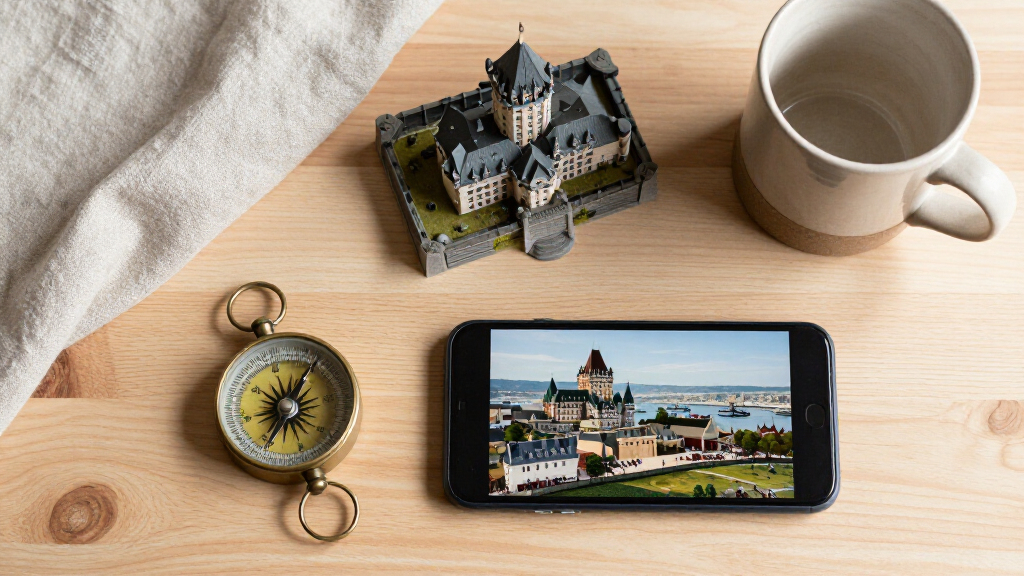

🔍 Read the full analysis: From Archival Records To Interactive Experience: AI And La Citadelle’s 1693 Siege on ThorstenMeyerAI.com

Get business pricing on tech for your team
- Business-only prices and quantity discounts
- Tax-exempt purchasing
- Multiple users, one account, clear invoices
TL;DR
An AI-powered interactive exhibition reimagines the 1693 siege of La Citadelle, transforming historical records into a cinematic, scroll-driven digital experience. The project balances historical accuracy with artistic storytelling, utilizing layered SVGs, CSS, and canvas elements without static images.
La Citadelle’s 1693 siege has been reimagined through an AI-generated interactive exhibition that offers a cinematic, scroll-driven visualization based entirely on archival records. This digital reconstruction, accessible via a web browser, employs layered SVGs, CSS, and canvas elements to create a dynamic, explorable depiction of the historic siege, without static images or external assets. For a detailed analysis of the project, see the original analysis. The project aims to blend historical fidelity with artistic storytelling, making the event more accessible and engaging for modern audiences.
The exhibition, titled Room 109 of 175: ‘La Citadelle — An Anatomy of Siege, 1693’, is part of a larger series of AI-crafted digital sites designed to explore historical events through innovative digital storytelling. Learn more about the digital reconstruction in this detailed archive. It features a scroll-driven diagram that visually transforms terrain and military movements into a cinematic experience, simulating the progression of the siege over days. The entire visualization relies on layered SVGs, CSS transforms, and JavaScript animations, avoiding static images to ensure scalability and high fidelity across devices.
This project follows a three-stage workflow involving initial construction, AI-driven critique, and final approval by an art director. The process emphasizes layered architecture, historical plausibility, and emotional resonance, guided by a detailed manual authored by an AI assistant. The site’s design employs a restrained color palette inspired by archival materials—parchment, fortress ink, smoke gray, and vivid red accents—creating an atmosphere of gravitas. Typography combines Cinzel for display, EB Garamond for labels, and Space Mono for ranges, establishing a layered textual hierarchy.
The signature interaction centers on a multi-layered SVG map of the siege, where each element—such as earthworks, fortifications, and trajectories—is animated through JavaScript functions that simulate earthmoving, artillery fire, and breaches. This project is documented in the original project archive. The cinematic ambiance is enhanced by CSS overlays, parallax effects, and animated textures modeled after historical engravings. The entire site is built without external frameworks, relying solely on HTML, CSS, and JavaScript, ensuring a self-contained, scalable experience.
Implications for Digital History and Education
This project demonstrates how AI can be harnessed to produce highly detailed, immersive digital reconstructions of historical events without static images or external assets. It offers a new way for audiences to engage with history, making complex military campaigns accessible through interactive visualization. For educators and historians, such tools could enhance understanding by providing cinematic, explorable timelines rooted in archival data, potentially transforming digital history and museum experiences.
Moreover, the approach balances artistic storytelling with historical accuracy, setting a precedent for future digital exhibits that prioritize both fidelity and emotional impact. As AI techniques evolve, similar projects could expand to other historical conflicts, archaeological sites, or cultural heritage preservation efforts, broadening the scope of digital storytelling in the humanities.
interactive historical map display
As an affiliate, we earn on qualifying purchases.
As an affiliate, we earn on qualifying purchases.
Historical and Technological Foundations of the Siege Reconstruction
The 1693 siege of La Citadelle is a well-documented military event, involving French and allied forces besieging the fortress of Montfaucon. Historically, it exemplifies Vauban’s military engineering principles, with detailed records of battlefield geometry, earthworks, and artillery placements. These records have served as the foundation for the AI’s digital reconstruction, which aims to faithfully visualize terrain, fortifications, and troop movements.
The project emerges at the intersection of digital humanities and AI-driven visualization, building on recent advances in web-based graphics, layered SVGs, and procedural animations. Unlike earlier static reconstructions or 3D models, this exhibit emphasizes cinematic storytelling, responsiveness, and scalability, achieved through a manual-guided workflow that iterates between artistic critique and technical refinement. It is part of a broader movement exploring AI’s potential to reanimate historical data into engaging digital experiences.
“The project demonstrates how layered SVGs and CSS can create a cinematic, scroll-driven depiction of a historic siege, entirely without static images.”
— an anonymous researcher
digital history visualization tools
As an affiliate, we earn on qualifying purchases.
As an affiliate, we earn on qualifying purchases.
Unclear Aspects of the Digital Reconstruction’s Accuracy
While the visualization is based on detailed archival records, it is not yet clear how precisely the AI’s interpretation aligns with the original battlefield conditions. The project emphasizes artistic storytelling, which may involve interpretative choices, and the fidelity of certain dynamic elements—such as troop movements and artillery trajectories—remains subject to further validation. It is also uncertain how the exhibit’s design will evolve with user feedback or additional historical input.
As an affiliate, we earn on qualifying purchases.
Future Developments and Potential Expansions
The team plans to gather user feedback to refine the interactive experience, potentially adding more detailed annotations, alternative scenarios, or expanded contextual information. Further technical improvements may include integrating real-time data or expanding the exhibit to cover other aspects of the siege, such as supply lines or civilian impact. Additionally, similar AI-driven projects are expected to explore other historical conflicts, leveraging the same layered SVG and cinematic storytelling approach to broaden digital history’s reach.
As an affiliate, we earn on qualifying purchases.
Key Questions
How accurate is the reconstruction of the 1693 siege?
The visualization is based on archival records and military geometry, but some interpretative elements are artistic. Its primary goal is to provide an engaging, cinematic experience rooted in historical data, not a precise simulation.
Can I explore the siege interactively myself?
Yes, the exhibition is accessible online and designed for browser viewing. Users can scroll through the cinematic depiction and interact with layered elements to explore the siege’s progression.
What technologies underpin this digital exhibit?
The project relies solely on HTML, CSS, and JavaScript, with layered SVGs and canvas elements, avoiding static images or external frameworks to ensure high fidelity and scalability across devices.
Will this approach be used for other historical events?
Yes, the methodology is adaptable, and similar projects are planned for other conflicts and cultural sites, aiming to expand AI-driven digital storytelling in the humanities.
Who created this digital reconstruction?
The project was developed through an AI-guided workflow, involving a team guided by detailed design manuals and critique, with no specific individual credited as the creator.
Source: ThorstenMeyerAI.com
Halloween Picks
halloween
As an affiliate, we earn on qualifying purchases.