

AI marketing automation tools can help marketers plan campaigns, create content, manage ads, and connect repetitive tasks—but this roundup covers books and practical guides, not standalone software platforms. I rank The AI Marketing Canvas, Second Edition as the best overall starting point for its structured, strategy-first approach; No-Code AI Automation for Small Business stands out for implementation, while AI for Performance Marketing centers on measurable campaign outcomes. The main tradeoff is breadth versus specialization: broad guides can help shape a plan, while niche titles focus on a particular workflow or audience. Experience level matters too, since a beginner-friendly overview may not give an experienced marketer enough operational detail. Read on for the full breakdown and help matching a guide to your goals.

Get business pricing on tech for your team
- Business-only prices and quantity discounts
- Tax-exempt purchasing
- Multiple users, one account, clear invoices
Key Takeaways
- The AI Marketing Canvas, Second Edition leads because its five-step planning framework offers a broader starting point than guides centered on a single channel or tool.
- No-Code AI Automation for Small Business is the clearest fit for owners who want to connect workflows without making coding the main barrier.
- AI for Performance Marketing distinguishes itself by connecting prompts and platform automation to measurable business outcomes, rather than treating content production as the finish line.
- Several titles focus on tool discovery or broad AI use; buyers should look for practical workflows if their main goal is putting automation into day-to-day operations.
- The strongest choice depends on audience: real estate, agency building, entrepreneurship, and social media each have dedicated guides that trade general coverage for a closer fit.
| The AI Marketing Canvas, Second Edition: A Five-Step AI Plan for Marketers |  | Best for Strategic Planning | Format: Book | Edition: Second Edition | Framework: Five-step AI plan | VIEW LATEST PRICE | See Our Full Breakdown |
| The AI Marketing Edge: A Practical Guide to Using AI in Marketing & Sales |  | Best for Marketing and Sales Teams | Format: Book | Primary focus: AI in marketing and sales | Approach: Practical guide | VIEW LATEST PRICE | See Our Full Breakdown |
| A Premium AI Business Toolkit: 30 Practical AI Workflows for Small Businesses |  | Best for Small-Business Workflows | Format: Book | Workflow count: 30 | Intended audience: Small businesses | VIEW LATEST PRICE | See Our Full Breakdown |
| AI-Powered Ads Agency: A Step-by-Step System for Launching, Scaling, and Automating an AI Ads Agency |  | Best for Aspiring AI Advertising Agencies | Format: Book | Series: AI-Powered Agency | Series position: Book 1 | VIEW LATEST PRICE | See Our Full Breakdown |
| AI Marketer: How to Use ChatGPT, Midjourney, and Other AI Tools to Automate Your Marketing |  | Best for AI-Assisted Content Production | Format: Book | Primary focus: Automating marketing | Named AI tools: ChatGPT and Midjourney | VIEW LATEST PRICE | See Our Full Breakdown |
| AI for Entrepreneurs: Automation, Marketing, and Productivity Tools to Start and Scale Smarter (The AI for Success Series, Book 2) |  | Best for Entrepreneurial Breadth | Format: Book | Series: The AI for Success Series | Series book number: 2 | VIEW LATEST PRICE | See Our Full Breakdown |
| The AI Marketer’s Toolkit: 30 Must-Know Tools |  | Best for Tool Discovery | Format: Not specified in available product data | Stated tool count: 30 | Subject: Artificial intelligence tools for marketers | VIEW LATEST PRICE | See Our Full Breakdown |
| No-Code AI Automation for Small Business |  | Best for Practical No-Code Workflows | Format: Guide | Intended audience: Small-business owners | Technical requirement: No coding or technical expertise required | VIEW LATEST PRICE | See Our Full Breakdown |
| Digital & Social Media Marketing and Business Automation: Complete Guide for Beginners to AI Content for YouTube, Instagram, Facebook, X & TikTok | 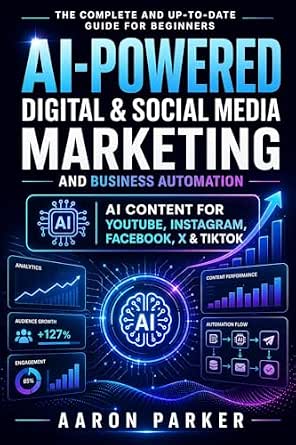 | Best for Multi-Platform Social Content | Format: Guide | Intended audience: Beginners | Topics: Digital marketing, social media marketing, business automation, and AI content | VIEW LATEST PRICE | See Our Full Breakdown |
| AI for Performance Marketing: From Prompts and Platform Automation to Measurable Business Outcomes |  | Best for Outcome-Focused Campaigns | Format: Not specified in available product data | Subject: AI for performance marketing | Stated topics: Prompts, platform automation, and measurable business outcomes | VIEW LATEST PRICE | See Our Full Breakdown |
| The 10x AI Realtor: ChatGPT Prompts, Automation Hacks, and AI Tools to Close More Real Estate Deals in Half the Time |  | Best for Real Estate Agents | Format: Book | Primary audience: Real estate professionals and Realtors | Featured AI assistant: ChatGPT | VIEW LATEST PRICE | See Our Full Breakdown |
| AI marketing automation tool | Format |
|---|---|
| The AI Marketing Canvas | Book |
| The AI Marketing Edge: A Pract | Book |
| A Premium AI Business Toolkit: | Book |
| AI-Powered Ads Agency: A Step- | Book |
| AI Marketer: How to Use ChatGP | Book |
| AI for Entrepreneurs: Automati | Book |
| The AI Marketer’s Toolkit: 30 | Not specified in available product data |
| No-Code AI Automation for Smal | Guide |
| Digital & Social Media Marketi | Guide |
| AI for Performance Marketing: | Not specified in available product data |
| The 10x AI Realtor: ChatGPT Pr | Book |
More Details on Our Top Picks
The AI Marketing Canvas, Second Edition: A Five-Step AI Plan for Marketers
The AI Marketing Canvas is the planning-led pick: its five-step framework and worksheets help marketers turn broad AI ambitions into a defined campaign plan. That makes it a different fit from A Premium AI Business Toolkit, which centers on ready-to-apply small-business workflows rather than an overarching marketing roadmap. The updated edition is intended to reflect current AI trends, while its accessible language keeps the planning process approachable for experienced marketers who need structure. The tradeoff is that a framework is not the same as hands-on training: readers without prior AI knowledge may need extra context, and the supplied information points to limited real-world case studies. Choose this book to organize decisions and implementation; choose a workflow collection when you want more task-level direction.
Pros:- Five-step roadmap gives AI adoption a clear sequence
- Templates and worksheets help translate planning into campaign work
- Updated edition addresses newer AI trends
- Accessible writing supports practical use by marketing teams
Cons:- May assume more prior AI knowledge than beginners have
- Limited case studies provide fewer examples of how plans work in practice
Best for: Marketing managers and consultants who already understand basic AI concepts and need a structured plan for integrating AI into campaigns
Not ideal for: AI newcomers seeking detailed tool tutorials or readers who learn best from extensive real-world case studies
- Format:Book
- Edition:Second Edition
- Framework:Five-step AI plan
- Primary focus:Integrating AI into marketing campaigns
- Included resources:Templates and worksheets
- Content emphasis:Strategic planning and practical tools
Our verdict“Choose this guide if you need a structured AI marketing plan more than a collection of ready-made workflows.”
The AI Marketing Edge: A Practical Guide to Using AI in Marketing & Sales
The AI Marketing Edge earns its place by covering both marketing and sales, making it a broader operational guide than The AI Marketing Canvas, which is centered on a five-step marketing plan. Its practical tactics, examples, and case studies can help professionals connect AI use to customer acquisition and sales activity instead of treating automation as a standalone marketing project. That cross-functional scope suits teams that need marketers and sales leaders to work from a shared playbook. The tradeoff is audience level: the material is aimed primarily at professionals, so readers new to AI may find some concepts advanced. It also appears less focused on a single implementation framework than The AI Marketing Canvas. Pick it for applied ideas across two teams; skip it if you need a beginner-first introduction.
Pros:- Covers practical applications across marketing and sales
- Step-by-step tactics support action beyond high-level strategy
- Examples and case studies add real-world context
- Clear structure makes it easier for professional teams to follow
Cons:- Some concepts may be advanced for beginners
- Broader marketing-and-sales coverage may offer less depth on a single marketing workflow
Best for: Marketing and sales leaders at businesses looking to apply AI across campaign execution and sales processes
Not ideal for: First-time AI learners seeking a gentle introduction or marketers who want a dedicated, step-by-step implementation framework
- Format:Book
- Primary focus:AI in marketing and sales
- Approach:Practical guide
- Included guidance:Step-by-step tactics
- Examples:Practical examples and real-world case studies
- Intended readers:Marketers, sales leaders, and business owners
Our verdict“Choose this guide if your marketing and sales teams need practical AI applications they can use together.”
A Premium AI Business Toolkit: 30 Practical AI Workflows for Small Businesses
A Premium AI Business Toolkit is the most task-oriented choice in this group: its 30 workflows cover customer acquisition, sales, customer service, and routine operations for small businesses. That gives it a more immediately operational angle than The AI Marketing Canvas, which helps readers plan AI adoption across marketing rather than focusing on a set of discrete workflows. The broader business coverage can be useful when one owner handles marketing alongside customer support and day-to-day tasks. However, the supplied details do not identify specific tools, workflow instructions, or examples, so buyers have less information about how deeply each process is explained. It also spans operations beyond marketing, which may dilute its usefulness for a dedicated marketing team. I’d pick it for breadth across a small business, not specialist campaign strategy.
Pros:- Provides 30 workflows aimed at practical business tasks
- Includes customer acquisition and sales use cases
- Extends beyond marketing into customer service and operations
- Targets the needs of small businesses
Cons:- Available details do not specify which AI tools or platforms the workflows use
- The broad business scope may provide less depth on marketing campaigns
- The supplied information does not describe case studies or the level of workflow instruction
Best for: Small-business owners and lean teams seeking AI workflow ideas for marketing, sales, customer service, and routine operations
Not ideal for: Marketing specialists who need deep campaign strategy, or buyers who require confirmed tool-by-tool instructions before choosing a guide
- Format:Book
- Workflow count:30
- Intended audience:Small businesses
- Marketing use cases:Customer acquisition
- Sales use cases:Increasing sales
- Additional use cases:Customer service and business operations
- Automation focus:Automating repetitive tasks
Our verdict“Choose this toolkit if you want a broad set of AI workflow ideas spanning marketing and everyday small-business operations.”
AI-Powered Ads Agency: A Step-by-Step System for Launching, Scaling, and Automating an AI Ads Agency
AI-Powered Ads Agency takes the most specialized route in this set: it is about building and automating an advertising agency, with coverage of ChatGPT, Meta Ads, Google Ads, and funnels. Compared with The AI Marketing Edge, which addresses marketing and sales applications for a wider professional audience, this guide is more directly aimed at agency launch and growth. That focus may suit independent operators who want their AI use tied to client acquisition and paid-ad delivery. The limitation is that the supplied product information gives little basis for judging how detailed or reliable its instructions are, so buyers cannot confirm the depth of the promised system from the available description. Its agency-specific scope also makes it a poor match for in-house marketers who do not need to launch a service business.
Pros:- Focuses on launching and scaling an advertising agency
- Names ChatGPT, Meta Ads, and Google Ads as covered platforms
- Includes funnels and automation alongside advertising topics
Cons:- Available details do not establish the depth or quality of the guidance
- Agency-building focus is less relevant to in-house marketing teams
- The supplied information does not describe case studies or specific workflow examples
Best for: Freelancers and aspiring agency owners who want a guide focused on launching, growing, and automating an AI-assisted advertising business
Not ideal for: In-house marketing teams or business owners seeking broad marketing automation guidance rather than an agency-building system
- Format:Book
- Series:AI-Powered Agency
- Series position:Book 1
- Primary focus:Launching, scaling, and automating an AI ads agency
- AI tool mentioned:ChatGPT
- Advertising platforms:Meta Ads and Google Ads
- Related topics:Funnels and automation
Our verdict“Choose this guide if your goal is an AI-enabled ads agency, not general-purpose marketing automation.”
AI Marketer: How to Use ChatGPT, Midjourney, and Other AI Tools to Automate Your Marketing
AI Marketer is the content-production pick: its stated focus on ChatGPT, Midjourney, and other AI tools points toward automating marketing tasks and content workflows. That makes it more tool-led than The AI Marketing Canvas, whose five-step framework is designed to shape an AI marketing plan. Readers looking to connect text and visual AI tools with content output may find the subject matter a closer fit than a general planning guide. The tradeoff is uncertainty: the supplied information offers no detail about the book’s examples, workflow instructions, or coverage beyond its title and short description. Its claim about replacing a content team and saving $100,000 a year should not be treated as a guaranteed outcome. Choose it for tool-focused content automation, but look elsewhere for a clearly documented framework or case studies.
Pros:- Names ChatGPT and Midjourney as tools covered
- Focuses on marketing automation rather than AI in general
- Addresses content production workflows
Cons:- Available details do not describe the depth or structure of its instruction
- No supplied examples or case studies show how the workflows perform
- The stated team-replacement and savings claim is not supported by details in the product information
Best for: Solo marketers and small content teams exploring ChatGPT and Midjourney to automate recurring content-production tasks
Not ideal for: Marketing leaders seeking verified case studies, a documented implementation framework, or a guaranteed business outcome
- Format:Book
- Primary focus:Automating marketing
- Named AI tools:ChatGPT and Midjourney
- Additional tools:Other AI tools
- Workflow area:Content production
- Claim described in title:Replacing a content team and saving $100,000 a year
Our verdict“Choose this book if you want tool-focused ideas for automating content work, while treating its savings claim as an unverified promise.”
AI for Entrepreneurs: Automation, Marketing, and Productivity Tools to Start and Scale Smarter (The AI for Success Series, Book 2)
AI for Entrepreneurs takes a business-wide view of AI, connecting automation, marketing, and productivity rather than focusing only on campaign execution. That makes it a useful starting point for founders deciding where AI could reduce routine work as a business grows. Compared with No-Code AI Automation for Small Business, its stated scope is broader; the tradeoff is that the product details do not establish how deeply it explains specific no-code workflows. It also covers more than the performance-focused approach suggested by AI for Performance Marketing, but may be less targeted for readers seeking campaign measurement guidance. The available information identifies its audience and themes, but not particular tools, exercises, or workflow examples, so buyers wanting a detailed implementation playbook may prefer a more narrowly defined guide.
Pros:- Addresses AI uses across entrepreneurship, not marketing alone
- Covers automation, marketing, and productivity in one guide
- Frames the material around starting and scaling a business
- Part of The AI for Success Series, with a stated place in the series
Cons:- Available details do not identify specific tools or step-by-step workflows
- Broad subject coverage may offer less depth on individual marketing channels
- The description does not specify examples, exercises, or update information
Best for: Founders and solo entrepreneurs who want one introductory resource spanning AI-assisted marketing, business automation, and personal productivity.
Not ideal for: Marketing specialists seeking documented campaign workflows, platform-specific instructions, or detailed performance measurement methods.
- Format:Book
- Series:The AI for Success Series
- Series book number:2
- Primary audience:Entrepreneurs
- Topics:AI automation, marketing, and productivity
- Stated purpose:Support starting and scaling a business with AI tools
Our verdict“Choose this guide if you want a broad introduction to AI across the work of starting and scaling a business, rather than a focused marketing playbook.”
The AI Marketer’s Toolkit: 30 Must-Know Tools
The AI Marketer’s Toolkit is the most explicitly tool-led pick in this group: its title promises an introduction to 30 AI tools for marketers. That makes it a potential fit for readers who want to survey the software landscape before choosing a workflow. Unlike AI for Entrepreneurs, which is framed around the wider needs of running a business, this guide keeps its stated focus on marketing tools. But the available product information says nothing about which tools are covered, how they are grouped, or whether the book explains setup and integration. That gap matters for automation buyers: a tool list can help with discovery, but it may not show how to connect tools into a repeatable process. Compared with No-Code AI Automation for Small Business, its description offers less evidence of step-by-step implementation support.
Pros:- Clearly focuses on AI tools for marketers
- States a defined scope of 30 tools
- May suit early-stage software discovery
- More narrowly marketing-focused than broad entrepreneurship guides
Cons:- Available product details do not name the tools included
- No information confirms whether it explains integrations or automation workflows
- The description does not specify format, examples, or how current the tool coverage is
Best for: Marketing generalists or small-team leads who are beginning to research AI software and want a guide explicitly centered on a collection of tools.
Not ideal for: Readers who need verified platform recommendations, detailed workflow instructions, or proof that the tools and guidance are current.
- Format:Not specified in available product data
- Stated tool count:30
- Subject:Artificial intelligence tools for marketers
- Intended audience:Marketers
- Named tools:Not specified in available product data
- Workflow coverage:Not specified in available product data
Our verdict“Consider it for a first survey of AI marketing tools, but choose a workflow-focused guide if implementation detail is your priority.”
No-Code AI Automation for Small Business
No-Code AI Automation for Small Business is the clearest fit for owners who want to automate recurring work without learning to code. Its stated emphasis on step-by-step instructions and quicker customer support gives the automation pitch a practical business outcome, not just a list of AI possibilities. Compared with The AI Marketer’s Toolkit, this guide is described as a how-to resource rather than a survey of tools; compared with Digital & Social Media Marketing and Business Automation, it appears narrower and more focused on everyday business processes than publishing across several social platforms. That focus comes with limits: some workflows may depend on paid AI subscriptions, and the product description warns that customization is limited for specialized needs. The stated time-saving claim is a product claim, not a guarantee for every business.
Pros:- Designed for readers without programming skills
- Promises step-by-step guidance for implementing workflows
- Targets recurring work that can free up staff time
- Connects automation to faster customer-support responses
Cons:- Some recommended AI services may require paid subscriptions
- The described workflows may not suit highly specialized operations
- The claimed weekly time savings are not guaranteed for every business
Best for: Small-business owners and operators with repetitive admin or customer-support tasks who want guided AI automation without coding.
Not ideal for: Technical teams with specialized processes that need extensive customization, or owners unwilling to pay for third-party AI services.
- Format:Guide
- Intended audience:Small-business owners
- Technical requirement:No coding or technical expertise required
- Primary subject:AI-powered daily task automation
- Instruction style:Step-by-step instructions
- Example application:Customer-support response workflows
- Subscription caveat:Some AI services may require paid subscriptions
- Customization caveat:Limited for highly specialized workflows
Our verdict“Pick this guide if you want accessible, no-code automation for common small-business tasks and can accept some limits on customization.”
Digital & Social Media Marketing and Business Automation: Complete Guide for Beginners to AI Content for YouTube, Instagram, Facebook, X & TikTok
Digital & Social Media Marketing and Business Automation stands out for its channel breadth, naming YouTube, Instagram, Facebook, X, and TikTok as destinations for AI-assisted content. That makes it more relevant to beginners building a social publishing routine than AI for Performance Marketing, whose stated focus is prompts, platform automation, and measurable business outcomes. The guide also advertises practical tips and step-by-step content instructions, giving new users a path from AI ideas toward regular publishing. The tradeoff is scope: covering several platforms alongside digital marketing and automation may leave less room for depth on any one channel. Its product description also flags that fast-moving AI tools can date parts of the guidance, so readers should be prepared to check current platform features rather than follow every instruction indefinitely.
Pros:- Names five major social platforms in its stated coverage
- Includes step-by-step guidance for AI-driven content creation
- Uses beginner-friendly language and real-world examples
- Combines social content, digital marketing, and business automation topics
Cons:- The wide subject and channel coverage may feel overwhelming
- Rapid changes to AI tools could date some instructions
- Broad coverage may provide less depth on individual platforms
Best for: Beginner creators, solo marketers, and small businesses planning AI-assisted content across several major social platforms.
Not ideal for: Experienced marketers seeking advanced channel-specific strategy, a tightly focused automation manual, or guidance guaranteed to match the latest tool interfaces.
- Format:Guide
- Intended audience:Beginners
- Topics:Digital marketing, social media marketing, business automation, and AI content
- Named platforms:YouTube, Instagram, Facebook, X, and TikTok
- Instruction style:Step-by-step instructions
- Examples:Real-world examples
- Stated caveat:AI tools change quickly, which may make some sections outdated
Our verdict“Choose this guide if you are a beginner creating content across multiple social platforms and value breadth over channel-specific depth.”
AI for Performance Marketing: From Prompts and Platform Automation to Measurable Business Outcomes
AI for Performance Marketing is the most explicitly measurement-oriented title in this batch: it links prompting and platform automation to business outcomes. That framing suits marketers who need to connect AI-assisted execution with campaign results, rather than simply explore tools or generate social content. Compared with Digital & Social Media Marketing and Business Automation, it appears more focused on performance work than multi-platform publishing. It also offers a different emphasis from The AI Marketer’s Toolkit: the latter names a set of tools, while this title points toward applying AI in a marketing process. The available description provides no further detail about platforms, measurement methods, or examples, however, so buyers should not assume it includes a specific analytics framework or hands-on implementation plan.
Pros:- Connects AI prompts with platform automation
- Frames marketing work around measurable business outcomes
- Has a more performance-focused angle than broad social-content guides
- Addresses both AI-assisted execution and results
Cons:- Available product information does not name supported platforms
- Measurement methods and metrics are not specified
- The description provides no details about examples or implementation depth
Best for: Performance marketers and campaign managers who want a resource framed around using AI automation to pursue measurable business results.
Not ideal for: Beginners seeking confirmed step-by-step instructions, platform-specific coverage, or a detailed list of tools and measurement methods.
- Format:Not specified in available product data
- Subject:AI for performance marketing
- Stated topics:Prompts, platform automation, and measurable business outcomes
- Intended focus:Performance marketing
- Named platforms:Not specified in available product data
- Measurement methods:Not specified in available product data
Our verdict“Choose this title if outcome-focused performance marketing is your priority, but verify its depth if you need concrete platform or measurement instructions.”
The 10x AI Realtor: ChatGPT Prompts, Automation Hacks, and AI Tools to Close More Real Estate Deals in Half the Time
Unlike broad marketing guides such as The AI Marketing Canvas, Second Edition, this book narrows its advice to real estate work: it offers ready-to-use ChatGPT prompts, automation strategies, and a curated set of AI tools for Realtors. That focus can help agents apply AI to routine tasks and reclaim time for client and deal work, rather than sorting through advice aimed at every industry. Its step-by-step approach is positioned for professionals seeking practical workflows without heavy technical setup. The tradeoff is its narrower scope: marketers outside real estate may find less relevant guidance, while agents still need some familiarity with AI concepts to put the ideas into practice. Suggested workflows also depend on third-party services, which may bring added costs or usage limits.
Pros:- Provides ready-to-use ChatGPT prompts tailored to real estate tasks.
- Explains step-by-step automation strategies intended to reduce repetitive work.
- Curates AI tools for Realtor workflows instead of offering only general marketing advice.
Cons:- Some familiarity with AI concepts may be needed to apply the guidance effectively.
- Using recommended third-party AI services may add costs or expose users to service limits.
- Its real estate focus makes it less useful for marketers in other industries.
Best for: Residential real estate agents who want industry-specific ChatGPT prompts and practical automation ideas without building complex technical systems.
Not ideal for: Marketing teams outside real estate, or agents seeking a fully integrated automation platform rather than guidance and recommended tools.
- Format:Book
- Primary audience:Real estate professionals and Realtors
- Featured AI assistant:ChatGPT
- Prompt content:Ready-to-use prompts for real estate tasks
- Automation content:Step-by-step automation strategies and hacks
- Tool guidance:Curated AI tools for Realtor needs
- Technical effort:Aimed at practical use with minimal technical effort
Our verdict“Choose this guide if you are a Realtor seeking practical, real-estate-specific AI workflows; choose a broader guide such as <em>The AI Marketing Canvas, Second Edition</em> for cross-industry planning.”

How We Picked
I compared the 11 titles as educational resources for choosing and applying AI marketing automation, not as software platforms. The main criteria were how clearly each title frames a marketing problem, the apparent practical focus of its workflows or step-by-step guidance, how well its scope matches a distinct buyer, and whether its subject can support decisions beyond experimenting with prompts. I also weighed accessibility for small businesses and beginners against the depth a marketer may need to improve campaign operations.
The ranking favors titles with a useful combination of strategic direction, practical application, and broad relevance. That puts The AI Marketing Canvas first as a general planning guide, while specialized picks rank higher for readers with a specific need. Tool lists and channel-specific guides can be helpful, but they rank below resources that connect AI use to workflows, business goals, or outcomes. The supplied titles establish subject and intended focus; I do not treat them as proof of unverified features or results.
| AI marketing automation tool | Format |
|---|---|
| The AI Marketing Canvas | Book |
| The AI Marketing Edge: A Pract | Book |
| A Premium AI Business Toolkit: | Book |
| AI-Powered Ads Agency: A Step- | Book |
| AI Marketer: How to Use ChatGP | Book |
| AI for Entrepreneurs: Automati | Book |
| The AI Marketer’s Toolkit: 30 | Not specified in available product data |
| No-Code AI Automation for Smal | Guide |
| Digital & Social Media Marketi | Guide |
| AI for Performance Marketing: | Not specified in available product data |
| The 10x AI Realtor: ChatGPT Pr | Book |
Factors to Consider When Choosing AI Marketing Automation Tools
Choose a guide by the decision you need to make next—not by how many tools or channels its title mentions. These resources differ in scope, audience, and how closely they appear to connect AI activity with an operating process.
Start With the Marketing Problem, Not the AI Tool
Before choosing a guide, name the task that slows your work down: campaign planning, content creation, lead follow-up, paid ad management, or handoffs between apps. A common mistake is buying a broad tool guide when the real problem is an unclear process that automation would only repeat faster. Strategy-led material is a better first step if you have not defined the audience, offer, or success measure. If those foundations are already set, a workflow-focused resource may be more useful than another overview. Match the scope of the guide to the bottleneck you can describe in one sentence.
Check Whether You Need Ideas, Workflows, or a Measurement System
These are different learning jobs, and one guide may not handle all three equally well. Tool roundups can help you discover options, but a list alone rarely explains how to connect a tool to a repeatable marketing process. Workflow-oriented resources are more useful when you need to map steps, triggers, and human approvals. Performance-focused guidance suits teams that already run campaigns and need to judge whether automation improves business results. Avoid treating prompt examples or faster content output as evidence that a marketing system is working.
Match the Guide to Your Team’s Technical Capacity
No-code automation can lower the setup barrier, but it does not remove the need to understand how data moves between services. A solo owner may value plain-language steps and a small number of connected tasks more than an elaborate system. A larger team may need to plan ownership, access permissions, data handling, and what happens when an automated step fails. Do not assume that “no-code” means maintenance-free or that a more technical approach is automatically more powerful for your needs. Choose a guide whose implied level of implementation matches the time and skills you can actually provide.
Decide How Much Specialization You Need
A general marketing guide can help you form a reusable approach across several channels, while a niche title may speak more directly to your working context. Specialized material makes sense when your business depends on one channel, business model, or audience—for example, real estate leads or agency operations. The tradeoff is transferability: examples built around one field may require adaptation elsewhere. Buyers sometimes choose the broadest title for flexibility, then find it does not address their immediate workflow. Pick a narrow guide for a near-term, well-defined problem and a broader one when you need direction across multiple activities.
Treat Measurement and Human Review as Part of Automation
Automation can increase output without improving qualified leads, conversions, or customer experience. Before adopting a workflow, decide what outcome it should affect and what baseline you will compare it against. Keep human review for claims, brand voice, sensitive customer data, and decisions that carry reputational or financial risk. A common mistake is automating every step simply because a tool allows it, even when an approval check prevents costly errors. Favor guidance that connects process changes to meaningful outcomes instead of measuring success only by time saved or content produced.
Choose for Ongoing Use, Not a One-Time Experiment
AI tools and platform features change, so a guide’s lasting value comes partly from its principles and workflows rather than its list of current tools. Look for material that can help you evaluate replacements when a product changes, a connection breaks, or your team’s needs shift. If you are new to automation, start with a small process you can review and maintain instead of rebuilding your entire marketing operation at once. More advanced buyers may benefit from investing effort in documentation, testing, and clear ownership. The right resource should help you make a process repeatable, not leave you with a collection of disconnected experiments.
Frequently Asked Questions
Are these AI marketing automation tools software products or books and guides?
The 11 entries in this roundup are books and educational guides, not standalone marketing automation platforms. They cover topics such as planning, no-code workflows, performance marketing, social media, and industry-specific use. That means the ranking helps you choose a learning resource rather than compare software subscriptions or integrations. If you need a platform to send campaigns or connect apps, use these titles to inform your approach, then evaluate software separately against your workflow and data needs.
Which guide should I choose if I have not used AI for marketing before?
Start with a resource whose scope matches your current decision rather than assuming the longest tool list will be easiest to follow. The AI Marketing Canvas, Second Edition is the strongest general starting point in this roundup because it is framed around a five-step marketing plan. If your immediate goal is to automate small-business tasks without coding, No-Code AI Automation for Small Business is a closer fit. Keep your first project small and define a human review step before using automated output with customers.
Should I choose a broad marketing guide or a niche guide for my industry?
Choose broad coverage when you need a framework that can apply across channels or when your marketing process is still taking shape. A niche guide is a better match when you already know the workflow and audience you need to improve, such as real estate sales or agency operations. The tradeoff is that specialized examples may transfer less readily to other business types. If you have room for only one resource, prioritize the problem you need to solve in the next few months over a hypothetical future need.
How can I tell whether marketing automation is producing useful results?
Set a baseline before changing a workflow, then track an outcome that matters to the business, such as qualified leads, completed follow-ups, conversion rate, or campaign cost efficiency. Time saved can be useful, but it should not stand in for better marketing results when the goal is growth. Compare similar periods or campaign types where possible, and record changes to the audience, offer, or channel that could affect the result. Keep human checks in place until the process produces reliable work and its errors are easy to catch.
When is a specialized performance or channel guide a better choice than a general AI marketing guide?
A specialized guide makes sense when your work already centers on a defined channel or outcome and you need help improving that particular process. AI for Performance Marketing is the most direct match here for readers focused on connecting automation to measurable campaign outcomes. A social media or ads-focused guide may better fit someone whose daily work is concentrated in those areas. Choose a general resource instead if you still need to decide where AI belongs across your marketing operation.
Conclusion
Best overall: The AI Marketing Canvas, Second Edition is my pick for readers seeking a structured, broad marketing plan. Best value in practical focus: No-Code AI Automation for Small Business suits owners who want to explore connected workflows without centering coding. Best premium-level depth: AI for Performance Marketing is the strongest fit for marketers who need to link automation with business outcomes, though its focused angle is less suitable as an all-purpose introduction. Best for beginners: The AI Marketing Canvas offers a clearer strategic starting point than a list of tools alone. For specific needs, choose AI-Powered Ads Agency for agency-building, Digital & Social Media Marketing and Business Automation for social content, or The 10x AI Realtor for real estate. My final recommendation: choose the guide that addresses your next real workflow decision, then judge any automation by the quality of the results—not the volume of AI output.