
🔍 Read the full analysis: What Happened To Working Animals As Farms Mechanized? on ThorstenMeyerAI.com

Get business pricing on tech for your team
- Business-only prices and quantity discounts
- Tax-exempt purchasing
- Multiple users, one account, clear invoices
TL;DR
U.S. farm horses and mules peaked at 26.7 million in 1918, then declined as tractors, combines and other machines spread. By 1960, their number had fallen to 3.1 million, while farm employment also shrank and workers moved toward jobs in cities. The historical comparison with artificial intelligence is an analogy, not a prediction that human workers will follow the same path.
American farms once relied on 26.7 million horses and mules, but their numbers fell to 3.1 million by 1960 as tractors and other machinery took over farm work, according to historical statistics summarized by ThorstenMeyerAI.com on November 4, 2026. The change freed cropland from growing animal feed and transformed farm employment, but its consequences for workers were not as simple as replacing one kind of labor with another.
The combined population of horses and mules on U.S. farms reached 26.7 million on January 1, 1918, based on Department of Agriculture estimates reproduced in the Census Bureau’s 1975 Historical Statistics of the United States. Horses alone peaked earlier, at 21.4 million in 1915. In that same year, about 93 million acres of harvested cropland—more than a quarter of the 340 million acres harvested—grew feed for the animals. The feed acreage remained about 90 million in 1920.
Tractor numbers rose quickly over the following decades. The source’s historical series counts about 1,000 tractors in 1910, 246,000 in 1920 and 4.69 million in 1960. Farm horses and mules numbered 25.7 million in 1920 and 3.1 million in 1960. The two counts crossed around 1955: the source gives 4.35 million tractors and 4.31 million horses and mules. It notes that the census figures were taken on somewhat different dates, and that the Department of Agriculture combined horses and mules in its counts from 1951.
Mechanization went beyond tractors. The source reports that U.S. combine harvesters grew from about 4,000 in 1920 to more than 1 million in 1960, alongside adoption of corn pickers, balers and milking machines. Over the same broad period, farm employment fell from a peak of 13.6 million in 1916 to 4.5 million in 1970, while the overall U.S. labor force doubled. The article says new jobs increasingly arose in cities, meaning many people had to move to find work.
Farm Mechanization Reshaped Work
The figures describe more than a change in farm equipment: they show how a new technology can reorganize land use and employment together. As tractors replaced animal power, farmers no longer needed to devote as much acreage to feed. The source puts that land at about 5 million acres in 1960, down from 93 million acres in 1915. It also cites a Department of Agriculture estimate that each farm worker supplied 47.1 people with farm products in 1970, compared with 7.1 in 1910. The 1970 figure includes people abroad supplied through exports.
For workers, higher productivity did not mean that farm jobs simply became machine-operating jobs at the same scale. Farm employment contracted, and economic opportunity shifted toward cities. The historical account therefore points to both increased agricultural output per worker and the disruption involved in relocating and finding other work. It does not establish that every displaced worker found a comparable job or benefited equally.
The episode also addresses a modern comparison: whether machines that automate tasks today might displace human workers as tractors displaced working animals. Economist Wassily Leontief made a version of that comparison in 1983, according to the source. But the historical case cannot by itself predict the scale or outcome of current automation. People can learn new skills, participate in politics and shape policy; horses could do none of those things. The analogy raises a question about labor disruption, but it is not a rule that human workers will experience the same fate.
Products Worth Considering

Apple MacBook Air 13-inch with M5 chip, 16GB memory, 512GB SSD, and 12MP Center Stage camera

LG UltraGear 32GX850A-B 32-inch 4K UHD Glossy OLED Gaming Monitor

LG UltraGear 34GX90SA-W 34-inch WQHD Curved OLED Gaming Monitor
As an affiliate, we earn on qualifying purchases.
From Animal Power to Tractors
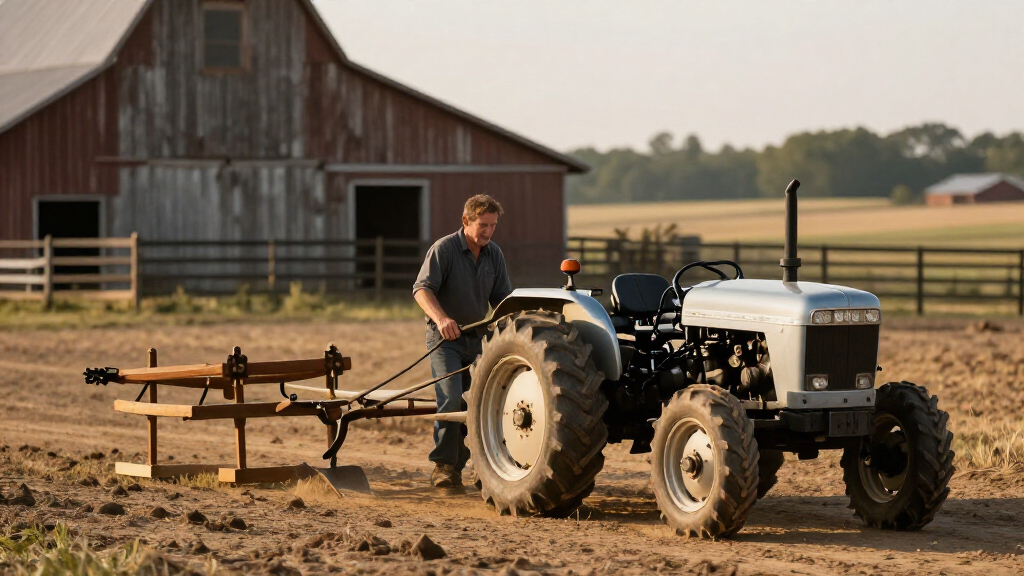
Before tractors became widespread, horses and mules supplied the pulling power for ploughs, seed drills, reapers and wagons. Their scale created a substantial ongoing demand for feed: animals needed to eat even when they were not working. A tractor, by contrast, used fuel when operating, and acreage once devoted to feed could be put to other uses. That difference helped make mechanical power attractive, although the source does not provide a single calculation comparing the full costs of animals and tractors.
The source identifies the Fordson, launched in 1917, as an important step toward wider adoption. The Henry Ford museum describes it as “the first mass-produced and inexpensive lightweight tractor” designed to meet small farmers’ needs, and says it rapidly became the most popular tractor in America. The source also reports that the 100,000th Fordson left the assembly line on February 21, 1920. Tractor adoption continued alongside combines and other farm machines, rather than through a single sudden change.
By 1960, the estimated number of farm horses and mules had fallen by almost 90% from the 1918 peak. The source says farmers generally did not retrain the animals or replace them as they aged; instead, they stopped breeding replacements. That is a gradual population decline, not evidence of one mass removal or a single day when animal-powered farming ended.
Limits of the Historical Comparison
The historical counts document the decline in farm horses and mules, but they do not provide a detailed account of individual animals’ circumstances or every worker’s path after leaving agriculture. The source says farmers stopped breeding replacements and the working population aged out; it does not quantify how that process varied by region or farm.
The data also have limitations. Tractor counts for several benchmark years come from census figures taken on slightly different dates, and the animal series changed its counting method in 1951 by combining horses and mules. Those figures are useful for describing the broad shift, but the source does not present them as perfectly comparable annual measurements.
The article mentions current automation, including John Deere’s February 2025 16-camera autonomy kit for tillage on select large tractors, and says China reported that about 74% of ploughing, sowing and harvesting was mechanized in 2023. These are limited, attributed descriptions, not evidence that driverless equipment can handle every farming task or that its effects on employment will match the earlier transition. The source provides no detailed measure of jobs gained or lost from these recent systems.
Farm Automation Remains Task-Specific
The historical account does not announce a new policy or set out a specific future milestone. It points instead to the next questions for readers tracking agricultural automation: which tasks newer machines can perform, which farms can use them, and how changes affect the workers who do those jobs. The source describes John Deere’s February 2025 system as handling tillage on select large tractors, rather than as a machine capable of fully autonomous farming.
Further comparison will depend on updated evidence about adoption, farm employment, equipment costs and the range of tasks automated. The source cites China’s 2023 mechanization figure but does not give a comparable employment series or explain its measurement method. For now, the record supports a clear account of the U.S. shift from animal power to machinery, while the implications of present-day automation for people remain unsettled.
Key Questions
How many horses and mules worked on U.S. farms at the peak?
The combined total reached 26.7 million on January 1, 1918, according to Department of Agriculture estimates reproduced in the Census Bureau’s historical statistics. Horses alone peaked at 21.4 million in 1915.
When did tractors outnumber farm horses and mules?
The source places the crossover around 1955, when it reports 4.35 million tractors and 4.31 million horses and mules. It cautions that the census counts were taken on slightly different dates.
What happened to the working animals?
The source says farmers generally stopped breeding replacements, and the working population declined as animals aged. It does not describe a single mass event or quantify what happened to each animal.
Did farm mechanization eliminate agricultural work?
Farm employment declined substantially, from a peak of 13.6 million in 1916 to 4.5 million in 1970, according to the source. Agriculture continued to produce food, but with far fewer workers; the article says new jobs arose increasingly in cities.
Does the horse comparison predict what AI will do to workers?
No. It is an analogy about technological displacement, not a proven forecast. The source notes that people can vote and learn new skills, unlike horses, and provides no evidence that current automation will produce the same employment pattern.
Source: ThorstenMeyerAI.com