
TL;DR

Get business pricing on tech for your team
- Business-only prices and quantity discounts
- Tax-exempt purchasing
- Multiple users, one account, clear invoices
Neufangled Robotics is presenting Stringman, an open-source cable-driven robot listed at $795 that moves a gripper through a room from four ceiling-mounted anchors. The company reports an average payload of 1.9 kilograms in a specified 7-by-7-by-3-meter room; independent performance testing and the robot’s wider availability are not established in the supplied material.
Neufangled Robotics has published plans and specifications for Stringman, an open-source, cable-driven gripper robot listed at $795 that can move through a room using four ceiling-mounted anchors. The company says the system can carry an average payload of 1.9 kilograms in a specified 7-by-7-by-3-meter room, offering a different approach to moving objects than a fixed-base robotic arm.
Stringman suspends a gripper from lines connected to four anchors mounted near the ceiling corners. The motors adjust line tension to position the gripper across the defined work area. Neufangled says the setup can cover rooms with an XY diagonal between 3 and 10 meters and heights between 2.3 and 4 meters. Its published speed is about 0.4 meters per second.
The company lists a payload of up to 2.2 kilograms near the floor and an average of 1.9 kilograms across its stated test volume. Those figures are tied to a 28-newton line-tension limit; the company’s comparison for a 7-by-7-by-3-meter room is calculated after subtracting the 638-gram gripper and marker. Neufangled compares that average with 0.32 kilograms for a hypothetical 0.75-meter, seven-actuator arm using the same motors at rated torque, while noting that its arm estimate ignores the weight of its links.
The published design uses 3D-printed parts, Raspberry Pi computers at the anchors and gripper, and an external computer to run the controller. The company says the mechanical CAD, circuit-board designs and software are available, and that Stringman is OSHWA certified. It lists local-network operation as an option, with the interface served locally and AI models running on the owner’s hardware.
A Different Way to Cover a Room
Stringman’s main proposition is work area per dollar: instead of building a long arm or moving a robot across the floor, it uses overhead lines to position a gripper throughout a room. That could be useful in a home lab or workshop where equipment and workstations are spread out, or where floor clutter makes wheeled robots impractical. Neufangled describes moving parts between work cells as a target use.
The low listed price and open build files may make room-scale robotics more accessible to researchers and hobbyists. But a large reachable volume does not by itself establish that the system is suitable for every room or task. Installation, overhead lines, payload limits, control requirements and the need for secure mounting all affect practical use. The company’s figures describe its design and test conditions, not an independent comparison across commercially available robots.
Products Worth Considering

Amazon Kindle Paperwhite (2024), 16 GB, 7-inch Display, Black

DJI Osmo Mobile 8 3-Axis Gimbal Stabilizer for Phones

Jackery Explorer 300 Portable Power Station, 292Wh
As an affiliate, we earn on qualifying purchases.
How the Cable System Works
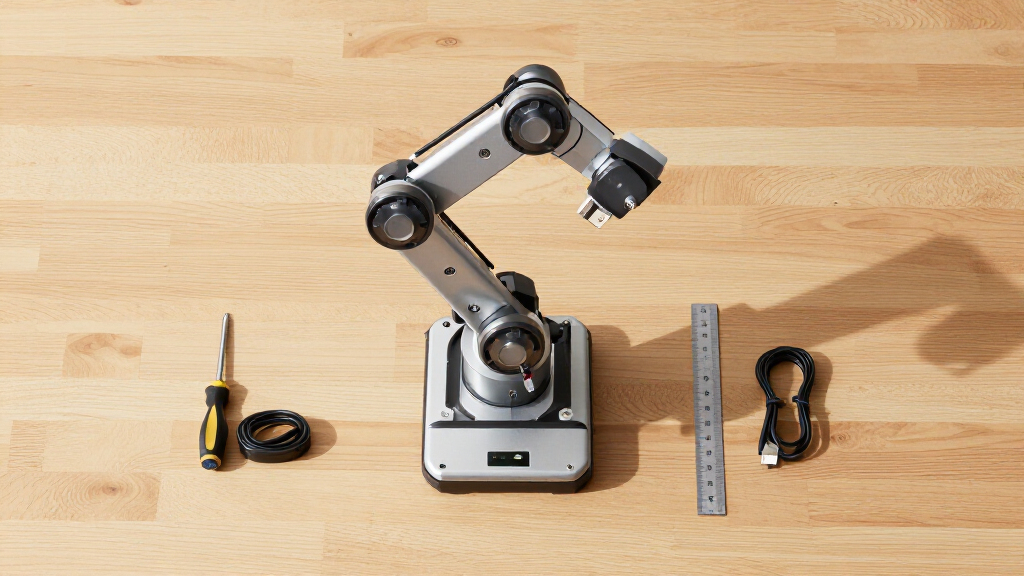
Conventional robotic arms reach within a fixed radius of a base. Stringman instead places anchors around the perimeter of a work area, with the gripper hanging from tensioned lines. The company says the combined lifting force of its four motors lets the system share a load across the lines. Its stated capacity varies with position, reaching its reported maximum near the floor and averaging less across the full volume.
According to the installation guide, anchors can be attached to wall studs or structural columns. Users connect the lines and run a calibration process that the company says takes about five minutes. Lines remain in the room while the system is installed, though Neufangled says they sit near the ceiling when the robot is parked. The design can be configured around some ceiling fans, but low-hanging objects in the center of a room can make installation unsuitable.
The product page also describes a Python API and an MCP server for connecting Stringman to software agents, as well as tools for collecting training data and running machine-learning models. These are capabilities described by the maker; the supplied material does not include third-party evaluations of the software or real-world task performance.
“Tension is all you need”
— Neufangled Robotics
Independent Testing and Installation Limits
The supplied information is from the product’s own report and does not include independent tests, customer reviews, or a verified shipping and availability schedule. It is unclear how the published payload and speed vary across different room sizes, mounting arrangements, objects, or repeated tasks. Neufangled says about 1,000 hours of testing have accumulated in real homes, but the material does not provide a test protocol, results breakdown or third-party verification.
Practical safety and reliability also depend on installation. The company says motors relax when line tension reaches the 28-newton limit, allowing the lines to be pulled loose. That is a manufacturer description; the supplied source does not include independent safety certification beyond the stated OSHWA certification, which concerns open-source hardware. Buyers would also need to assess whether their walls or columns can support the anchors and whether overhead lines are acceptable in the intended space.
The page describes local control as an option, while also discussing remote access through a company service for users who bind a robot to an account. The exact data and connectivity arrangements for each configuration, including the remote service’s operating terms, are not fully detailed in the supplied material.
Build Files and Availability
Neufangled’s published resources include CAD files, a bill of materials, build instructions and code, giving interested users a route to inspect or assemble the system. The company also points to setup guides and software for robot control and training. The source material does not state when commercial units will ship, whether the listed price includes every component needed for installation, or how support and warranty coverage work.
Readers considering the design should check the current bill of materials, mounting requirements and software documentation before treating the listed price as the complete cost of a working installation. Further reporting would need independent testing across room layouts and tasks, alongside details on availability and long-term reliability.
Key Questions
What is Stringman?
Stringman is a cable-driven gripper robot that uses four ceiling-mounted anchors to move objects through a room. Neufangled Robotics publishes its mechanical design and software as open-source resources.
How much can Stringman carry?
Neufangled lists a maximum payload of 2.2 kilograms near the floor and an average of 1.9 kilograms in a 7-by-7-by-3-meter room. The company ties those figures to a 28-newton line-tension limit; independent verification was not provided in the source material.
Does the $795 price include everything needed?
The product information lists a price of $795 and separately provides a bill of materials. It does not make clear whether that price covers every component, mounting materials, the external controller computer or installation costs.
Can Stringman work in a room with a ceiling fan?
The company says it can, if anchors are mounted at or below the fan blades so the lines cannot reach them. It also says rooms with low-hanging objects in the center may not be suitable.
Does Stringman send data outside the home?
Neufangled says the robot can run on a local Wi-Fi network, with its interface and AI models operating locally. The company also describes an optional account-based remote-access service; details about that configuration should be checked in its current documentation.
Source: neufangled.com