
TL;DR
Blender 5.3 has been released with native support for importing, processing and rendering 3D Gaussian Splats. The update also adds features for Cycles, EEVEE and the compositor; Blender says some Gaussian Splat rendering limitations remain, including performance optimization and color-space inaccuracies.
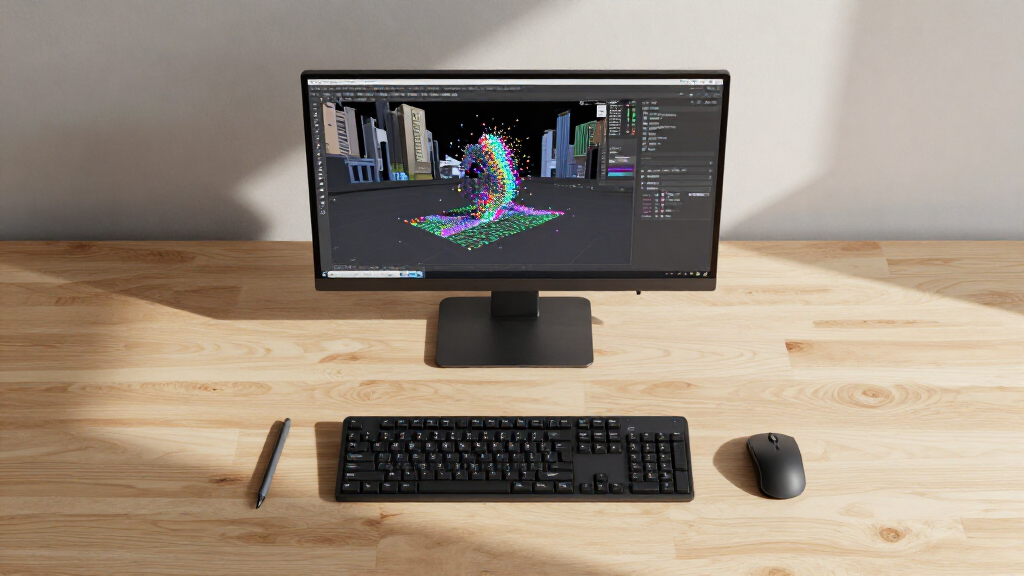
Blender 5.3 is released with native support for 3D Gaussian Splats, a scene-reconstruction representation that can now be imported, processed and rendered within the 3D software. Blender says the update supports imports from PLY, SPZ and glTF files, with rendering available in EEVEE, Cycles and Workbench solid mode.

Get business pricing on tech for your team
- Business-only prices and quantity discounts
- Tax-exempt purchasing
- Multiple users, one account, clear invoices
Blender represents splats as a distinct type of point cloud, with attributes for their scale, rotation, opacity and radiance. Users can work with them in Geometry Nodes, preview them in Workbench, and render them through Blender’s two render engines, EEVEE and Cycles. The release announcement describes the default rendering approach as an emissive shader.
Blender says relighting is possible in a rudimentary way by replacing the Emission node with a hard-surface shader, such as Diffuse BSDF. The project cautions that performance is still being optimized. It also reports potential rendering inaccuracies where color values from tools using sRGB differ from Blender’s linear color space, particularly in areas with low opacity and high radiance.
Other changes span several parts of the application. Cycles gains dispersion in the Principled BSDF and anisotropy support for the Glass BSDF and the Principled BSDF’s transmission component. The release also integrates NVIDIA DLSS 4.5 Ray Reconstruction as a denoising option, which Blender says requires NVIDIA driver version 620 or newer. EEVEE adds panoramic camera projections and material lighting nodes, while the compositor gains a stackable effects workflow and support for 17 Geometry Nodes.
Gaussian Splats Enter Blender Workflows
Native support means artists can bring Gaussian Splat scenes into Blender and combine them with the application’s existing tools, rather than treating the splats only as external imagery. The ability to use Geometry Nodes for processing and render through EEVEE or Cycles may make it easier to include reconstructed scenes in broader 3D projects, subject to the limitations Blender describes.
The release also groups practical changes across rendering and compositing. DLSS denoising is aimed at faster, cleaner viewport results on supported NVIDIA systems; EEVEE’s panoramic projections broaden camera options; and compositor effect stacks offer a more direct way to apply common image treatments. These are features stated in Blender’s release announcement, not independent performance test results.
Products Worth Considering

Apple Watch SE 3 GPS 44mm Smartwatch

Samsung Odyssey G3 G30D 27-Inch FHD Gaming Monitor

Samsung 37-inch Odyssey G7 Curved 4K UHD Gaming Monitor (G75F)
As an affiliate, we earn on qualifying purchases.
What Blender 5.3 Adds
Gaussian Splats are made from many small, soft, transparent elements that combine to represent a scene’s geometry and appearance. Blender describes them as commonly used to reconstruct 3D scenes from photographs or video. In version 5.3, the data is stored as a specialized point cloud with values describing each splat’s size, orientation and radiance.
The release’s scope extends beyond splats. In Cycles, dispersion adds the characteristic separation of light into colors in glass and gemstones, and the new support corresponds to OpenPBR v1.1.1, according to Blender. EEVEE’s lighting nodes expose per-light information and evaluation for materials, with potential uses including stylized shading and physical effects. Its panoramic rendering supports projections such as equirectangular, cubemap and fisheye, although Blender lists limitations for depth of field, ray tracing and viewport volumetric temporal reprojection.
For the compositor, Blender describes a new Effects tab where users can stack built-in options such as Bloom, Chromatic Aberration, Film Grain and Vignette. Effects are implemented as node groups and can be adjusted in the Compositor editor. Blender also lists support for 17 Geometry Nodes in the compositor, including bundle, math and utility operations.
Known Rendering Limits Remain
The announcement does not provide benchmark figures for Gaussian Splat import, processing or rendering, nor does it quantify how much performance optimization remains. Blender also does not specify how broadly the reported color-space inaccuracies affect different files or authoring tools. The release notes identify these issues but do not give a schedule for fixes.
EEVEE panoramic rendering also has stated limitations: depth of field, ray tracing and volumetric temporal reprojection in the viewport are not supported by the current implementation. The source announcement does not establish when those capabilities might be added. DLSS denoising has a clear driver requirement, but the announcement does not provide independent testing of its image quality or speed.
Testing the New Features
Artists can now test the features in Blender 5.3, including importing supported PLY, SPZ and glTF splat files, using Geometry Nodes, and rendering through the available engines. Users considering the DLSS denoiser should check that their NVIDIA driver meets the version 620 or newer requirement. Blender says Gaussian Splat performance remains under optimization; the release announcement does not give a date for further updates or fixes.
Key Questions
What is the main new feature in Blender 5.3?
The release adds native 3D Gaussian Splat support, including import, Geometry Nodes processing, Workbench preview and rendering in EEVEE or Cycles.
Which Gaussian Splat file formats can Blender 5.3 import?
Blender’s release announcement lists PLY, SPZ and glTF formats.
Can Gaussian Splats be relit in Blender 5.3?
Blender describes relighting as rudimentary. Its suggested approach is to replace the default Emission node with a hard-surface shader such as Diffuse BSDF.
What limitations does Blender identify?
Blender says Gaussian Splat performance is still being optimized and warns of possible color-space inaccuracies, especially in areas with low opacity and high radiance. EEVEE panoramic rendering also lacks depth of field, ray tracing and viewport volumetric temporal reprojection in the current implementation.
What is needed to use DLSS denoising?
The release notes say NVIDIA DLSS 4.5 Ray Reconstruction denoising requires an NVIDIA driver version 620 or newer.
Source: blender.org