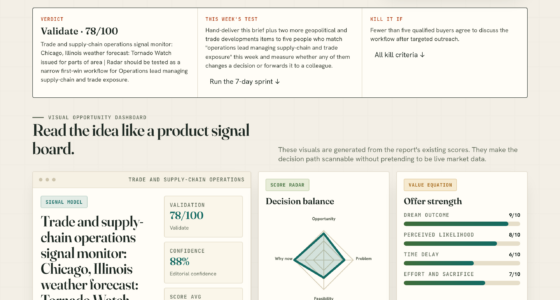
📊 Full opportunity report: A Closer Look At Local Food And Beverage Trends At Falstaff’s Vienna Festival on IdeaNavigator AI — validation score, market gap, and execution plan.

Get business pricing on tech for your team
- Business-only prices and quantity discounts
- Tax-exempt purchasing
- Multiple users, one account, clear invoices
TL;DR

IdeaNavigator AI proposes treating the Falstaff-Bar & Spirits Festival Vienna 2026 listing as a test case for a targeted food-and-beverage trend monitor. The material does not confirm festival dates, exhibitors, products, or consumer trends; it describes a proposed workflow and a way to test demand with industry professionals.
IdeaNavigator AI has proposed using a listing for the Falstaff-Bar & Spirits Festival Vienna 2026 as a test case for a targeted food-and-beverage trend monitor aimed at product and marketing leads. In its proposal, IdeaNavigator AI describes a potential business workflow, not confirmed reporting on festival announcements, exhibitors, launches, or emerging local tastes.
According to IdeaNavigator AI’s proposal, the service would track food trends, product launches, and recalls across news and other feeds, then filter those items for their likely relevance to a product or marketing lead at a food or beverage brand. Each selected item would be turned into a short brief explaining what changed, why it may matter to that role, and what action might merit consideration. The proposal offers the festival listing as one possible item for that workflow, rather than evidence of a particular trend at the event.
IdeaNavigator AI describes the opportunity as a response to information being scattered across news, forums, and filings. It argues that a role-filtered update delivered on the same day could be more useful to a busy brand team than a general weekly roundup. These are the proposal’s rationale; it provides no user research, examples of decisions changed, or independent evidence that buyers currently lack suitable tools.
IdeaNavigator AI suggests an initial product that would monitor Local and similar feeds for relevant developments and produce concise, decision-oriented summaries. Its material assigns the signal an 88/100 score, but does not explain the score’s methodology, scale, or comparison group. The figure is therefore an internal signal rating in the proposal, not a verified measure of consumer interest or the festival’s commercial importance.
A Closer Look at Local Trends and a Vienna Festival Listing
IdeaNavigator AI proposes using a Falstaff-Bar & Spirits Festival Vienna 2026 listing to test a trend-monitoring service. The material reports a proposed workflow, not confirmed festival news or consumer trends.
What the monitor would do
The proposed service turns selected food and beverage updates into role-specific, action-oriented briefs.
Track food trends, product launches, and recalls across news and other feeds.
Select updates likely to matter to product or marketing leads at food and beverage brands.
Explain what changed, why it may matter, and what action to consider.
A small test comes first
The proposal suggests hand-delivering three briefs to five target-role professionals in the same week.
Decision change
Look for whether a recipient changes a decision after reading a brief.
Brief sharing
Check whether a recipient forwards a brief to a colleague.
What is known—and open
- A festival listing is a candidate input.
- The intended users are product and marketing leads.
- The 88/100 score is assigned by IdeaNavigator AI.
- Festival dates, venue, exhibitors, or announcements.
- Specific products or emerging consumer trends.
- Score methodology, customer demand, or test results.
A Test for Brand Trend Monitoring
For food and beverage teams, the proposal addresses a practical question: can a stream of scattered updates be converted into timely information that affects product, communications, or planning decisions? A festival listing could become useful if it points to a launch, an ingredient trend, a new bar or beverage concept, or a change in consumer interest. None of those developments is established here; they are examples of the kind of signal the proposed service would need to identify and verify.
The commercial case depends on usefulness rather than volume. A brief that reaches the right person quickly could help a team decide whether to investigate a trend, adjust campaign messaging, or monitor a competitor. But a fast alert can also create noise if it lacks reliable sourcing or overstates what a single event indicates. The proposal’s emphasis on role-based filtering and a concise explanation of implications reflects that distinction.
IdeaNavigator AI suggests charging by subscription to product or marketing leads. Before that model could be assessed, potential customers would need to show that the briefs save time or change a decision often enough to justify payment. The validation exercise described in the proposal is therefore central: it would test whether people use and share the information, rather than treating an assigned signal score as proof of demand.
Products Worth Considering

DJI Mini 5 Pro Bundle with RC-N3 Controller, 1 50MP CMOS Camera Drone, 4K/120fps HDR, LiDAR Obstacle Sensing, Under 249g, ND Filter Kit (ND8

Samsung Odyssey G3 G30D 27-Inch FHD Gaming Monitor

LG UltraGear 32-inch 4K UHD OLED Gaming Monitor, 165Hz
As an affiliate, we earn on qualifying purchases.
From Festival Listing to Product Brief
In its proposal, IdeaNavigator AI places the festival listing within a broader category called food and beverage trends. The material does not give a report on the event itself, nor does it identify specific drinks, food products, participating brands, visitor figures, or announcements. The reference to Vienna and 2026 appears as the subject of the listing being monitored; no schedule or venue details are supplied.
IdeaNavigator AI outlines a workflow with three parts: monitor feeds, decide which items matter to a defined job role, and convert selected items into short action-oriented briefs. That framing makes the idea narrower than a general food-news digest. It is intended for a particular buyer who must turn external developments into decisions at a brand, and the festival item is presented as an example of what the system might process.
To validate the concept, IdeaNavigator AI proposes hand-delivering the festival brief along with two other items about food trends, launches, or recalls to five people matching the target role in the same week. The proposed measures are whether any recipient changes a decision or forwards a brief to a colleague. This is a small early test, not a market-wide study, and IdeaNavigator AI reports no results from it.
Festival Details and Demand Unverified
IdeaNavigator AI’s material does not establish when or where the festival will take place, what will appear there, or whether any particular product or trend will be announced. It refers to a listing associated with Leadersnet but does not identify or link to the underlying listing. Readers should not interpret the proposal as confirmation of festival programming or as an account of findings from the event.
Several parts of the business case remain open. The 88/100 score stated by IdeaNavigator AI has no published explanation in the material, and there is no evidence showing how accurately the proposed monitor distinguishes meaningful developments from routine news. The proposal names no potential customers, reports no interviews, establishes no willingness to pay, and provides no results from the suggested five-person test. It also does not specify which feeds beyond Local would be monitored or how claims and recalls would be checked before reaching users.
Five-Person Test Comes First
IdeaNavigator AI proposes preparing the festival-related brief and two additional food-and-beverage items, then delivering them to five product or marketing leads during the same week. The test would look for evidence that a recipient changes a decision or shares a brief with a colleague. The proposal gives no test date, participant list, or outcome, so it is not clear whether this work has begun.
If that exercise produces signs of practical use, IdeaNavigator AI’s proposal points toward building a limited monitor for trends, launches, and recalls, with summaries tailored to the target role. Further testing would still be needed to assess accuracy, coverage, frequency, and whether a subscription is viable. Until those steps are reported, the festival listing remains a candidate input for a proposed service—not confirmation of a food or beverage trend.
Source: IdeaNavigator AI proposal
Key Questions
What is the actual news about the Falstaff festival?
The development described in IdeaNavigator AI’s proposal is a proposal for a trend-monitoring service that uses a Falstaff-Bar & Spirits Festival Vienna 2026 listing as a test case. The material does not report confirmed festival programming or announcements.
What would the proposed monitor do?
As described by IdeaNavigator AI, it would scan feeds for food trends, launches, and recalls, filter items for product and marketing leads at food or beverage brands, and produce brief summaries of what changed and why it may matter.
Does the 88/100 score show that the festival is important?
No. IdeaNavigator AI assigns the score in its proposal, but does not explain its method or comparison basis. It is not accompanied by evidence measuring consumer interest or the event’s commercial importance.
How would the idea be tested?
IdeaNavigator AI proposes sending a brief about the festival listing and two other relevant items to five people in the target job role, then checking whether anyone changes a decision or forwards a brief. The proposal reports no results.
What remains unknown about the festival?
The material from IdeaNavigator AI gives no confirmed event date, venue, exhibitors, products, or announcements. It also does not establish whether the proposed monitoring service has been built or whether potential customers would pay for it.
Source: IdeaNavigator AI