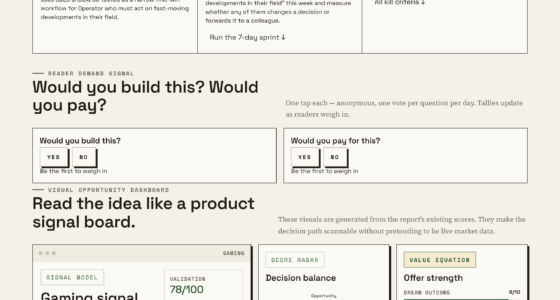
📊 Full opportunity report: How Technology Operations Can Interpret Tech Trends on IdeaNavigator AI — validation score, market gap, and execution plan.

Get business pricing on tech for your team
- Business-only prices and quantity discounts
- Tax-exempt purchasing
- Multiple users, one account, clear invoices
TL;DR
IdeaNavigator AI proposes a narrow monitoring workflow for product and engineering leads at small software companies. It would track feeds such as Hacker News and turn relevant platform and tooling items into short decision briefs; the proposal has not been validated with customers.
IdeaNavigator AI’s proposal outlines a focused technology-trend monitor for product and engineering leads at small software companies, designed to turn scattered platform and tooling updates into short decision briefs. The concept remains a proposal: the material’s suggested next step is to deliver briefs to five potential users and see whether the information changes a decision or is forwarded to a colleague.
In its proposal, IdeaNavigator AI says the monitor would follow Hacker News and similar feeds for developments in platforms and tools, then filter items for relevance to a small software company’s product or engineering work. The proposal says each selected item would be summarized around three questions: what changed, why it matters, and what to do. It uses “Choose Boring Technology (2015)” as an example of a signal that could merit a role-specific brief.
IdeaNavigator AI frames the problem as relevant updates being spread across news, forums and filings, while a general roundup may not tell a particular team whether to act. Its material assigns the example a Hacker News signal score of 88/100, but does not explain how that score is calculated, what period it covers or how it compares with other items. This is a rating reported in the proposal, not independent evidence of market demand.
The proposal identifies a subscription as the potential business model for product or engineering leads who need earlier, filtered information. For initial validation, IdeaNavigator AI proposes hand-delivering the example brief and two additional platform or tooling items to five people matching the intended customer profile, then tracking whether they report changing a decision or forwarding a brief. The material reports no test outcomes, customer commitments or operating product.
How Technology Operations Can Interpret Tech Trends
IdeaNavigator AI proposes turning scattered platform and tooling updates into short, role-specific decision briefs for small software teams. The concept has not been validated with customers.
From feeds to decisions
The proposal adds relevance filtering and interpretation to updates scattered across news, forums and filings.
Track Hacker News and similar feeds for platform and tooling developments.
Select items that may affect a small company’s product or engineering work.
Summarize what changed, why it matters and what to do.
What the example shows
“Choose Boring Technology (2015)” illustrates a signal in the proposal; it is not a newly announced release.
- Less time scanning multiple channels
- Context matched to product and engineering roles
- Briefs that may support a specific decision
- How the 88/100 score is calculated
- Which sources beyond Hacker News are covered
- Whether users would pay for a subscription
Proposed user trial
IdeaNavigator AI suggests hand-delivering the example brief and two other platform or tooling items.
Five potential users
Product or engineering leads at small software companies.
Look for action
Track whether a brief changes a decision or is forwarded to a colleague.
Early feedback only
No trial results are reported, and five participants cannot establish market demand.
Testing Whether Briefs Change Decisions
The proposal addresses a decision problem rather than simply a shortage of technology news. IdeaNavigator AI’s material suggests that small teams may have limited time to monitor multiple channels, while an update that matters to one company’s stack may be irrelevant to another. A useful monitor would need to reduce that noise without hiding developments that could affect product plans, engineering work or tool choices.
For readers evaluating the idea, the key question is not how many links the monitor can collect. It is whether a brief reaches the right person in time and supports a specific action or decision. The test described by IdeaNavigator AI reflects that distinction by tracking changes in decisions and forwarding behavior rather than relying only on clicks or stated interest. However, a five-person exercise can provide early feedback, not establish demand across the market or show that a subscription business is viable.
Products Worth Considering

Bose TV Speaker Compact Soundbar with Bluetooth and HDMI-ARC, Black

Apple AirPods Pro 3 Wireless Earbuds

Bose SoundLink Plus Portable Bluetooth Speaker, Black
As an affiliate, we earn on qualifying purchases.
From Scattered Feeds to Team Decisions
IdeaNavigator AI frames the concept around technology operations, particularly the work of product and engineering leads at small software companies. Its proposal names Hacker News as one place where a relevant item surfaced and points to news, forums and filings as broader sources of dispersed signals. The proposed product would add a role-based filter and a concise interpretation layer on top of those feeds.
“Choose Boring Technology (2015)” is the example used in IdeaNavigator AI’s proposal, not a newly announced technology release. The material does not describe a new underlying event associated with that title; the development being reported here is the monitoring concept and its proposed test. No product launch, technical implementation, pricing, customer adoption or measured business results are stated in the source material.
Demand and Scoring Still Unverified
IdeaNavigator AI’s proposal leaves several parts of the concept untested. It does not specify which sources beyond Hacker News the monitor would track, how it would decide that an item affects a particular team, or whether summaries would be written by people, generated automatically or produced through a combination of methods. The proposal also provides no details on update frequency, coverage limits, accuracy checks or how conflicting information would be handled.
The proposal’s 88/100 score has no stated methodology or comparison baseline, so it cannot establish that the item was unusually important or that users would value a paid service. The five-person validation plan has no reported results, and the material does not identify the participants or define how a “changed decision” would be verified. Pricing, retention, competitors and the size of the addressable customer group are also unspecified.
The Proposed Five-User Trial
According to IdeaNavigator AI’s proposal, the next step is to deliver three briefs—the example item and two other platform or tooling developments—to five product or engineering leads at small software companies. The proposed test would look for evidence that a brief changes a decision or is shared with a colleague. Responses could help determine which topics are useful and whether the summaries provide enough context to act.
The proposal gives no timetable beyond suggesting the test take place “this week,” and no findings have been announced. If the trial proceeds, useful follow-up evidence would include what participants did with the information, how consistently they found it relevant, and whether they would pay for continued access. Until then, the monitor is best understood as an early product hypothesis, not a proven service or a confirmed market opportunity.
Source: IdeaNavigator AI
Key Questions
What is the proposed technology-trend monitor?
IdeaNavigator AI describes it as a proposed service that would scan feeds such as Hacker News, select platform and tooling developments relevant to small software teams, and summarize what changed, why it matters and what to do.
Has the monitor launched?
No launch is reported. IdeaNavigator AI’s material presents a product concept and validation plan, with no confirmed product, customers or results.
What does the 88/100 signal score mean?
IdeaNavigator AI’s proposal assigns the example item a score of 88/100, but does not describe its calculation, time window or comparison baseline. The score’s meaning and evidentiary value are unclear.
How would the idea be tested?
IdeaNavigator AI proposes hand-delivering three briefs to five product or engineering leads at small software companies, then measuring whether a brief changes a decision or is forwarded.
Is a subscription business proven?
No. IdeaNavigator AI identifies a subscription as the proposed revenue model, but reports no pricing, payment commitments, retention data or broader evidence of willingness to pay.
Source: IdeaNavigator AI