

Readers searching for AI data extraction tools may find this lineup is better understood as a set of books about AI-assisted data work—not a list of software products. I rank Mastering Claude Cowork for Web Research and Reporting first for non-coders who want a focused path from web collection to reports, while Data Analysis with LLMs has the broadest stated scope across text, tables, images, and sound. For readers building durable systems, AI-Native Data Engineering is the architecture-focused pick.

Get business pricing on tech for your team
- Business-only prices and quantity discounts
- Tax-exempt purchasing
- Multiple users, one account, clear invoices
The tradeoff is scope versus practical fit: some titles describe specific workflows, while others signal broader analysis or infrastructure topics. Product details are limited for several books, so I treat the stated descriptions as the evidence—not as proof of particular exercises, tools, or outcomes. These picks can help readers learn and plan, but they are not standalone extraction software. I compare them by how directly their described subject matter maps to collecting, interpreting, and turning data into usable output.
Key Takeaways
- For non-coders focused on web research, collection, and reporting, Claude Cowork is the most directly aligned title in this lineup.
- Data Analysis with LLMs has the broadest stated modality coverage, spanning text, tables, images, and sound.
- AI-Native Data Engineering is the strongest fit for readers thinking about LLM-era platforms, pipelines, and architecture rather than one-off tasks.
- Claude AI for Data Analysis and Financial Modeling has the clearest analyst-focused workflow, with stated coverage of extraction, SQL generation, and market research.
- From Excel to AI Tools connects analysis to report writing and workflow automation, but the available description does not specify its format details or exact methods.



| AI data extraction tool | Product type | ASIN | Primary subject |
|---|---|---|---|
| Mastering Claude Cowork for We | Book | — | Web research and reporting |
| Data Analysis with LLMs: Text | Book | 1633437647 | Data analysis with LLMs |
| AI-Native Data Engineering: De | Book | B0HBMMMCQZ | AI-native data engineering |
| Claude AI for Data Analysis an | Book | B0HFZWWNG2 | — |
| From Excel to AI Tools: Use AI | Book | B0H67VP8NK | — |
More Details on Our Top Picks
Mastering Claude Cowork for Web Research and Reporting: A Non-Coder’s Guide to Automating Data Collection and Report Generation
This is my first pick for buyers whose actual task is collecting information from the web and turning it into a report, especially if they do not want a coding-first guide. Its described scope connects the stages that make a research workflow useful: web research, data collection automation, and report generation. That direct chain gives it a closer match to practical extraction work than AI-Native Data Engineering, which is aimed at platform and pipeline design, or Data Analysis with LLMs, whose stated scope spans several kinds of input but does not name a specific collection workflow.
The title is also unusually explicit about its audience and approach: it calls itself a non-coder’s guide and identifies Claude Cowork as its focus. That specificity helps a buyer decide whether the subject fits. It is not evidence that every step is simple, that the material covers a particular website, or that a reader can automate any source without restrictions. The supplied description does not identify supported integrations, examples, or the book’s level of detail, so I would treat it as a guide to investigate rather than a promise of a ready-made system.
Compared with Claude AI for Data Analysis and Financial Modeling, this pick leans toward web collection and reporting rather than SQL, quantitative work, or financial modeling. It also differs from From Excel to AI Tools: the latter connects AI to spreadsheet analysis and workflow automation, while this book names web research as the starting point. Choose it when that source-and-output pairing is central. Skip it if you need a general-purpose software platform, advanced data engineering, or a deep financial analysis reference.
Pros:- Explicitly aimed at readers without coding experience
- Direct focus on web research and data collection
- Connects collection with report generation
- Identifies Claude Cowork as its workflow focus
Cons:- The supplied description does not specify integrations, examples, or detailed methods
- A Claude Cowork focus may not transfer directly to other AI tools
- It is a book, not an extraction application or hosted service
Best for: Non-coders who want a guide focused on automating web research, collecting information, and producing reports with Claude Cowork.
Not ideal for: Readers seeking extraction software itself, a code-heavy engineering reference, or a guide centered on SQL and financial modeling.
- Product type:Book
- Primary subject:Web research and reporting
- Named AI tool:Claude Cowork
- Audience:Non-coders
- Collection focus:Automating data collection
- Output focus:Report generation
- Series:Claude Cowork Mastery Series
- Series number:5
Our verdict“I rank it first for non-coders because its stated path from web research to automated collection and reporting is the clearest practical match in this lineup.”
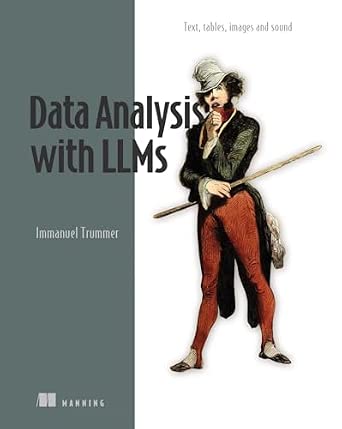
Data Analysis with LLMs: Text, Tables, Images, and Sound
I place this title second because its stated subject covers the widest range of input types: text, tables, images, and sound. That breadth is appealing to readers who cannot assume their source material arrives as clean rows in a spreadsheet. A guide framed around several modalities may help a buyer think beyond conventional document or table processing, although the product information does not say exactly what techniques or examples the book includes.
Its difference from the leading Claude Cowork title is a difference in emphasis. The Cowork guide names a specific collection-and-reporting workflow and a non-coder audience; this one points toward analysis across varied data formats. That could make it a better conceptual match for researchers or analysts handling mixed inputs. On the other hand, its description does not expressly promise web collection, automation, or report generation, so buyers whose main goal is to gather online data should start with the more focused Cowork book instead.
The title is broad, but the listing supplies few details beyond the subject. I cannot verify from the provided information whether it includes code, practical exercises, tool comparisons, or a particular level of technical depth. That uncertainty matters more here because four modalities can mean wide orientation rather than detailed instruction for each one. I would choose it when input variety is the defining problem, not when a specific extraction workflow or software recommendation is the priority. Compared with the engineering title, it appears oriented toward analyzing data rather than designing the platform that moves it.
Pros:- Names four distinct data modalities
- Broadly relevant to mixed-source analysis
- Focuses specifically on LLMs and data analysis
- Can suit readers whose inputs extend beyond spreadsheets
Cons:- The supplied information does not describe methods or chapter coverage
- No stated audience or technical level is available
- The description does not specifically identify web extraction or reporting automation
Best for: Readers and analysts who want to explore LLM-based analysis across text, tabular data, images, and sound.
Not ideal for: Buyers who need a clearly described web-collection workflow, a non-coder automation guide, or a detailed data-platform architecture reference.
- Product type:Book
- Primary subject:Data analysis with LLMs
- Named modalities:Text, tables, images, and sound
- Text analysis:Included in the title scope
- Table analysis:Included in the title scope
- Image analysis:Included in the title scope
- Sound analysis:Included in the title scope
- ASIN:1633437647
Our verdict“I recommend it when varied input formats matter more than a narrowly defined collection workflow, while noting that the available description leaves its practical depth unclear.”
AI-Native Data Engineering: Designing Intelligent Data Platforms, Pipelines, and Architectures for the LLM Era
This is the architecture-minded choice. Its stated focus on data platforms, pipelines, and architectures for the LLM era points beyond extracting a few fields from a document: it concerns the structures that support data work at system level. Readers responsible for designing or rethinking a data stack may find that framing more relevant than a task guide. I rank it behind the two titles with clearer direct links to collection and input analysis because the supplied description emphasizes engineering architecture, not a specific extraction procedure.
That distinction separates it from Data Analysis with LLMs. The latter names text, tables, images, and sound as analysis inputs; this book instead names the systems and flows that can support LLM-oriented data work. It also differs from Claude AI for Data Analysis and Financial Modeling, which is framed around analyst tasks such as SQL generation and market research. If your need is to plan a durable pipeline rather than perform a single analysis, this title has the more relevant stated scope.
The central drawback is limited available detail. The product data does not say whether the book includes implementation examples, diagrams, code, vendor guidance, or specific approaches to extraction. I would not assume that its architecture focus translates into a how-to manual for a chosen platform. It is best treated as a systems-design reading choice for technical decision-makers, not as an immediate answer for a non-coder collecting web information. In contrast with the first-ranked Cowork guide, it trades task-level specificity for a broader infrastructure perspective.
Pros:- Explicit focus on data engineering for the LLM era
- Covers platforms, pipelines, and architectures in its stated scope
- Relevant to system-level planning rather than only one-off analysis
- Addresses infrastructure concerns distinct from the workflow-focused titles
Cons:- The supplied product data offers no detailed content outline
- Specific extraction methods and implementations are not described
- May be too architecture-oriented for readers with an immediate research task
Best for: Data engineers, architects, and technical leads planning platforms and pipelines for LLM-era data workflows.
Not ideal for: Non-coders looking for a step-by-step web research workflow or analysts seeking a narrowly focused financial modeling guide.
- Product type:Book
- Primary subject:AI-native data engineering
- Era focus:Large language model era
- Platform scope:Intelligent data platforms
- Pipeline scope:Data pipelines
- Architecture scope:Data architectures
- ASIN:B0HBMMMCQZ
Our verdict“I recommend it to technical readers planning LLM-era data infrastructure, but not to buyers whose main need is a direct extraction workflow.”
Claude AI for Data Analysis and Financial Modeling
This title earns a place for its specific analyst workflow: the description names data extraction, SQL generation, and market research, alongside data analysis and financial modeling. That makes it a more targeted choice for people who turn information into structured queries or financial work than the web-research guide, which focuses on collection and reporting for non-coders. It also offers a more clearly named use case than Data Analysis with LLMs, whose stated coverage is broad across input modalities but does not single out finance.
The Claude focus makes the guide easier to match to a buyer’s intended tool, but it also narrows its apparent scope. A reader seeking general-purpose guidance across multiple AI systems may prefer the cross-modal analysis book. Someone designing a reusable enterprise pipeline may be better served by AI-Native Data Engineering. This one makes the most sense when analyst tasks and financial modeling are the reason for learning AI-assisted extraction, rather than web collection alone or infrastructure planning.
The supplied description does not specify the depth of SQL instruction, which financial models are covered, or whether the guide contains examples and exercises. I would not infer that it replaces domain expertise or validates the accuracy of generated results. Its useful distinction is the stated combination of extraction with downstream analytical tasks; its limitation is the lack of detail about how those tasks are taught. Compared with the Excel-to-AI title, it has a more explicit Claude and finance orientation, while the latter signals a broader bridge from spreadsheets to AI workflows.
Pros:- Names data extraction as part of its subject
- Connects extraction with SQL generation and market research
- Specifically addresses financial modeling
- Targets analyst and quantitative research workflows
Cons:- The available information does not describe the level of SQL instruction
- No details are provided about examples, exercises, or model validation
- Claude-specific framing may be less relevant to readers seeking tool-neutral guidance
Best for: Analysts and quantitative researchers who want a Claude-focused guide to extraction, SQL generation, market research, and financial modeling.
Not ideal for: Readers who need a non-coder web automation path, cross-modal coverage, or data engineering architecture guidance.
- Product type:Book
- Named AI tool:Claude AI
- Primary audience:Analysts and quantitative researchers
- Stated workflow:Data extraction
- SQL topic:SQL generation
- Research topic:Market research
- Modeling topic:Financial modeling
- ASIN:B0HFZWWNG2
Our verdict“I would choose this guide for Claude-oriented analytical and financial workflows, rather than for general web collection or platform design.”
From Excel to AI Tools: Use AI to Analyse Data, Write Reports, and Automate Your Workflow (From Spreadsheets to Code, Book 6)
This book is the spreadsheet bridge in the group. Its described scope links AI-assisted data analysis, report writing, and workflow automation, making it a plausible fit for readers whose starting point is Excel rather than web research or data-platform engineering. I rank it fifth because the description does not name extraction as directly as the Cowork or Claude financial analysis titles, and it provides little detail about the exact workflows. Still, the connection between spreadsheet analysis and repeatable work can be useful for buyers who need output, not just a data query.
Compared with Mastering Claude Cowork for Web Research and Reporting, this title appears less focused on where data comes from and more focused on what users do after data is in their workflow. Compared with Claude AI for Data Analysis and Financial Modeling, it signals a broader spreadsheet-to-AI path rather than a named focus on SQL or financial modeling. The series framing—From Spreadsheets to Code—also suggests a progression, but the supplied details do not establish how much coding this volume expects or teaches.
The absence of format, length, and detailed content information makes it difficult to judge how actionable the book will be. I would not assume it includes particular spreadsheet integrations, automation recipes, or code examples. Buyers should choose it for its stated combination of analysis, writing, and workflow automation, not on the assumption that it is a specialized web extractor. For a reader who already works in spreadsheets, that downstream emphasis may be more useful than a multimodal survey; for someone starting with online collection, the Cowork guide is the clearer match.
Pros:- Combines AI-assisted analysis with report writing
- Includes workflow automation in its stated scope
- Explicitly connects spreadsheets and AI tools
- Part of the From Spreadsheets to Code series
Cons:- The description does not specify particular extraction workflows
- Format, length, and technical level are not provided
- The supplied information does not detail examples or supported tools
Best for: Spreadsheet users who want to connect AI-assisted analysis with report writing and workflow automation.
Not ideal for: Readers needing a dedicated web data-collection guide, a specific financial modeling reference, or detailed architecture instruction.
- Product type:Book
- Series:From Spreadsheets to Code
- Series number:6
- Starting point:Excel and spreadsheets
- Analysis focus:AI-assisted data analysis
- Writing focus:Report writing
- Automation focus:Workflow automation
- ASIN:B0H67VP8NK
Our verdict“I recommend it for spreadsheet-first readers who want analysis, reports, and automation in one learning path, with limited evidence about the book’s exact methods.”

How We Picked
I ranked these titles by how directly their described subject matter supports data extraction work: collecting information, structuring it, analyzing it, or delivering it in a report or system. Because the supplied information describes books rather than software, I do not present them as plug-and-play tools or claim they extract data on their own. A book can explain a workflow; the reader still needs an appropriate model, data source, and process.
My order gives more weight to a clear match between the stated audience and a practical data-collection task. That puts the non-coder guide to Claude Cowork first: its description directly joins web research, automated collection, and reporting. I then rank the cross-modal analysis title for its unusually wide stated input range, followed by the architecture book for readers building data platforms. The Claude financial modeling guide and the Excel-to-AI workflow book address narrower analyst and spreadsheet paths, respectively.
I also account for how much product information is available. Several listings provide little beyond a title, so I avoid inferring chapter contents, code samples, supported integrations, accuracy, or publication format where those details are absent. Tradeoffs and fit matter more than assumed features: a broad title may be useful for orientation but less direct for a specific workflow, while a focused guide may not transfer to other tools. None of the supplied descriptions establishes extraction quality or guarantees results. I use the same evidence standard across all five selections.
| AI data extraction tool | Primary subject |
|---|---|
| Mastering Claude Cowork for We | Web research and reporting |
| Data Analysis with LLMs: Text | Data analysis with LLMs |
| AI-Native Data Engineering: De | AI-native data engineering |
| Claude AI for Data Analysis an | — |
| From Excel to AI Tools: Use AI | — |
Factors to Consider When Choosing AI Data Extraction Tools
These five titles are learning resources, not interchangeable extraction platforms. I would choose among them by starting with the source of the data, the work that follows collection, and the technical level you want to handle. A guide about web research is a different purchase from one about multimodal analysis or system architecture.
Start with the data source
If the information starts on websites and you need to gather it for a report, Mastering Claude Cowork for Web Research and Reporting is the closest fit in this set. Its description names both web research and automated data collection. If your inputs include a mix of text, tables, images, and sound, Data Analysis with LLMs has the broadest stated modality range. For spreadsheet-centered work, From Excel to AI Tools is the more natural starting point, though it does not describe a dedicated extraction method.
Match the title to the source you actually handle. A book focused on analyzing varied data types may not teach web collection; a web research guide may not address image or audio analysis. I would avoid buying on the strength of the general phrase “AI data extraction” alone. Look for an explicit connection between your source and the workflow described.
Separate learning material from extraction software
None of these listings describes a standalone application, an API, or a service that takes a source and returns extracted fields. They are books about AI-enabled work. That distinction matters if you need a tool to deploy immediately: a book may explain concepts or workflows, but it does not itself process documents, browse websites, or connect systems.
Before choosing, identify whether you want instruction or software. If you already have a tool and need to understand how to use AI within a workflow, the focused Claude titles may be relevant. If you need a production extractor, compare actual software on its supported sources, output structure, review controls, integrations, privacy terms, and failure handling. The titles here cannot be ranked on those software capabilities because no such product details are supplied.
Choose a technical level that fits the job
The clearest audience signal belongs to the Claude Cowork title, which is described as a non-coder’s guide. By contrast, AI-Native Data Engineering points toward technical readers concerned with platforms, pipelines, and architecture. Claude AI for Data Analysis and Financial Modeling is aimed at analysts and quantitative researchers, with SQL generation among its named topics. Those are distinct needs, not interchangeable levels of the same tutorial.
For the titles without a stated audience or technical depth, I would check the full listing before deciding. The supplied information does not say whether Data Analysis with LLMs uses code, or how much programming the Excel-to-AI book expects. Do not assume a title is beginner-friendly because it mentions AI, or advanced because it mentions architecture; use the detailed contents and sample pages if available.
Think about what happens after extraction
Collection is only one stage. Some buyers need to analyze what they gather, others need a report, and technical teams may need data to move through a repeatable pipeline. Claude Cowork connects collection to reporting; From Excel to AI Tools connects analysis to report writing and automation; AI-Native Data Engineering names platforms and pipelines. The Claude financial modeling title links extraction with SQL, market research, and modeling.
Choose the book that covers the next step you need, not only the initial act of pulling information. A workflow that produces unverified output can still create extra work. When using AI for extraction or analysis, plan for source checks, structured validation, and human review—especially when errors could affect financial, operational, or public-facing decisions.
Treat missing details as a real tradeoff
Several descriptions in this lineup are brief. They do not specify chapter outlines, exercises, code samples, integrations, or exact methods. I therefore rank on the stated subject and audience rather than guessing at content. Specific titles make selection easier, but they do not prove how thoroughly a topic is taught.
Before purchasing, verify the edition and available format, review the contents and any sample material, and check whether the book covers the tools you expect to use. This is especially relevant when you need detailed implementation rather than an overview. A clear match on subject is a good first filter; evidence of suitable depth should be the next one.
Frequently Asked Questions
Are these AI data extraction software tools?
No. The five products are books about AI data work, analysis, engineering, and related workflows. The descriptions do not identify any as an application or service that independently extracts data. I would use this roundup to choose a learning resource; buyers who need software should separately compare source support, structured outputs, integrations, review features, privacy terms, and error handling.
Which title is the best fit for a non-coder collecting web data?
Mastering Claude Cowork for Web Research and Reporting is the closest match because it explicitly targets non-coders and describes web research, automated data collection, and report generation. That description does not confirm support for every website or provide details about integrations, so I would check the full listing for the level of practical instruction before choosing it.
Which book covers the widest range of data types?
Data Analysis with LLMs: Text, Tables, Images, and Sound names the broadest range of input types in its title. It is the clearest choice if your work spans those modalities, but the supplied product information does not explain how deeply each one is covered. Readers who need web collection or report automation may find the Claude Cowork title more directly aligned with that task.
Which title should a data engineer or analyst choose?
A data engineer or technical lead planning systems should start with AI-Native Data Engineering, which names platforms, pipelines, and architecture. Analysts and quantitative researchers working with extraction, SQL generation, market research, or financial modeling may prefer Claude AI for Data Analysis and Financial Modeling. The right choice depends on whether the work is system design or analysis at the task level.
Can I tell from these descriptions whether the books include code or exercises?
No. The supplied information does not establish which titles include code samples, exercises, integrations, or detailed implementation steps. I would not infer those features from words such as “engineering,” “automation,” or “analysis.” Check the full product listing, contents, and any sample pages before purchasing if hands-on instruction or a particular technical level is a requirement.
Conclusion
For non-coders focused on web collection and reporting, I would start with Mastering Claude Cowork for Web Research and Reporting. Choose Data Analysis with LLMs when your work spans several input types, and AI-Native Data Engineering when you are planning LLM-era platforms or pipelines. Analysts and quantitative researchers have a more specific match in Claude AI for Data Analysis and Financial Modeling, while spreadsheet-first readers may prefer From Excel to AI Tools for its stated emphasis on analysis, reports, and automation.
My ranking reflects the descriptions provided, not verified software capability or unseen book contents. These are learning resources rather than extraction products, and several listings leave practical details open. Match the title to your source, role, and next workflow step, then verify the book’s contents before deciding.