
📊 Full opportunity report: Micro-agency Proposal Scope Checker on IdeaNavigator AI — validation score, market gap, and execution plan.

Get business pricing on tech for your team
- Business-only prices and quantity discounts
- Tax-exempt purchasing
- Multiple users, one account, clear invoices
TL;DR
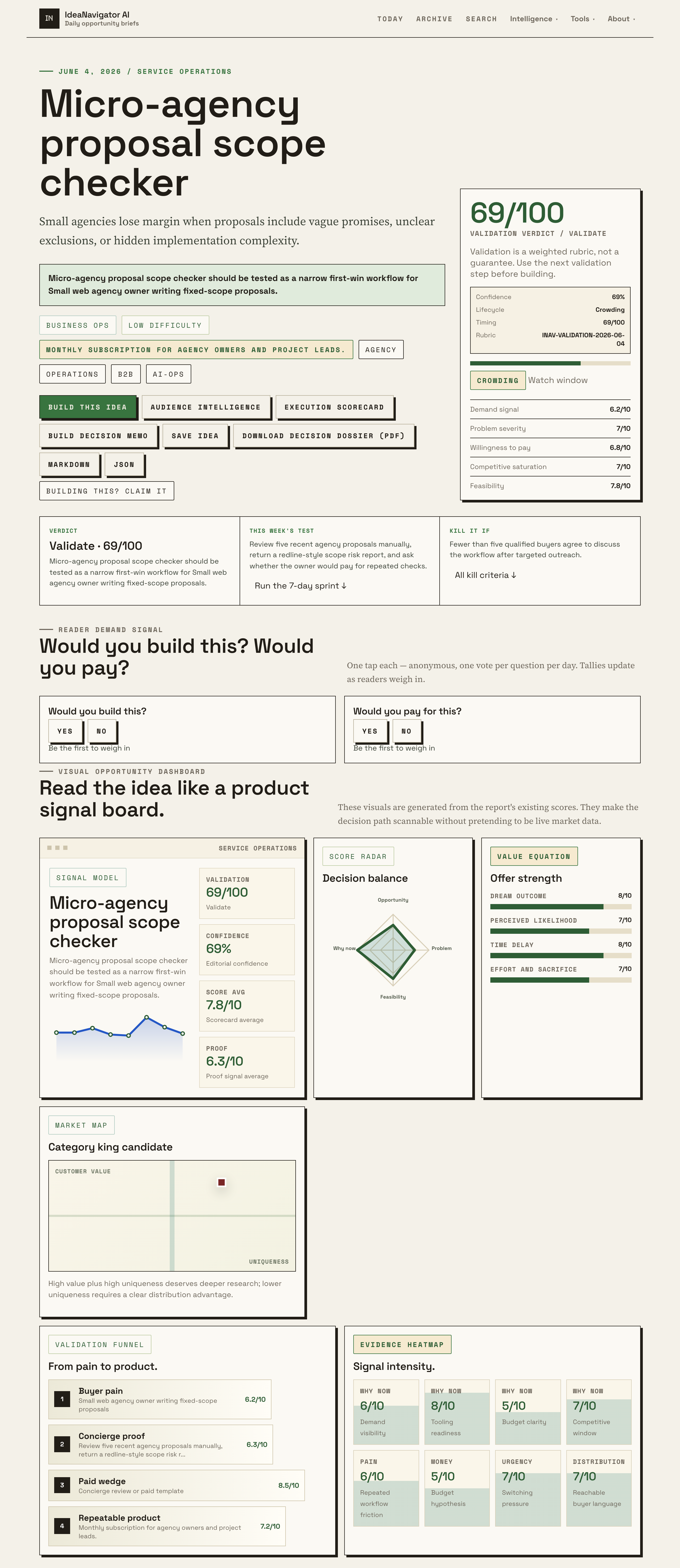
A micro-agency proposal scope checker is in testing, aiming to help small web agencies identify scope risks early. It uses AI to compare drafts against checklists and flag issues.
IdeaNavigator AI has begun testing a proposal scope checker tool aimed at small web agencies. This tool uses AI to identify scope risks, vague promises, and missing assumptions in fixed-scope proposals before they are sent to clients. The development responds to common margin erosion caused by unclear proposals, offering a potential solution to improve proposal quality and profitability for small agencies.
The proposed micro-agency scope checker is designed as a workflow tool that allows agency owners to upload draft proposals. It then highlights vague deliverables, missing assumptions, risky integrations, and suggests exclusion language to clarify scope. The initial testing involves manually reviewing five recent proposals to generate redline-style risk reports, which will be evaluated for usefulness and whether agency owners would pay for repeated checks. The tool is intended to be offered via a monthly subscription model targeting small web agencies that operate with fixed scopes.
According to an anonymous researcher involved in the project, the goal is to reduce margin loss caused by scope creep and misunderstandings, which are common in small agency projects. The MVP (minimum viable product) focuses on comparing proposals against reusable delivery checklists, aiming to catch potential issues early in the proposal process. The market focus is on service operations, specifically small web agencies that struggle with scope clarity and profitability.
Potential Impact on Small Web Agency Profitability
This development could significantly improve profit margins for small web agencies by reducing scope-related disputes and rework. By catching scope risks early, agencies can present clearer proposals, avoid hidden costs, and improve client trust. If successful, this tool might set a new standard for proposal quality control in the service operations sector, especially for agencies with limited resources for detailed manual review.
As an affiliate, we earn on qualifying purchases.
Addressing Scope Risks in Small Agency Proposals
Small web agencies often face challenges with scope definition, leading to lost margins and client disputes. Currently, many rely on manual review processes, which are time-consuming and inconsistent. The rise of AI tools offers an opportunity to automate and standardize scope risk detection. The idea of a proposal scope checker has been discussed in industry circles, but practical testing of such a tool for small agencies is just beginning. The development aligns with broader trends toward automation and AI-driven quality control in service industries.
“The goal is to help small agencies identify scope issues before they become costly disputes or rework.”
— an anonymous researcher
As an affiliate, we earn on qualifying purchases.
Uncertainties in Effectiveness and Adoption
It is still unclear how accurately the AI can identify scope risks in diverse proposal formats or whether agency owners will find the tool valuable enough to pay for ongoing use. The initial validation involves a small sample of proposals, and broader testing will be needed to confirm effectiveness. Additionally, integration with existing proposal workflows and user adoption remain uncertain at this stage.
As an affiliate, we earn on qualifying purchases.
Next Steps for Validation and Market Testing
The next phase involves reviewing five recent proposals with the tool to generate risk reports and gather feedback from agency owners. Based on this feedback, the developers will refine the AI models and user interface. If the results are promising, a broader pilot program and potential commercialization could follow within the next few months. Monitoring user engagement and measuring impact on proposal margins will be key to future development.
As an affiliate, we earn on qualifying purchases.
Key Questions
How does the scope checker identify scope risks?
The tool compares uploaded proposals against predefined checklists to flag vague deliverables, missing assumptions, risky integrations, and suggest language for exclusions.
Will this tool replace manual proposal reviews?
It is designed to assist, not replace, manual reviews by highlighting potential issues early, saving time and reducing errors.
Who can access this scope checker during testing?
Initially, it will be available to small web agency owners participating in the validation phase, with potential expansion based on results.
What is the pricing model for the tool?
The tool is planned to be offered via a monthly subscription, targeting small agencies seeking cost-effective scope risk management.
When will the tool be generally available?
There is no fixed release date yet; further testing and refinement are needed before broader rollout.
Source: IdeaNavigator AI
Halloween Picks
halloween
As an affiliate, we earn on qualifying purchases.