📊 Full opportunity report: Phone-based injury-risk movement screening for hiring on IdeaNavigator AI — validation score, market gap, and execution plan.

Get business pricing on tech for your team
- Business-only prices and quantity discounts
- Tax-exempt purchasing
- Multiple users, one account, clear invoices
TL;DR
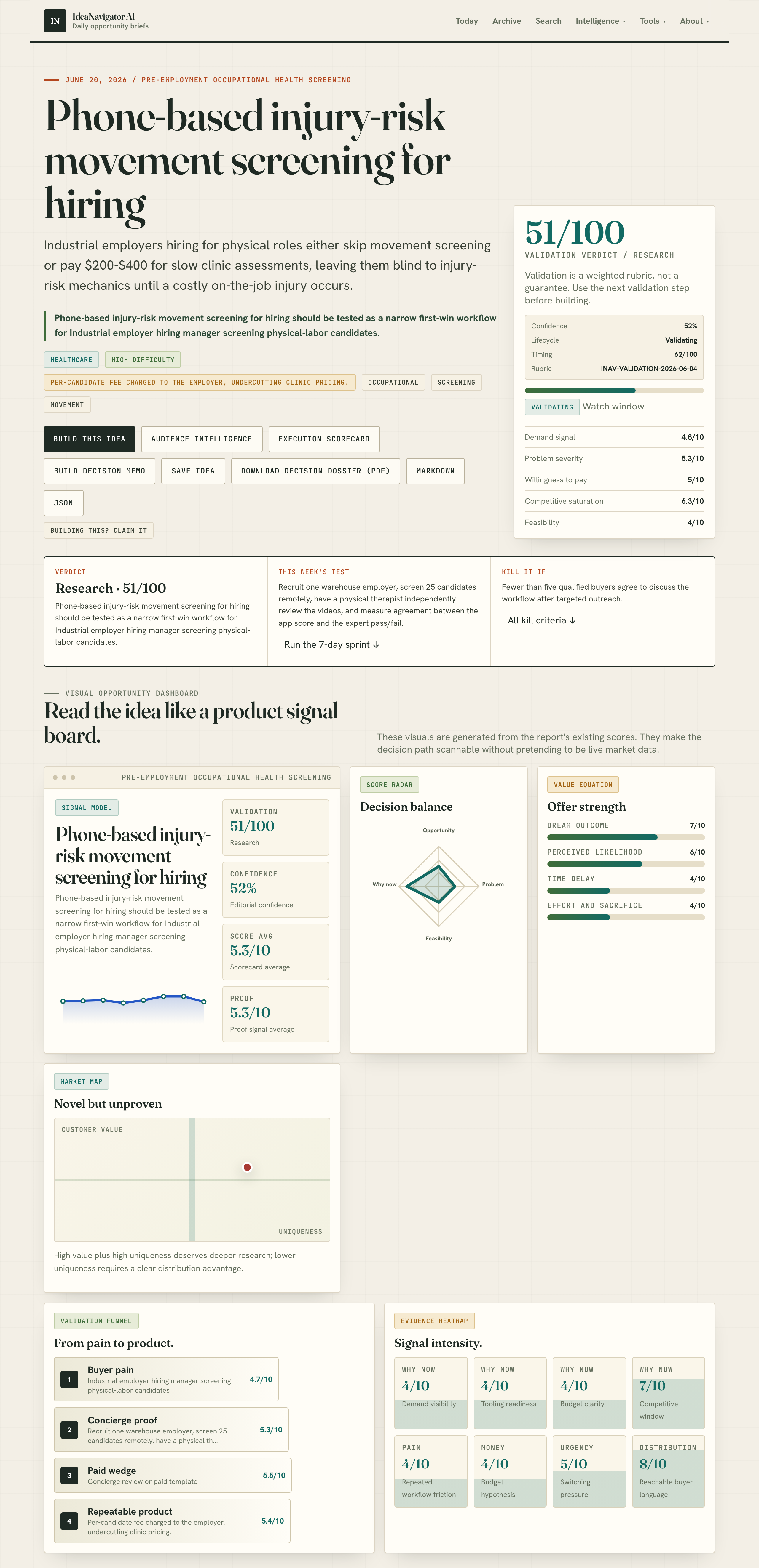
A pilot program is underway to evaluate a phone-based movement screening tool for pre-employment injury risk assessment in industrial settings. The approach uses smartphone cameras and pose estimation to deliver quick pass/fail scores, potentially reducing injury costs.
A pilot program is testing a phone-based movement screening tool designed to assess injury risk in prospective industrial workers. The method uses smartphone cameras and pose estimation to evaluate candidates’ lifting, reaching, and balancing movements, offering a quick, cost-effective alternative to traditional clinic assessments. This development could reshape pre-employment screening processes for physically demanding roles.
The initiative aims to address the common challenge faced by industrial employers: balancing thorough injury risk screening with cost and time constraints. Currently, many employers either skip movement assessments or rely on expensive, slow clinic evaluations costing between $200 and $400 per candidate. The new phone-based approach proposes a guided remote assessment where candidates perform 5-7 movements, such as squats, reaches, and lifts, which are recorded via smartphone cameras. The recordings are processed through pose estimation technology to generate a movement-risk score within 24 hours. The proposed cost per candidate is estimated at $30 to $50, significantly lower than clinic assessments. Employers would be billed per candidate, making it a scalable solution for high-volume hiring. The pilot involves screening 25 warehouse candidates, with independent physical therapists reviewing the videos to validate the app’s scoring accuracy. The goal is to measure agreement between the app’s pass/fail outcome and expert judgment, establishing the tool’s reliability.Potential Impact on Industrial Hiring and Injury Prevention
If proven effective, this remote screening process could significantly reduce workplace injuries by identifying high-risk candidates before they begin physically demanding roles. It could also lower hiring costs and streamline the onboarding process, especially in high-volume hiring scenarios. The approach aligns with rising workers’ compensation costs, encouraging employers to adopt preemptive injury prevention measures. Widespread adoption could lead to safer workplaces and substantial cost savings over time.
As an affiliate, we earn on qualifying purchases.
Emergence of Remote Movement Screening Technologies
The concept of remote injury risk assessment has gained momentum as smartphone technology and pose estimation algorithms have advanced rapidly. Traditionally, movement screening has relied on in-person assessments by trained clinicians, which are costly and time-consuming. Recent developments in computer vision and AI enable the analysis of video recordings to evaluate physical mechanics remotely. This approach is now being explored as a practical solution for pre-employment screening, particularly in sectors with high injury risks, such as warehousing and construction. The pilot program builds on these technological trends, aiming to validate the method’s accuracy and feasibility at scale.
“Using smartphone cameras and pose estimation, we can remotely assess a candidate’s lifting and balancing mechanics quickly and affordably.”
— an anonymous researcher
As an affiliate, we earn on qualifying purchases.
Validation and Reliability of Phone-Based Screening Still Unclear
It remains uncertain how accurately the app’s risk scores will align with expert assessments across diverse candidate populations and different physical roles. The pilot is ongoing, and results are not yet available. Questions about scalability, user compliance, and integration into existing hiring workflows are also unresolved.
industrial injury risk assessment device
As an affiliate, we earn on qualifying purchases.
As an affiliate, we earn on qualifying purchases.
Next Steps: Pilot Expansion and Data Analysis
The pilot program will continue with screening 25 candidates, after which the collected data will be analyzed to determine the scoring system’s accuracy. If results are promising, plans may include expanding the pilot to more employers and refining the technology. Further validation studies are expected to follow, aiming to establish the method as a standard pre-employment screening tool for physically demanding roles.
As an affiliate, we earn on qualifying purchases.
Key Questions
How does the phone-based movement screening work?
Candidates perform a series of movements guided by instructions on their phone, which are recorded via the device’s camera. The recordings are analyzed using pose estimation algorithms to generate a risk score indicating injury likelihood.
What types of movements are assessed?
The screening includes 5-7 movements such as squats, reaching, lifting simulations, and balance holds, designed to mimic physical tasks in industrial jobs.
How accurate is this method compared to traditional assessments?
Validation is ongoing; the pilot aims to compare app scores with independent physical therapist reviews to establish reliability. Results are not yet available.
What are the cost implications for employers?
The proposed cost per candidate is between $30 and $50, significantly lower than clinic assessments, making it more feasible for high-volume hiring.
When will this screening method be widely available?
If pilot results are positive, broader deployment could occur within the next year, pending further validation and integration efforts.
Source: IdeaNavigator AI
Halloween Picks
halloween
As an affiliate, we earn on qualifying purchases.