
📊 Full opportunity report: Efficient, Accurate Food Safety Checks With Vision-Model Technology on IdeaNavigator AI — validation score, market gap, and execution plan.

Get business pricing on tech for your team
- Business-only prices and quantity discounts
- Tax-exempt purchasing
- Multiple users, one account, clear invoices
TL;DR
A new vision-model-based inspection tool enables restaurant managers to verify food safety compliance through phone photos. It offers more accurate, verifiable data than traditional checklist methods. The technology is currently being tested for effectiveness and accuracy.
A new vision-model technology is being tested to automatically identify food safety violations during kitchen walk-throughs, transforming routine visual inspections into verifiable data. The system uses photos taken by managers to flag issues such as uncovered containers or missing labels, providing a more reliable record than traditional checklist methods. This development could significantly improve food safety compliance in restaurant groups.
The technology involves managers photographing key areas during morning checks, including prep stations, storage, and sinks. A vision model analyzes these images for violations, assigning severity ratings and generating timestamped reports for each location. The system aims to turn subjective walk-throughs into objective, traceable data, reducing errors and missed issues common with manual checklists.
According to an anonymous researcher involved in the pilot, initial testing at five restaurant locations over two weeks showed that the vision model successfully flagged violations such as propped cooler doors and unlabeled containers. The results will be compared against findings from professional health inspectors to validate accuracy and reliability. The system is offered as a per-location monthly subscription, with a group dashboard for managers to track trends and compliance over time.
Efficient, Accurate Food Safety Checks With Vision-Model Technology
Phone photos become verifiable compliance evidence. A developing inspection system analyzes restaurant walk-through images, flags visible violations, assigns severity, and produces timestamped records for every location.
From “check completed” to visible proof
Traditional checklists confirm that someone performed a walk-through, but they rarely prove what conditions actually looked like. Vision analysis adds an objective evidence layer to routine restaurant operations.
Guided kitchen photos
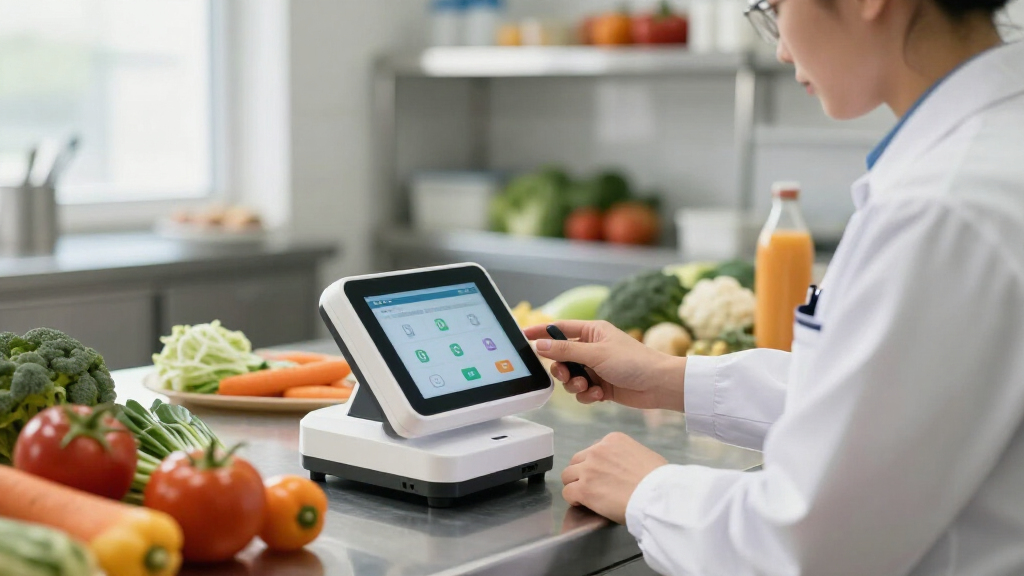
Managers photograph prep stations, storage areas, coolers, sinks, and other critical zones during morning checks.
Automated issue flags
The model reviews visible conditions and identifies potential violations such as uncovered food or missing labels.
Severity-based response
Detected issues receive severity ratings so staff can focus first on risks that require immediate correction.
Timestamped evidence
Each inspection creates a traceable record tied to a location and time, improving accountability across shifts.
Group-level trends
A shared dashboard allows multi-location operators to identify recurring problems and compare compliance patterns.
Human judgment retained
The technology is intended to support managers and inspectors—not replace professional inspection or review.
A routine walk-through becomes structured data
Each stage preserves evidence and context, creating a clear chain from a real kitchen condition to corrective action and longer-term compliance monitoring.
Photograph
Capture required kitchen zones with a standard phone.
Analyze
Vision model reviews visible safety conditions.
Flag
Potential violations receive labels and severity.
Correct
Managers respond to prioritized findings.
Track
Timestamped reports reveal trends over time.
Checklist records versus visual evidence
The central advantage is not simply faster inspection. It is the ability to connect a compliance claim to reviewable evidence while applying a consistent first-pass analysis.
| Inspection capability | Traditional checklist | Vision-model workflow | Professional inspector |
|---|---|---|---|
| Verifies visible conditions | ✗ Limited | ✓ Photo evidence | ✓ Direct observation |
| Creates timestamped record | ~ Completion time only | ✓ Image-linked report | ~ Formal report |
| Consistent first-pass screening | ✗ User dependent | ✓ Model-based review | ~ Expertise dependent |
| Understands hidden context | ✗ Minimal | ~ Still limited | ✓ Strong judgment |
| Scales to daily checks | ✓ Easy to repeat | ✓ Repeatable evidence | ✗ Resource intensive |
| External validation status | ~ Established process | ~ Testing ongoing | ✓ Regulatory standard |
Promising signals, incomplete proof
Early testing reportedly found recognizable violations, but the pilot has not yet established long-term accuracy across varied kitchens, lighting conditions, layouts, or operating practices.
Current evidence maturity
Indicative assessment based on the reported development stage—not measured performance scores.
What operators still need to know
The case for adoption will depend on demonstrated accuracy, operational fit, staff acceptance, and integration with existing restaurant management and record-keeping systems.
How close is it to an expert inspector?
Initial tests suggest common issues can be flagged, but full comparison against professional findings remains ongoing.
Will it replace manual inspections?
No. The intended role is to augment human inspection with consistent screening and verifiable visual records.
Which violations can it identify?
Reported examples include uncovered food, missing labels, propped cooler doors, and improper storage conditions.
When could wider use begin?
If validation succeeds, broader commercial availability could follow within a year through phased deployment.
What must happen before wider adoption
Impact of Vision-Model Tech on Food Safety Monitoring
This technology could revolutionize how restaurant groups conduct food safety inspections by providing consistent, verifiable data. It reduces reliance on subjective visual checks and manual record-keeping, potentially lowering violations and improving compliance. Accurate, timestamped records also support better accountability and faster responses to safety issues, which are critical for public health and regulatory adherence.
As an affiliate, we earn on qualifying purchases.
Current Challenges in Restaurant Food Safety Checks
Traditional inspections rely heavily on checklist completion, which often records that a visual check was performed rather than verifying actual conditions. Inspectors later discover overlooked violations like uncovered food or missing labels, leading to discrepancies between reported and actual safety status. The use of phone photos for verification has been limited, and manual record-keeping remains prone to errors. The advent of AI-driven image analysis offers a promising solution to these ongoing issues, aligning with broader trends toward automation in food safety management.
“The vision model can reliably flag violations from standard phone photos, turning routine checks into objective, traceable data.”
— an anonymous researcher
restaurant food safety check tools
As an affiliate, we earn on qualifying purchases.
As an affiliate, we earn on qualifying purchases.
Unverified Aspects of the Vision-Model Inspection System
It is not yet clear how well the system will perform across different restaurant environments over longer periods. The accuracy of violation detection compared to professional health inspectors remains to be fully validated, and the potential for false positives or negatives is still being assessed. Additionally, broader deployment and integration with existing restaurant management systems are in early stages, and user acceptance has yet to be gauged.
food safety violation detection device
As an affiliate, we earn on qualifying purchases.
As an affiliate, we earn on qualifying purchases.
Next Steps for Validation and Wider Adoption
The pilot program at five locations will continue for several more weeks, with results compared against external health inspections. If successful, the system could be offered more broadly, with further refinement based on user feedback. Future developments may include expanding the types of violations detected and integrating with digital record-keeping platforms for seamless compliance tracking.
As an affiliate, we earn on qualifying purchases.
Key Questions
How accurate is the vision-model system compared to human inspectors?
Initial tests suggest the system can reliably flag common violations, but full validation against professional inspectors is ongoing to determine its accuracy and reliability over time.
Will this technology replace manual inspections?
It is designed to augment, not replace, human inspections by providing verifiable data that can improve accuracy and consistency in food safety checks.
What types of violations can the system detect?
Currently, the system can identify issues such as uncovered food, missing labels, propped cooler doors, and improper storage conditions.
When will this technology be available for wider use?
If pilot results are positive, commercial availability could follow within the next year, with phased deployment depending on client feedback and validation outcomes.
Source: IdeaNavigator AI
Halloween Picks
halloween
As an affiliate, we earn on qualifying purchases.