📊 Full opportunity report: Liquid vs Air Cooling for 24/7 Inference Rigs on ThorstenMeyerAI.com — validation score, market gap, and execution plan.
TL;DR
For 24/7 AI inference systems, air cooling generally offers greater reliability, lower cost, and quieter operation than liquid cooling. Liquid coolers excel in thermal headroom but introduce potential failure points and higher costs.
For continuous AI inference systems running 24/7, air cooling is generally the preferred choice over liquid cooling due to its simplicity, reliability, and lower total cost of ownership, according to industry analysis.
Most AI inference rigs operate unattended for extended periods, making reliability a critical factor. Air coolers, such as dual-tower heatsinks, feature a single moving part — the fan — which can be easily replaced if needed, and have no fluid components that can leak or degrade over time. In contrast, all-in-one (AIO) liquid coolers rely on sealed loops with pumps, tubing, and coolant, all of which have finite lifespans and potential failure points. Pumps typically last 5–7 years, and coolant permeation can reduce effectiveness over time, increasing the risk of leaks and component damage.
Cost analysis shows that air coolers are significantly cheaper upfront and over the lifespan of the system. High-end air coolers can match the thermal performance of mid-sized AIOs, often dissipating 200–250W, sufficient for most workstation CPUs under sustained load. Additionally, air coolers tend to operate more quietly than liquid coolers, which often produce a constant pump hum that can be disruptive in quiet environments. Maintenance is also simpler, limited to dust removal and occasional thermal paste reapplication, without the need to manage fluids or replace entire units.
Liquid coolers, especially large 360mm or bigger radiators, excel in handling the highest thermal loads, such as overclocked CPUs or chips with very high TDPs, providing more thermal headroom and cooler operation during sustained workloads. They are also advantageous in compact cases where large air coolers cannot fit, as they can export heat outside the case and reduce internal temperature buildup.
Liquid vs air
for a 24/7 inference rig.
For an always-on machine the question isn’t “which cools better” — it’s which one still works in three years without you thinking about it. That reframing makes air the default for most rigs. Answer three questions in Part 2 to find yours.
- Nothing to fail — fan swaps in minutes
- Lasts a decade+; lower total cost
- Quieter floor — no pump hum (~40–45 dBA)
- Trivial maintenance — wipe & repaste
- Tall — can block RAM, dumps heat in case
- Best headroom — ~360W TDP sustained
- Compact block — fits tight cases, clears RAM
- Exports heat out the radiator & room
- Pump fails at 5–7 yrs; replace whole unit
- Costs 2–3× more over its life; pump hum
- You run it 24/7 and want set-and-forget.
- Your CPU is mainstream-to-high-end (or power-capped).
- A big tower fits your case.
- You value lower cost and a quieter floor.
- Your CPU is too hot for air under sustained all-core load.
- A big tower won’t fit (compact / multi-GPU case).
- You need to export heat out of a warm room.
- RAM clearance is tight.
Why Reliability and Cost Matter for AI Inference Systems
For AI inference rigs that operate continuously without human intervention, system reliability is paramount. A failure in the cooling system can cause shutdowns, data loss, or hardware damage, leading to costly downtime. Air cooling’s simplicity and durability make it the safer choice for such setups. Cost considerations also favor air cooling, especially over multiple years, as liquid coolers tend to have higher initial prices and replacement costs. Noise levels are another factor; quieter operation improves working environments and reduces system fatigue.
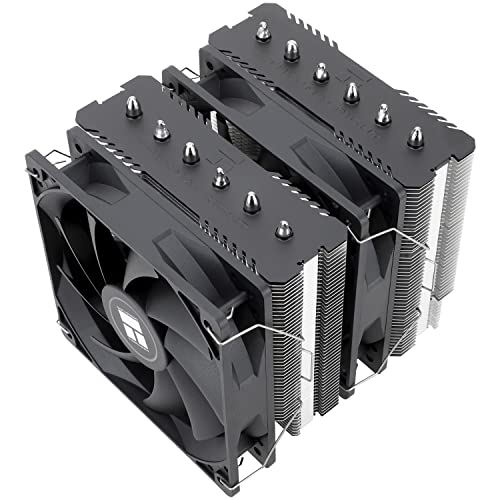
Thermalright Peerless Assassin 120 SE CPU Cooler, 6 Heat Pipes AGHP Technology, Dual 120mm PWM Fans, 1550RPM Speed, for AMD:AM4 AM5/Intel LGA 1700/1150/1151/1200/1851,PC Cooler
- Brand Origin: Taiwan-based with 20+ years experience
- Product Dimensions: 125x135x155mm (4.92x5.31x6.1 inches)
- Heat Sink Material: Aluminum for efficient cooling
As an affiliate, we earn on qualifying purchases.
As an affiliate, we earn on qualifying purchases.
Cooling Choices in the Evolution of AI Workstations
Historically, cooling solutions for high-performance computing have balanced thermal performance against reliability. Gaming and enthusiast markets often prioritize maximum thermal headroom, favoring liquid cooling. However, AI inference systems differ in their operational profile, often running 24/7 with minimal human oversight. Industry analyses, including insights from Thorsten Meyer AI, emphasize that for these applications, the focus shifts from peak temperatures to long-term dependability. Modern air coolers now rival mid-range AIOs in performance, challenging the notion that liquid cooling is always superior for sustained workloads.
"High-end air coolers can dissipate comparable heat loads to mid-sized AIOs, with lower noise and fewer failure points."
— Industry testing reports

ID-COOLING FX240 PRO 240mm AIO CPU Cooler, High-Efficiency Fans
- Premium AIO Cooler: Supports 300W TDP for gaming
- Powerful Pump: Runs at 2900RPM for efficient heat dissipation
- Extreme Cooling Fans: Two 120mm fans with high airflow and pressure
As an affiliate, we earn on qualifying purchases.
As an affiliate, we earn on qualifying purchases.
Unresolved Questions About Long-Term Liquid Cooler Performance
While modern AIOs are reliable, their lifespan under continuous operation is still being evaluated. The long-term effects of coolant permeation, seal degradation, and pump wear in 24/7 setups remain somewhat uncertain, and real-world data over multiple years is limited.
quiet all-in-one CPU liquid cooler
As an affiliate, we earn on qualifying purchases.
As an affiliate, we earn on qualifying purchases.
Monitoring and Future Developments in Cooling Technologies
Expect ongoing studies and user reports to clarify the long-term reliability of liquid coolers in AI inference rigs. Manufacturers may introduce more durable pump designs or refillable loop options. Meanwhile, system builders are advised to prioritize air cooling for unattended, long-duration workloads and consider liquid cooling only when thermal headroom is critical or case constraints prevent larger air coolers.

Thermalright Peerless Assassin 120 SE V2 CPU Cooler, Dual Tower, 1850RPM
- Cooling Type: Dual Tower CPU Cooler with 6 Heat Pipes
- Fan Size and Speed: Dual 120mm PWM Fans, 1850RPM
- Compatibility: Supports AMD AM4/AM5 and Intel LGA1700/1851
As an affiliate, we earn on qualifying purchases.
As an affiliate, we earn on qualifying purchases.
Key Questions
Is liquid cooling worth it for long-term AI inference rigs?
Generally, no. For most 24/7 inference systems, air cooling offers sufficient thermal performance with greater reliability and lower lifetime costs.
How often do liquid coolers need maintenance or replacement?
Liquid coolers typically last 5–7 years, with potential coolant permeation and seal degradation over time. Pumps are the most common failure point.
Can air coolers handle high TDP CPUs under continuous load?
Yes, high-end dual-tower air coolers often dissipate 200–250W, suitable for most workstation CPUs during sustained operation.
What about noise levels between the two cooling methods?
Quality air coolers tend to operate more quietly than AIOs, which have a constant pump hum adding to fan noise.
Are there specific scenarios where liquid cooling is necessary?
Liquid cooling is beneficial when thermal headroom is needed for overclocking or in cases where large air coolers cannot fit, or to export heat outside the case in warm environments.
Source: ThorstenMeyerAI.com