📊 Full opportunity report: Phone-photo Gauge Reading To Replace Clipboard Rounds on IdeaNavigator AI — validation score, market gap, and execution plan.

Get business pricing on tech for your team
- Business-only prices and quantity discounts
- Tax-exempt purchasing
- Multiple users, one account, clear invoices
TL;DR
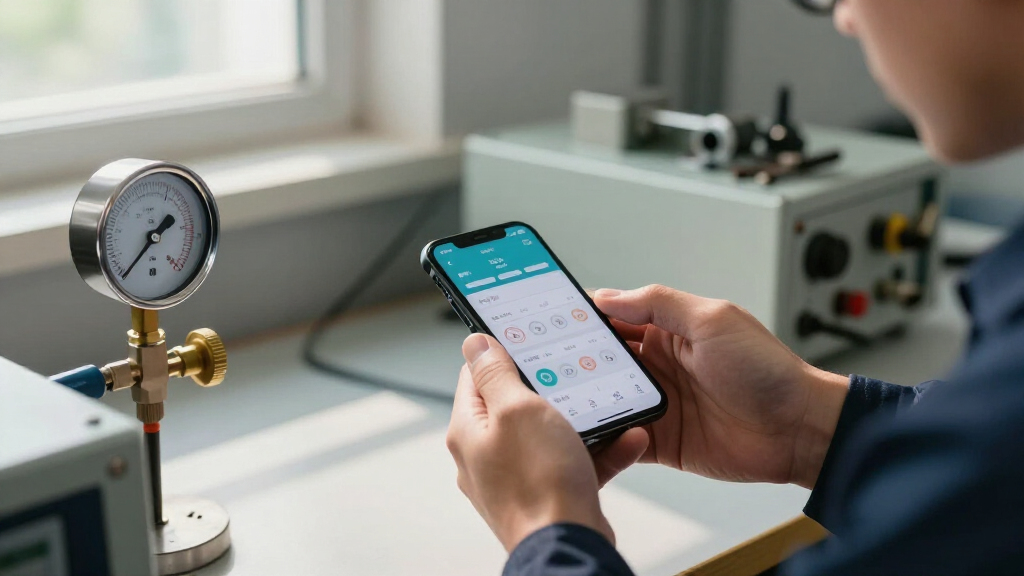
A pilot program is testing the use of phone photographs to record analog gauge readings, aiming to replace manual clipboard rounds. This approach could enhance data accuracy and trend tracking without costly sensor retrofits.
Industrial facilities are testing a new method that uses phone photographs to record gauge readings, replacing traditional clipboard rounds. This development aims to improve data accuracy, enable trend analysis, and reduce manual transcription errors, potentially transforming maintenance workflows across legacy equipment environments.
The pilot program involves technicians photographing analog gauges during their routine rounds. An app then automatically reads the gauge value from the photo, compares it to expected ranges, logs it with a timestamp and location, and flags anomalies in real-time. This process aims to eliminate transcription errors and provide continuous data streams for maintenance decision-making.
The initiative is currently being tested at three facilities, where parallel photo-and-clipboard rounds are conducted over a month. Early results will compare error rates and the ability to catch early failures, with the goal of validating the technology’s reliability and efficiency. The approach leverages recent advances in vision models capable of reading analog dials, sight glasses, and counters from standard phone photos, making it a cost-effective solution for legacy systems.
Industry experts see this as a promising step toward digital transformation in industrial maintenance, especially for facilities hesitant to retrofit expensive IoT sensors on aging equipment. The solution offers a low-cost, scalable way to generate actionable data from existing gauges, potentially reducing downtime and maintenance costs in the long term.
Potential Impact on Maintenance Data Collection
This technology could significantly improve the accuracy and timeliness of maintenance data, enabling facilities to detect issues earlier and plan interventions more effectively. By automating gauge readings, companies can reduce human error and improve operational reliability, especially in environments with extensive legacy equipment where retrofitting IoT sensors is cost-prohibitive.
Additionally, the ability to build trend histories from routine gauge photos can facilitate predictive maintenance strategies, ultimately reducing unplanned outages and maintenance costs. The shift from manual transcription to automated, photo-based logging represents a notable step toward digitalization of industrial workflows.
As an affiliate, we earn on qualifying purchases.
Legacy Equipment and the Need for Better Data
Many industrial plants operate with aging equipment that relies on analog gauges, sight glasses, and counters. Traditional methods involve technicians recording readings on paper or clipboards, then filing and manually entering data into systems. This process is prone to transcription errors, delays, and often results in data that is not easily analyzed or used for trend forecasting.
Recent advances in computer vision and machine learning have made it possible to reliably read analog gauges from photos taken with standard smartphones. This capability opens the door for a low-cost, scalable solution that can generate continuous, accurate data streams from existing legacy equipment without the need for costly sensor retrofits.
The idea has gained traction as facilities seek to modernize maintenance processes while managing budget constraints. Pilot programs are underway to evaluate how well phone-photo gauge readings perform compared to traditional methods, with initial tests focusing on error rates and anomaly detection capabilities.
industrial gauge reader smartphone
As an affiliate, we earn on qualifying purchases.
As an affiliate, we earn on qualifying purchases.
Uncertainties in Pilot Results and Scalability
It is not yet clear how consistently the phone-photo method will perform across different types of gauges and environmental conditions. The pilot program is ongoing, and results regarding error rates, anomaly detection accuracy, and overall reliability are still being analyzed. Additionally, questions remain about integration with existing maintenance systems and workflows, as well as the cost-effectiveness at scale.
As an affiliate, we earn on qualifying purchases.
Next Steps for Validation and Broader Adoption
The pilot at the three facilities will conclude within the coming months, with initial data comparisons expected shortly thereafter. If successful, the developers plan to expand testing to additional sites and refine the app’s algorithms. Long-term, the goal is to establish a standardized, low-cost workflow for facilities to adopt phone-photo gauge reading, potentially replacing manual clipboard rounds entirely in certain environments.
Further development may include integrating with maintenance management systems and expanding to other types of analog measurements, paving the way for broader digital transformation in industrial operations.
As an affiliate, we earn on qualifying purchases.
Key Questions
How accurate are phone-photo gauge readings compared to manual transcription?
Initial tests suggest that the vision models can read gauges with high accuracy, but comprehensive validation results are still pending. The goal is to match or exceed manual transcription accuracy while reducing errors.
Will this method work in low-light or dirty environments?
Performance in challenging conditions is still being evaluated. Improvements in image processing and lighting conditions during photo capture are areas of focus for ongoing development.
What are the costs associated with implementing this system?
The primary costs involve developing or licensing the app and training technicians to use it. Since it leverages existing smartphones and gauges, it is expected to be more affordable than retrofitting IoT sensors.
Can this method replace all manual rounds in the future?
While promising, the approach is likely to complement rather than fully replace manual rounds in the near term. Its effectiveness depends on the reliability demonstrated during pilot testing and integration with existing workflows.
How soon could facilities adopt this technology widely?
If pilot results are positive, wider adoption could occur within the next year, contingent on validation, system integration, and industry acceptance.
Source: IdeaNavigator AI
Halloween Picks
halloween
As an affiliate, we earn on qualifying purchases.