📊 Full opportunity report: Pre-Call Memory Cards For Relationship-Driven Sales: A How-To Guide on IdeaNavigator AI — validation score, market gap, and execution plan.

Get business pricing on tech for your team
- Business-only prices and quantity discounts
- Tax-exempt purchasing
- Multiple users, one account, clear invoices
TL;DR
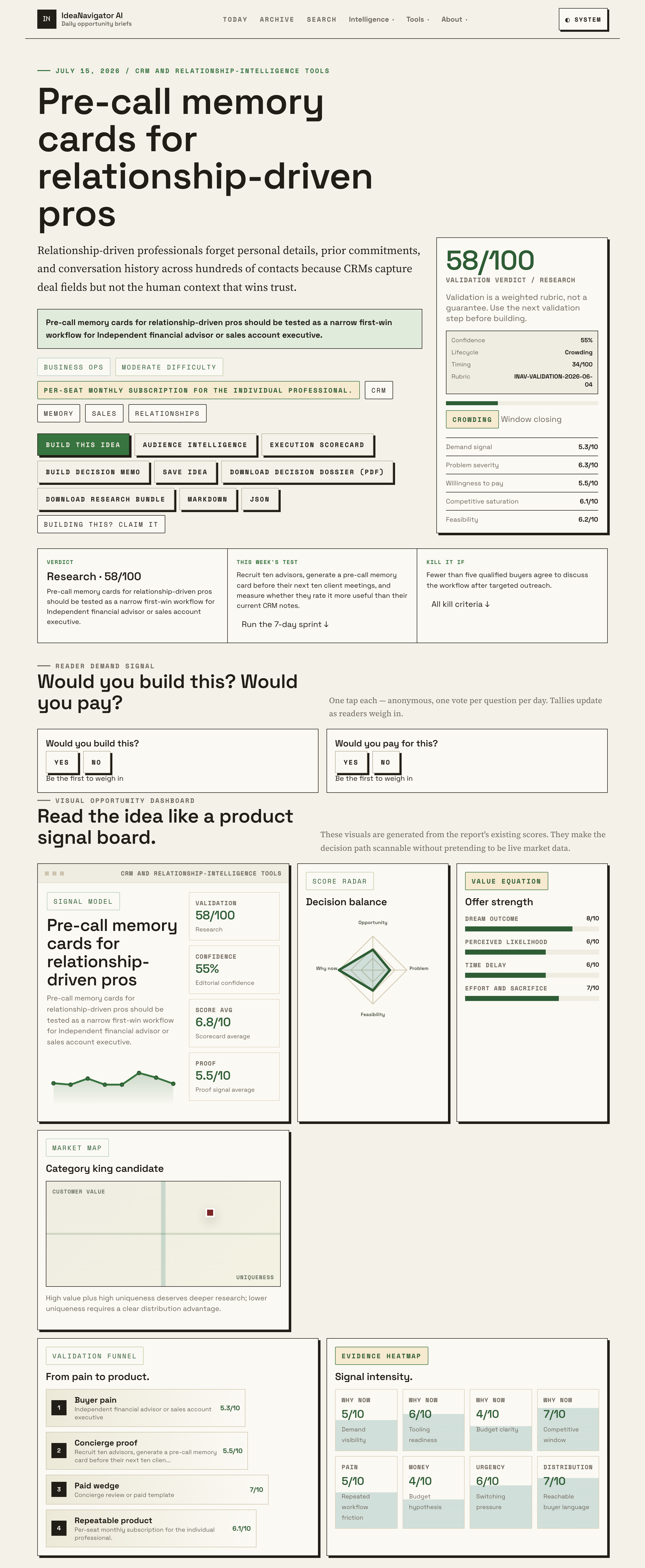
Pre-call memory cards are being tested as a new workflow for relationship-focused sales professionals. They aim to improve recall of client details using AI-generated summaries, potentially transforming CRM use.
Pre-call memory cards are being tested as a new workflow for relationship-driven sales professionals, such as independent financial advisors and sales account executives, to improve client engagement and trust. This development leverages recent advances in large-language-model summarization to create concise, searchable client profiles from past interactions, addressing longstanding CRM limitations.
The initiative focuses on developing a pre-call brief generator that connects a contact’s past emails and notes to produce a one-page memory card. This card summarizes who the client is, what was last promised, and any open threads, helping professionals recall key details quickly and accurately.
According to sources familiar with the project, this approach aims to fill the gap left by traditional CRMs, which often fail to capture the human context necessary for trust-building. The solution is expected to be offered via a per-seat monthly subscription model targeted at individual professionals.
Market validation involves recruiting ten advisors to test the memory cards before their next ten client meetings, with success measured by user ratings of usefulness compared to current CRM notes.
Why Pre-Call Memory Cards Could Transform Relationship Sales
This innovation could significantly improve the efficiency and effectiveness of relationship-driven professionals by providing quick, reliable access to relevant client context. It addresses a persistent challenge in sales: maintaining detailed, accurate, and accessible client history across many contacts.
By leveraging AI summarization, professionals may build stronger trust and improve client retention, potentially leading to better sales outcomes. The development reflects a broader trend of integrating advanced AI tools into CRM workflows to enhance human-centered sales processes.
As an affiliate, we earn on qualifying purchases.
Limitations of Current CRMs in Capturing Human Context
Traditional CRMs primarily focus on deal fields and transaction data, often neglecting the personal details and conversation history that foster trust in relationship-driven sales. This gap has long been recognized but remained unaddressed due to technical limitations.
The recent availability of large-language-model summarization makes it feasible to distill extensive conversation histories into compact, searchable summaries. This technological shift opens new possibilities for enhancing client engagement tools.
“AI-generated pre-call memory cards could bridge the gap between CRM data and the human context necessary for trust-building.”
— an anonymous researcher
As an affiliate, we earn on qualifying purchases.
Uncertainties About Implementation and Adoption
It is not yet clear how widely this workflow will be adopted or how effective it will prove in practice. The success of the initial testing phase and user acceptance remain to be seen, and technical challenges in integrating with existing CRM systems could arise.
Further validation is needed to confirm whether professionals find these memory cards more useful than traditional notes and whether they lead to measurable improvements in client trust and sales outcomes.
As an affiliate, we earn on qualifying purchases.
Next Steps for Testing and Validation
Developers plan to recruit ten advisors to test the pre-call memory cards over their next ten client meetings. Results from this pilot will determine whether the workflow warrants broader deployment. Additional iterations may focus on refining the summarization accuracy and integration ease.
If successful, the tool could be commercialized as a subscription service, with further enhancements based on user feedback and technological advances.
sales professional client engagement tools
As an affiliate, we earn on qualifying purchases.
As an affiliate, we earn on qualifying purchases.
Key Questions
How will the pre-call memory cards improve client interactions?
They provide a concise, AI-generated summary of the client’s recent interactions, promises, and open issues, helping professionals recall important details quickly and build trust more effectively.
What technology underpins these memory cards?
Large-language-model summarization technology is used to distill lengthy conversation histories into short, searchable summaries suitable for quick review before calls.
Who will have access to these memory cards?
The initial focus is on individual professionals, such as independent financial advisors and sales account executives, via a per-seat subscription model.
Are there privacy concerns with using AI to summarize client data?
Privacy considerations are expected to be addressed through secure data handling and compliance with relevant regulations, but specific measures are still under development.
When will this workflow be available for broader use?
Initial testing is underway, with broader deployment contingent on positive pilot results, likely within the next few months to a year.
Source: IdeaNavigator AI
Fall Picks
fall essentials
As an affiliate, we earn on qualifying purchases.