
TL;DR

Get business pricing on tech for your team
- Business-only prices and quantity discounts
- Tax-exempt purchasing
- Multiple users, one account, clear invoices
Siemens is shifting its AI focus from chatbots to physical factory applications, partnering with NVIDIA to develop an Industrial AI Operating System. The initiative aims to embed AI across manufacturing processes, leveraging Siemens’ domain expertise and proprietary data. The first AI-driven factory is expected in 2026, marking a significant move into industrial AI.
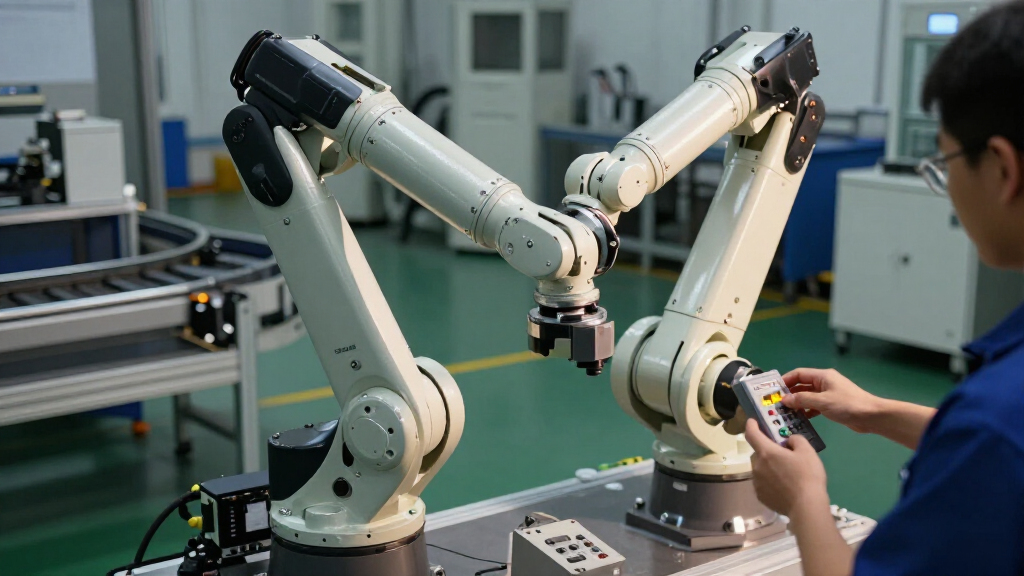
Siemens has announced a major strategic shift toward industrial artificial intelligence (AI), emphasizing the factory floor as the primary domain for AI deployment. The company revealed plans to develop an ‘Industrial AI Operating System’ in partnership with NVIDIA, aiming to embed AI across the entire manufacturing lifecycle. This move signifies a departure from focus on language-based AI, instead prioritizing physical-world applications that leverage Siemens’ extensive industrial data and domain expertise.
During CES 2026, Siemens CEO Roland Busch highlighted that ‘Industrial AI is no longer a feature; it’s a force that will reshape the next century,’ emphasizing the company’s focus on physical AI rather than chatbots or language models. Siemens’ core product is the Industrial Foundation Model (IFM), announced at Hannover Messe 2025, designed to process 3D models, 2D drawings, sensor telemetry, and automation logic to optimize engineering and manufacturing operations.
The partnership with NVIDIA aims to create a comprehensive platform—the ‘Industrial AI Operating System’—that integrates GPU-accelerated simulation, generative digital twins, and real-time optimization tools. Siemens plans to launch its first fully AI-driven, adaptive manufacturing site in Erlangen, Germany, in 2026, with additional tools like Digital Twin Composer and industrial copilots supporting various stages of the production process. Siemens’s existing customer base, including PepsiCo and Audi, will be key early adopters of these new AI tools.
Implications of Siemens’ Factory-Centric AI Strategy
This development marks a significant shift in industrial AI, emphasizing physical applications over language models. Siemens’ focus on leveraging proprietary industrial data and domain expertise could give it a competitive edge in manufacturing automation. The move also signals a broader industry trend toward integrating AI into factory operations, which could lead to increased efficiency, reduced costs, and new levels of automation. However, reliance on NVIDIA’s infrastructure raises questions about hardware dependency and geopolitical considerations for European buyers.
As an affiliate, we earn on qualifying purchases.
Background of Siemens’ Industrial AI Initiatives
Siemens has long been a leader in industrial automation and digital twin technology. Its announcement of the Industrial Foundation Model (IFM) in 2025 marked its entry into domain-specific AI, designed to process complex industrial data. The company’s partnership with NVIDIA, announced at CES 2026, builds on previous collaborations to accelerate simulation and digital twin capabilities. The focus on factory-floor AI is a strategic response to the limitations of general-purpose language models in manufacturing contexts, where physics and specialized data are paramount.
Previous industry efforts have struggled to translate AI advances into tangible factory improvements, but Siemens aims to change that with proprietary data, domain knowledge, and targeted AI models tailored for industrial use cases. The company’s existing relationships with major manufacturers position it to deploy these innovations at scale, although the long deployment timelines reflect the complexity of industrial transformation.
“Industrial AI is no longer a feature; it’s a force that will reshape the next century.”
— Roland Busch, Siemens CEO
As an affiliate, we earn on qualifying purchases.
Unconfirmed Performance and Deployment Details
While Siemens has announced plans for a fully AI-driven factory in 2026, specific hardware configurations, performance metrics, and deployment timelines remain undisclosed. The effectiveness of the platform and its scalability across different factory types are still unproven at this stage. Additionally, the reliance on NVIDIA’s infrastructure raises questions about independence and geopolitical implications, especially for European customers concerned about hardware sovereignty.
GPU-accelerated simulation software
As an affiliate, we earn on qualifying purchases.
As an affiliate, we earn on qualifying purchases.
Next Steps for Siemens’ Industrial AI Rollout
Siemens plans to demonstrate its first AI-powered factory in Erlangen in 2026, serving as a blueprint for global deployment. The company will also expand support for digital twin tools like Digital Twin Composer and introduce industrial copilots across various manufacturing stages. Monitoring performance metrics from these early implementations will be key to assessing the platform’s effectiveness and scalability. Siemens and NVIDIA will likely continue refining the operating system and expanding customer adoption over the coming years.
As an affiliate, we earn on qualifying purchases.
Key Questions
How is Siemens’ approach to industrial AI different from general-purpose AI models?
Siemens focuses on domain-specific models trained on proprietary industrial data, processing 3D models, sensor telemetry, and automation logic, rather than relying on language-based AI. This enables more accurate and relevant applications in manufacturing and engineering.
What are the main benefits Siemens aims to achieve with this AI platform?
The platform aims to improve manufacturing efficiency, enable real-time optimization, reduce downtime, and facilitate adaptive, AI-driven factory operations through digital twins and generative simulation.
What challenges does Siemens face in deploying this AI across factories?
Challenges include integrating new AI systems with existing infrastructure, demonstrating performance at scale, overcoming long industrial deployment cycles, and managing dependency on NVIDIA hardware and software.
Will this AI platform be available to other industries beyond manufacturing?
While Siemens’ primary focus is on manufacturing and automation, its AI models and tools could potentially be adapted for other sectors like automotive, pharmaceuticals, and energy, where complex physical processes are involved.
Source: ThorstenMeyerAI.com
Fall Picks
fall essentials
As an affiliate, we earn on qualifying purchases.