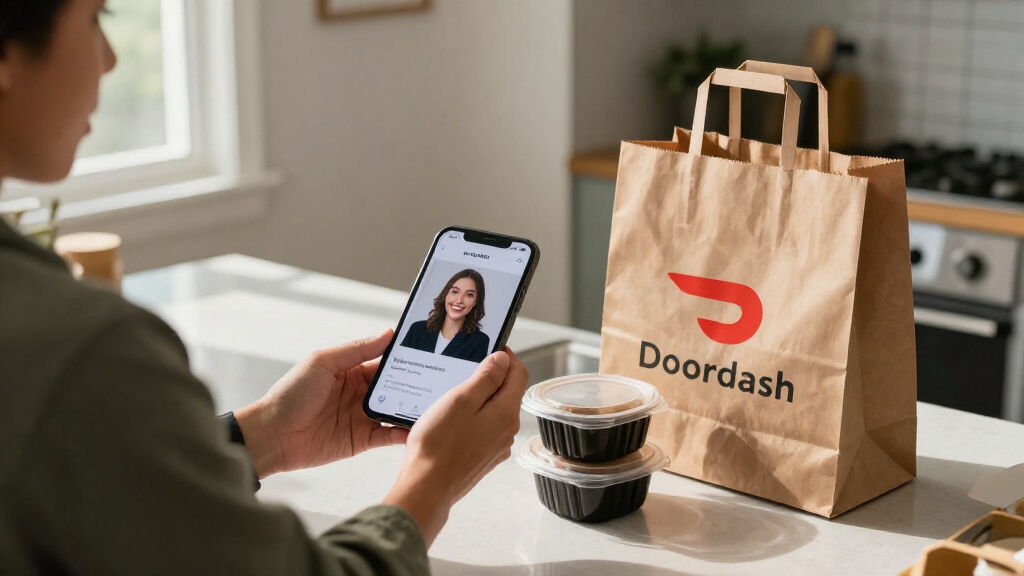

🔍 Read the full analysis: DoorDash Delivered 993 Million Orders Last Quarter. AI Agents Placed “Several Hundred.” A Reality Check On Agent Shopping on ThorstenMeyerAI.com

Get business pricing on tech for your team
- Business-only prices and quantity discounts
- Tax-exempt purchasing
- Multiple users, one account, clear invoices
TL;DR
DoorDash CEO Tony Xu said third-party AI agents have generated “maybe several hundred orders in total” since they began operating. DoorDash handled 993 million orders in the third quarter of 2026, but the figures cover different time periods, so they do not establish an exact quarterly share for agent orders.
DoorDash CEO Tony Xu said outside AI agents have generated “maybe several hundred orders in total” since they became available, describing the use case as low volume. The disclosure came as DoorDash reported 993 million total orders in the third quarter of 2026, underscoring the gap between the platform’s overall activity and the early use of third-party agents.
Xu gave the estimate during DoorDash’s Oct. 29 earnings call, in response to a question about whether the company would power food-ordering agents itself or leave that work to general-purpose agents such as Meta’s Muse. He said the area remained dynamic, but that for a straightforward task such as ordering food, most customers still use DoorDash’s app.
Xu repeated the estimate later in the call, saying agents had generated several hundred orders “across the time that they’ve been up and running.” He called it a “fairly low use case”. Asked whether agents could affect DoorDash’s advertising business or share in its revenue, he said advertising opportunities could emerge within AI agents, but that current volumes did not yet create that value.
DoorDash’s earnings release said third-quarter orders rose 28% year over year to 993 million. That total covers the three months ending in September; Xu’s estimate covers the agents’ full operating period, whose length and exact order count he did not specify. The figures therefore show a broad difference in scale, but do not support a precise same-period rate for agent orders.
Infographic 01 · The number
993 million orders. “Several hundred” from AI agents.
What DoorDash’s CEO said about orders placed by outside AI agents, next to the company’s own order count.
Drawn to scale
Q3 2026 orders vs. a generous upper bound for agent orders
The second bar is not missing. At this scale it is about one ten-thousandth of one percent wide.
“You never want to fight gravity. But at the same time, you don’t want to be delusional … we’re seeing maybe several hundred orders in total from some of these third-party agents.”Tony Xu, CEO of DoorDash · Q3 2026 earnings call, 29 Oct 2026
Sources: DoorDash Q3 2026 results (29 Oct 2026); DoorDash earnings call (29 Oct). Ratio and per-day figure: my calculation. “Several hundred” is a spoken, rounded figure.
Powered by Thorsten Meyer AI
Why Agent Orders Matter to DoorDash
DoorDash’s disclosure offers a concrete measure of how little outside agents currently contribute to ordering on one large delivery platform, despite growing attention to agent-led shopping. For the company, the immediate issue is practical: if customers continue to place orders in its app, DoorDash retains the direct relationship and the opportunities associated with its own interface, including advertising.
The estimate is not a complete measure of AI shopping. It covers third-party agents ordering through DoorDash, not every purchase influenced by an AI tool, nor transactions within a company’s own assistant. It also does not establish whether agents will remain marginal or become more common as checkout and payment systems change.
Xu said DoorDash sees potential advertising opportunities inside agents, but added that current volumes are too low for those opportunities to carry value. That makes the disclosure relevant to merchants and technology firms weighing whether to build agent shopping features, as well as to consumers deciding whether those tools are a convenient alternative to ordering directly.
Products Worth Considering

Anker SOLIX C1000 Gen 2 Portable Power Station

Bose SoundLink Flex (2nd Gen) Portable Bluetooth Speaker

Anker SOLIX S2000 Portable Power Station, 2,010Wh, 1,500W
As an affiliate, we earn on qualifying purchases.
Other Companies Report Early Agent Use
DoorDash’s comments came amid varied company statements about agent-led shopping. On Oct. 29, Amazon CEO Andy Jassy said few customers were doing much shopping through outside “horizontal agents” yet. He said the experience was not as good or convenient as researching or ordering directly from a retailer. His comments were about Amazon’s broader shopping business, not a reported count of agent orders on DoorDash.
Visa CEO Ryan McInerney said on Oct. 27 that the number of agentic transactions remained limited and described trust as a major barrier to growth. Meta CEO Mark Zuckerberg, speaking on Oct. 21, said more than 10 million people in the United States and Canada had set up its Muse personal agent in about six weeks, and that shopping was its most common use. Meta also reported an average purchase above $200. Those are Meta’s own figures; the source material does not provide an independently verified total sales value or show that these purchases were comparable to routine food orders.
The source account says DoorDash has described its approach as “atoms vs. bits,” pointing to investment in physical delivery infrastructure alongside software. It also cites warehouses, autonomous delivery and a proposed $17 billion Instacart deal. The account does not provide transaction details or status for that deal, so it should not be treated here as a completed acquisition.
““We’re seeing maybe several hundred orders in total from some of these third-party agents.””
— Tony Xu, DoorDash CEO, on the Oct. 29 earnings call
What the Order Estimate Leaves Open
Xu did not give an exact count, identify each agent included, or state precisely when the agents began operating. “Several hundred” is a rounded estimate, and the comments do not clarify whether it counts completed orders only or another measure. The time window differs from DoorDash’s third-quarter reporting period, so dividing one figure by the other would produce a misleading order share.
It is also unclear how much agent use occurs outside DoorDash’s direct ordering flow, or whether shoppers use AI to research a meal before completing the purchase themselves. Companies’ statements about agent activity use different measures, including people setting up an assistant, purchases, transactions and orders. Those measures are not directly comparable.
DoorDash did not provide a forecast for when agent orders might grow, a breakdown of their value, or details about any revenue-sharing arrangement with agents. Xu’s comments about possible advertising opportunities were prospective, not an announcement of a current commercial agreement.
Signals to Watch in Future Results
DoorDash’s next earnings updates may show whether the company gives a more specific count or discusses changes in agent-driven ordering. Investors and merchants will also be watching for signs of whether customers begin completing more purchases through third-party assistants rather than retailer or delivery apps.
Any change will depend in part on how companies address payment authorization, customer trust and checkout convenience, issues raised by Visa and Amazon as well as DoorDash’s low-volume estimate. For now, the confirmed figures show a large delivery business and a small, imprecisely measured level of orders attributed to outside agents—not a forecast of how quickly that balance may change.
Key Questions
How many orders have third-party AI agents placed through DoorDash?
DoorDash CEO Tony Xu said they had generated “maybe several hundred orders in total” across the period they had been operating. He did not provide an exact count.
How many orders did DoorDash handle in the third quarter of 2026?
DoorDash reported 993 million orders in the quarter, up 28% from a year earlier.
Can the agent estimate be compared directly with DoorDash’s quarterly total?
Not precisely. The 993 million figure covers the third quarter, while Xu said the agent estimate covered their full operating period. The company did not specify the agents’ start date or an exact count.
What did DoorDash say about AI agents and advertising?
Xu said advertising opportunities could develop within AI agents, but that current order volumes were too low for those opportunities to have value at present.
What do other companies say about agent shopping?
Amazon’s Andy Jassy said few customers were doing much shopping through outside agents yet, while Visa’s Ryan McInerney said agentic transactions remained limited and identified trust as a barrier. Meta has reported substantial setup numbers for its Muse agent, but those figures measure a different kind of activity.
Source: ThorstenMeyerAI.com