🔍 Read the full analysis: Falcon ASR: Exploring An AI Model For Speech on ThorstenMeyerAI.com

Get business pricing on tech for your team
- Business-only prices and quantity discounts
- Tax-exempt purchasing
- Multiple users, one account, clear invoices
TL;DR
The Technology Innovation Institute in Abu Dhabi has introduced Falcon-ASR, a 1.6-billion-parameter speech recognition model designed for Arabic, with a focus on Emirati speech. TII reports a 20.92% average word error rate across six Arabic test sets and 22.73% on an internal Emirati evaluation; the results are developer-reported and have not been independently replicated in the source material.
The Technology Innovation Institute (TII) in Abu Dhabi has introduced Falcon-ASR, a 1.6-billion-parameter speech recognition model designed for Arabic, particularly Emirati speech. TII reports a 20.92% average word error rate across six Arabic test sets and its lowest comparative error rates on an internal Emirati evaluation; the institute has made a demo available online. Read the original analysis of Falcon-ASR.
On the six Arabic test sets used by the Open Universal Arabic ASR Leaderboard, TII reports an average word error rate (WER) of 20.92%. The institute says the best published average in the leaderboard snapshot it checked was 23.17%, a difference of 2.25 percentage points. The snapshot was checked on September 30, 2026, so this is a comparison with results published by that date, not a claim about a live or permanent ranking. Lower WER means fewer word-level transcription errors.
For Emirati speech, TII reports 22.73% WER and 10.19% character error rate in an internal evaluation using held-out Emirati and Gulf recordings with human-validated transcripts. It says those were the lowest scores among the systems it compared, with Qwen3-Omni’s WER 4.07 percentage points higher. TII also reports a 5.74% mean WER on seven public English test sets used by the Hugging Face Open ASR Leaderboard. These figures are reported by the model’s developer.
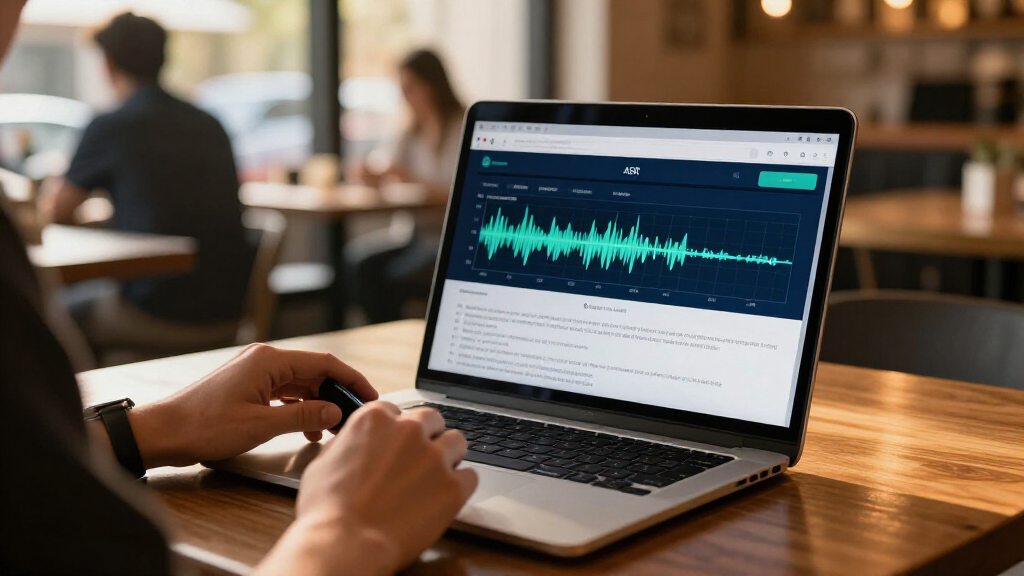
TII says Falcon-ASR supports Arabic, English, French, Spanish and Portuguese using the same model weights, without requiring a language flag. For another example of AI work involving voice and sound, see ByteDance’s SwanTale model. It returns word-level timestamps, which associate each transcribed word with its position in the audio. The institute says its training material included Emirati, Modern Standard Arabic, other Gulf and Arabic dialects, and English, with varied audio conditions such as noise, overlapping speech, music and telephone effects.
Dialect Recognition Beyond Formal Arabic
Arabic speech varies by region and setting, and dialectal speech is less represented in transcribed training material than Modern Standard Arabic. A system that works well on formal broadcasts may perform differently on casual conversation, phone calls or speakers who switch between dialects and languages. Falcon-ASR’s stated Emirati focus and reported evaluation address a practical test case that can be missed by assessments centered on formal Arabic.
If the reported performance carries over to everyday recordings, the model could be useful for meeting and call transcription, as well as tools built for Arabic-speaking users. Word-level timestamps may also help people locate passages in long recordings. But benchmark results apply to specified test material: they do not establish how accurately Falcon-ASR will transcribe every speaker, accent, device or noisy environment.
Arabic speech recognition software
As an affiliate, we earn on qualifying purchases.
As an affiliate, we earn on qualifying purchases.
How TII Tested the Model
TII says it followed the Open Universal Arabic ASR Leaderboard protocol and used the leaderboard’s pinned manifests. The leaderboard, maintained by the ELM Research Center, calculates an equal-weight average across six test sets. The institute compared its result with published entries in a snapshot checked on September 30, 2026. Because the comparison uses a dated snapshot, subsequent leaderboard submissions could change which result is highest.
The Emirati result comes from a separate internal evaluation, rather than the six-set leaderboard average. TII says it used held-out Emirati and Gulf recordings and human-validated transcripts, and points to the public Casablanca dataset, which includes a UAE subset. The source material does not provide individual scores for each Arabic test set or a complete description of the internal evaluation’s size and composition. TII says Falcon-ASR builds on its earlier Falcon3-Audio work.
““Our aim is to transcribe the words people use in everyday speech, including dialectal forms and switches between languages.””
— Technology Innovation Institute
multilingual speech to text transcription device
As an affiliate, we earn on qualifying purchases.
As an affiliate, we earn on qualifying purchases.
What the Reported Scores Leave Open
The published figures do not include a full breakdown by dialect, speaker or recording condition, and the source material does not list every system in TII’s internal Emirati comparison. The size and composition of that evaluation are also not specified. More detail would help readers judge how broadly the reported results apply.
The benchmark numbers are developer-reported; the source material does not describe an independent replication. Nor does it establish how Falcon-ASR performs outside the identified test recordings, including with accents, code-switching patterns or audio conditions not represented in those evaluations. The September 30 leaderboard snapshot can also become outdated as new results are published.
AI-powered voice recognition microphone
As an affiliate, we earn on qualifying purchases.
As an affiliate, we earn on qualifying purchases.
Demo Available, Releases Unscheduled
Users can try Falcon-ASR through TII’s Hugging Face Demo Space, which the institute says accepts recordings for transcription. TII has also said it plans to offer API access and native applications, but it has not announced release dates in the supplied material.
Further information that would clarify the model’s reach includes per-test-set and per-dialect results, fuller details about the internal Emirati evaluation, and independent testing. Until those details or additional products are available, the demo lets users inspect output on particular recordings, while the published benchmark scores describe performance only on the stated evaluation material.
Emirati dialect speech recognition tool
As an affiliate, we earn on qualifying purchases.
As an affiliate, we earn on qualifying purchases.
Key Questions
What is Falcon-ASR?
Falcon-ASR is a 1.6-billion-parameter speech recognition model introduced by Abu Dhabi’s Technology Innovation Institute. TII says it is designed for Arabic, with particular attention to Emirati speech, and also supports English, French, Spanish and Portuguese.
What results did TII report for Arabic?
TII reports an average 20.92% word error rate across six Arabic test sets in the Open Universal Arabic ASR Leaderboard protocol. It compared that result with a 23.17% best published average in a snapshot checked September 30, 2026.
How did Falcon-ASR perform on Emirati speech?
TII reports 22.73% WER and 10.19% character error rate on an internal evaluation of held-out Emirati and Gulf recordings with human-validated transcripts. The figures are reported by TII, and details about the evaluation’s size and full system comparison were not provided in the source material.
Can people try Falcon-ASR now?
Yes. TII says the model can be tried through its Hugging Face Demo Space. API access and native applications are planned, but no release dates were supplied.
Have the benchmark results been independently verified?
The supplied information does not describe an independent replication. The reported scores should be treated as TII’s results on the specified evaluations, not as independently confirmed performance across all speakers or real-world conditions.
Primary source: Hugging Face · via ThorstenMeyerAI.com
Halloween Picks
halloween
As an affiliate, we earn on qualifying purchases.