TL;DR
NVIDIA has added four open-weight checkpoints to its Cosmos 3 Nano family, aimed at interactive world simulation for autonomous driving and robotics. The models generate or predict observations from simulator controls, driving inputs, or robot actions; NVIDIA says each has 16 billion trainable parameters and uses the OpenMDW 1.1 license. Their performance for policy training and evaluation has not been established in the supplied material.
NVIDIA has added four open-weight checkpoints to its Cosmos 3 Nano model family for generating interactive simulated worlds, including synchronized driving-camera and LiDAR observations and video responding to robot actions. The announcement expands the company’s world-model development platform for researchers and developers working on autonomous driving and robotics; NVIDIA says each checkpoint has 16 billion trainable parameters and is released under the OpenMDW 1.1 license.

Get business pricing on tech for your team
- Business-only prices and quantity discounts
- Tax-exempt purchasing
- Multiple users, one account, clear invoices
The four models are Cosmos3-Nano-Transfer-Auto, which generates multi-view driving data with varied weather, lighting and time of day; Cosmos3-Nano-Sim-Auto, which streams synchronized camera and LiDAR observations for driving simulation; Cosmos3-Nano-Sim-Transfer, which turns simulator controls and text prompts into rendered video; and Cosmos3-Nano-Sim-Bimanual, which predicts video from robot or camera actions. NVIDIA describes all four as post-trained examples of Cosmos 3 Nano.
For driving, Transfer-Auto can generate video for up to 11 camera views, including fisheye views, and can jointly generate RGB video and LiDAR data. Its controls let users specify scene structure and traffic motion, while text prompts guide appearance. Sim-Auto is a streaming version derived from Transfer-Auto: it generates successive small observation chunks in a few denoising steps, using generated history and updated driving controls. NVIDIA says an external simulation runtime and World Scenario Map renderer are needed to update controls for closed-loop interaction.
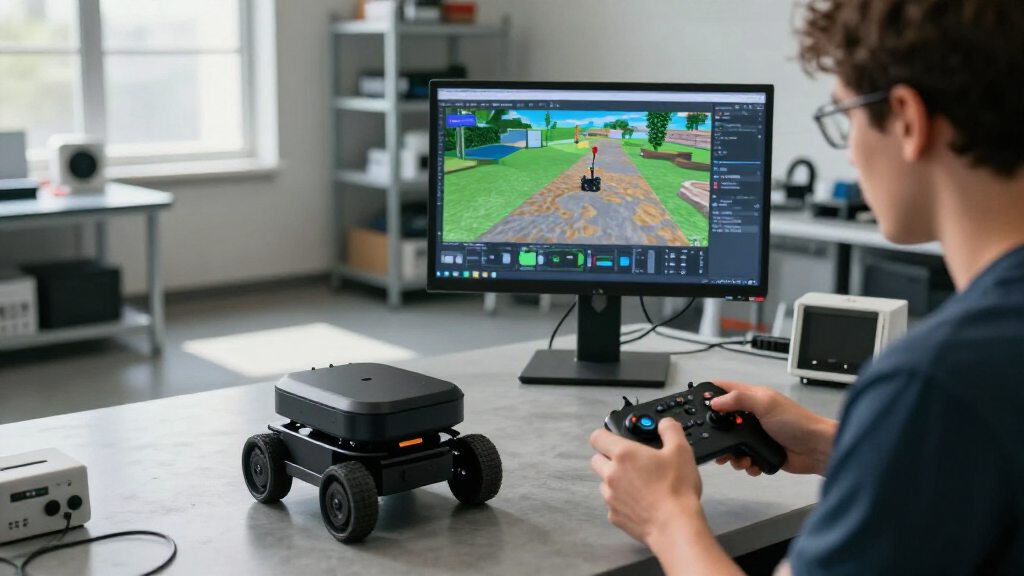
The two robotics-oriented checkpoints use different approaches. Sim-Transfer renders RGB observations from spatial information supplied by a physics simulator, such as depth, segmentation, edges and coarse layout; the simulator remains responsible for physical state and motion. Sim-Bimanual predicts how a scene changes in response to bimanual robot actions and supports the YAM and AgiBot embodiments, according to NVIDIA. The company links checkpoint downloads, inference instructions, notebooks and a technical report from its announcement.
Simulation Data for Driving and Robotics
The release addresses a practical bottleneck in training and evaluating embodied systems: models need varied observations and environments in which actions lead to changing scenes. Multi-view camera and LiDAR generation could give developers a way to vary road conditions and traffic scenarios, while the robotics models offer methods for producing visual responses to manipulation and viewpoint changes.
The checkpoints also divide the simulation task into distinct components. Sim-Transfer is designed to render observations while a physics simulator supplies state and controls; Sim-Bimanual predicts video from action sequences; and Sim-Auto targets streaming driving observations. That range may help teams test different world-model approaches, but the announcement does not establish that synthetic data improves real-world system performance. NVIDIA says further work is needed to measure how faithfully the models support policy learning and evaluation and to identify their limitations.
Open weights and post-training recipes give researchers a shared starting point to adapt models and compare methods. The license permits commercial and non-commercial use subject to its terms, but that permission alone does not answer questions about model accuracy, data quality or suitability for a particular deployment.
Products Worth Considering

DJI Osmo 360 Road Cycling First-Person Combo Action Camera

Sony WH-1000XM6 Wireless Noise-Cancelling Headphones (Black)

Apple Watch Series 12 GPS 46mm Smartwatch
As an affiliate, we earn on qualifying purchases.
How the Four Checkpoints Differ
NVIDIA presents the models as related checkpoints within its Cosmos world-model development platform, rather than as one simulator that handles every task. Transfer-Auto is an offline generation model: users supply scene controls and prompts to create driving data. Sim-Auto builds on that model through causal training and distillation, producing successive observations intended for interactive rollouts.
The distinction matters for adapting the models. NVIDIA says developers targeting a new vehicle sensor configuration or driving domain should first post-train Transfer-Auto on their own data, then distill it into Sim-Auto for streaming use. Sim-Transfer takes a separate route, translating simulator-provided spatial controls into visual observations, while Sim-Bimanual focuses on action-conditioned video for two-arm robot interaction.
These are vendor-described capabilities in NVIDIA’s report. The supplied material gives technical examples and access to a technical report, but it does not provide independent evaluations or benchmark results that would let readers compare the checkpoints with other systems.
“These problems remain hard: the work ahead is to measure where the models faithfully support policy learning and evaluation, understand their limits, and improve where they fall short.”
— NVIDIA, in its Hugging Face announcement
Performance and Deployment Questions
The announcement does not report independent benchmark results, quantified gains in policy performance, or evidence that the generated scenes reliably match real-world sensor data. It also does not establish how the four models perform across different environments, robot configurations or driving domains. NVIDIA identifies evaluation of fidelity and policy-learning usefulness as work still to be done.
Some features depend on supporting systems and correct inputs. Closed-loop Sim-Auto use requires a simulation runtime and renderer to update driving controls; LiDAR generation uses aligned HD-map range controls. Sim-Bimanual also relies on a specific action schema, including coordinate frames, gripper calibration and timing conventions. The announcement does not quantify the compute required, generation speed beyond describing Sim-Auto as using a few denoising steps, or the effort needed to adapt checkpoints for individual projects.
The source says use is allowed under the OpenMDW 1.1 license, but users should consult the license itself for its full conditions. The announcement alone does not settle how suitable the models are for safety-critical development or production use.
Evaluation and Model Adaptation
Researchers and developers can download the checkpoints and use the inference skills, notebooks and technical report linked in NVIDIA’s post to examine the models. Teams seeking a different driving sensor rig or domain can follow NVIDIA’s stated path of adapting Transfer-Auto first and then distilling it into Sim-Auto for streaming simulation.
The next substantive test is whether independent evaluations show that the generated observations are sufficiently faithful and useful for training or assessing driving and robotics policies. NVIDIA has not provided a schedule for such evaluations or announced a further release date in the supplied material. Until those results are available, the models’ practical value remains a question for testing rather than a demonstrated outcome.
Key Questions
What did NVIDIA announce?
NVIDIA announced four open-weight Cosmos 3 Nano checkpoints for interactive driving and robotics simulation: Transfer-Auto, Sim-Auto, Sim-Transfer and Sim-Bimanual.
What can the driving models generate?
Transfer-Auto generates synchronized driving video across up to 11 camera views and can jointly generate RGB and LiDAR data. Sim-Auto is designed to stream successive camera and LiDAR observations using driving controls and generated history.
Do the models replace a physics simulator?
No. NVIDIA says Sim-Transfer renders visual observations from spatial controls while the simulator computes motion, contacts and physical state. Closed-loop Sim-Auto also requires a simulation runtime and renderer to update its controls.
Can the checkpoints be used commercially?
NVIDIA says the models use the OpenMDW 1.1 license, which permits commercial and non-commercial use subject to its terms. Users should review the license for the applicable conditions.
Has NVIDIA shown that the models improve policy performance?
The supplied announcement does not provide evidence of improved policy performance or independent benchmark results. NVIDIA says measuring how faithfully the models support policy learning and evaluation remains part of the work ahead.
Source: huggingface.co