
🔍 Read the full analysis: What Happens When OpenAI Splits Its Robotics Team And Runway Opens Praxis-1? on ThorstenMeyerAI.com

Get business pricing on tech for your team
- Business-only prices and quantity discounts
- Tax-exempt purchasing
- Multiple users, one account, clear invoices
TL;DR
OpenAI has disbanded its stand-alone robotics team, moving its researchers into the company’s broader research and applied organizations. Two days before the change was reported, Runway released Praxis-1, an open-weight robot model; early results suggest general-purpose models can handle more simulated tasks, while specialist models act much faster.
OpenAI has broken up its stand-alone robotics team, moving researchers into its main research organization and applied robotics and hardware teams into its Applied organization, Fortune reported Nov. 13. The change came as Runway released Praxis-1, a dedicated robot model with downloadable weights, putting two different approaches to robot control in focus: general-purpose AI models and systems built specifically for physical actions.
OpenAI confirmed the reorganization to Fortune, which reported that robotics researchers now report to Chief Research Officer Mark Chen, while applied robotics and hardware teams moved under the Applied organization, led by President Greg Brockman. Fortune found the company’s registered booth empty at the CoRL robotics conference in Austin. OpenAI had not published its own announcement about the change as of Nov. 14.
The company’s explanation, as relayed by Fortune, is that its frontier general-purpose models, including GPT-6 Astra, have shown they can be applied directly to robotics. OpenAI’s spokesperson described the reorganization as a sign of commitment rather than a retreat, saying robotics remains part of the company’s long-term vision. That rationale is distinct from the cost pressures Fortune cited as broader business context; OpenAI did not give cost-cutting as its stated reason for the move.
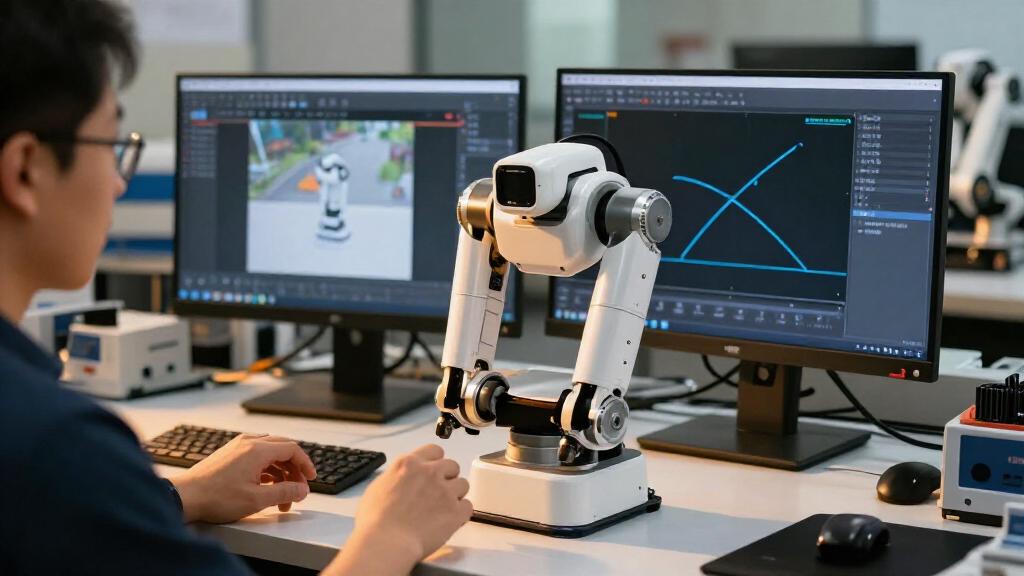
Runway’s Praxis-1 is a 27-billion-parameter “world action model” released with weights and fine-tuning code under the Apache 2.0 license. In the reported RoboLab-120 results, Praxis-1 scored 46.2%, the highest among world action models and open-source robot models on that leaderboard, and fifth overall. The benchmark is a simulation of 120 tabletop tasks for a single robot arm; its scores do not by themselves establish performance on physical robots in everyday settings.
Robot control loop · explainer
Who decides the robot’s next move?
Every robot repeats one loop: cameras see, a model decides, the arm moves. The two bets in this story put a different kind of model into the decide step.
Option 1
A general model in the loop
Example: GPT-6 Astra in NVIDIA’s simulation study
18.56 s per model call on average in the direct set-up. Inference was 97.0% of the estimated episode time; the simulation paused while the model was thinking.
Option 2
A specialist robot model in the loop
Example: Runway’s Praxis-1, a world action model with open weights
About 0.55–0.6 s per call on one H100 server, and each call returns 1.6 s of motion. Needs fine-tuning data for each robot.
General model plans the next stepslow, outside the loop
Option 3 · illustrative
Both, in two layers
The idea Runway and the NVIDIA researchers both describe
Runway calls the two approaches “complementary”: an agent plans, a fast policy carries out each step. NVIDIA’s authors say the best way to combine them “remains an open question”.
Sources: NVIDIA Seattle Robotics Lab, “Astranomy” study of GPT-6 Astra, Oct 14, 2026 (simulation, direct set-up); Runway, Praxis-1 technical report, Nov 2026 (one H100 server). Loops and timelines are schematic; the two figures come from different set-ups, not from a head-to-head test.
Graphic: Powered by Thorsten Meyer AI
Speed Versus Simulated Task Success
The early comparison highlights a practical trade-off for robotics developers. In a study by researchers at NVIDIA’s Seattle Robotics Lab, an agent using GPT-6 Astra achieved a 74.8% success rate on RoboLab-120 in an agentic setup. The researchers said that result surpassed the best policy on the benchmark leaderboard by 23.8 percentage points. But in the study’s direct setup, each model call averaged 18.56 seconds, with the simulation paused while the model processed its response.
Praxis-1’s reported performance was lower on the same benchmark, but Runway said it took about 0.55 to 0.6 seconds per call to produce 1.6 seconds of motion. Runway also reported that, on one of its robots completing three tasks, GPT-6 Astra took 15.6 times longer and cost 51 times more per completed task than Praxis-1. Those figures are Runway’s own test results, not an independent head-to-head evaluation. Together, the results point to a deployment question: a model’s ability to solve many kinds of tasks may not be enough if it responds too slowly or expensively for real-time control.
The distinction matters for companies building robots because control systems must balance task flexibility with response speed, operating costs and reliability. The evidence available here is preliminary and comes from a simulation study and a company-run robot test. It does not settle which approach will work better across different machines, environments or tasks.
Products Worth Considering

Logitech MX Mechanical Wireless Illuminated Keyboard, Tactile Quiet, Graphite

Apple AirPods Pro 3 Wireless Earbuds with Active Noise Cancellation

Samsung 37-inch Odyssey G7 4K UHD Curved Gaming Monitor
As an affiliate, we earn on qualifying purchases.
OpenAI’s Robotics Strategy Shifts
OpenAI rebuilt a robotics team in 2024 after winding down an earlier stand-alone effort in 2020. The company partnered with humanoid maker Figure during the later effort, but Figure said in February 2025 that it would develop its own robot AI, ending the partnership. OpenAI has also said it is developing a humanoid robot; CEO Sam Altman has targeted a public demonstration in 2027.
Earlier this year, OpenAI researchers had expected to build on video models such as Sora, according to the company spokesperson quoted by Fortune. The spokesperson said later progress with general-purpose models changed that direction. Fortune reported the team move on Nov. 13, and The Decoder’s Nov. 14 account drew on Fortune’s reporting. The NVIDIA study cited in those reports was published Oct. 14 as a CoRL 2026 late-breaking result.
Runway’s release represents a contrasting path: a model made specifically for robot actions, with weights and code available for modification and commercial use under its stated license. Runway has called general-purpose and specialist approaches “complementary”, rather than presenting Praxis-1 as proof that broader models cannot control robots.
“The two approaches are complementary.”
— Runway
What the Early Tests Cannot Show
It is not yet clear how the reorganized teams will operate day to day, what projects or staffing changes may follow, or whether OpenAI will publish a formal explanation. The available reporting describes where teams now sit inside the company, but not the full scope of the organizational changes.
The performance figures also have limits. GPT-6 Astra’s 74.8% result comes from a particular agentic setup in a simulated benchmark, while Praxis-1’s speed and cost comparison comes from Runway’s own test on one of its robots and three tasks. The source material does not provide an independent replication of that comparison or enough information to judge how either system performs across varied physical environments. The figures should not be treated as directly interchangeable measures.
It remains uncertain whether general-purpose models can meet the latency and cost requirements of real-world control, whether specialist models can match their breadth, and how the two approaches might be combined. OpenAI has not publicly detailed how its humanoid-robot plans relate to the new team structure.
Next Tests and OpenAI’s Plans
The next useful evidence will come from tests that compare general-purpose and specialist models under the same conditions, including real-world tasks, response times, costs and reliability. Further results from the CoRL research community may add detail, but the current benchmark evidence does not answer those questions on its own.
For OpenAI, the near-term indicators are whether it shares more information about the new reporting structure and how the robotics work connects to its stated humanoid plans. Altman’s previously stated target for a 2027 public demonstration remains a future milestone, not confirmation of a date or of what the demonstration will show. Runway’s released weights and fine-tuning code give outside users a way to examine and adapt Praxis-1, though no broader independent results are included in the reports cited here.
Key Questions
What changed in OpenAI’s robotics organization?
According to Fortune, OpenAI moved its robotics researchers into the main research organization under Mark Chen and moved applied robotics and hardware teams into the Applied organization under Greg Brockman. The company confirmed the reorganization to Fortune.
What is Runway’s Praxis-1?
Praxis-1 is a 27-billion-parameter robot model released with weights and fine-tuning code under the Apache 2.0 license. Runway describes it as a world action model.
Which model performed better on RoboLab-120?
In the cited results, GPT-6 Astra reached 74.8% success in an agentic setup, while Praxis-1 scored 46.2%. The tests and reporting do not establish a complete, independent comparison of the systems in real-world use.
Why might a specialist model still be useful?
The reported results suggest a speed advantage: Praxis-1 took about 0.55 to 0.6 seconds per call for 1.6 seconds of motion, while calls in GPT-6 Astra’s direct study setup averaged 18.56 seconds. Real-world performance will require further testing.
Has OpenAI abandoned plans to build robots?
OpenAI’s spokesperson told Fortune that the company remains committed to robotics. OpenAI has previously said it is developing a humanoid robot, with Sam Altman targeting a public demonstration in 2027; the latest reports do not clarify how the reorganization affects that work.
Source: ThorstenMeyerAI.com