
🔍 Read the full analysis: How AI Shapes The Exhibition-Like Ending Of “After Action” on ThorstenMeyerAI.com

Get business pricing on tech for your team
- Business-only prices and quantity discounts
- Tax-exempt purchasing
- Multiple users, one account, clear invoices
TL;DR
After Action is a fictional, AI-built exhibition presented as a Wing V debrief theater, where a continuous credit roll links 24 web experiences and pauses for miniature scenes. The source describes how JavaScript, CSS and accessibility features shape the experience, while distinguishing code-generated effects from a locally stored poster image. It is an art-and-design project, not a report about a real company or military activity.
After Action, a live AI-built exhibition described as room 125 of 175 in the FABLE/175 project, presents 24 fictional web experiences as the closing credits of an imagined Wing V theater, as detailed in the original analysis. Rather than arrange the sites in a conventional gallery, the page moves visitors through a continuous, navigable credit roll, interrupted by miniature scenes made with CSS; its framing is theatrical, not an account of real military operations.
The project’s central device is a single moving credit track. JavaScript tracks elapsed time and moves the credits with a transform, while chapter stops coordinate a time display, location marker, section label and jump controls. Visitors can pause or move between sections, instead of following links that pass by in an uncontrolled scroll. The source says the names in the moving roll are removed from keyboard focus; a separate, stationary linked index offers another way to reach the same material.
After roughly every eight productions, the roll gives way to a CSS-built sand-table scene. Perspective, tilted terrain, layered contour gradients and raised markers create small tableaux suggesting a shield formation, a catapult’s arc and two keys approaching a shared lock. The scenes are visual interludes, not depictions of real events. An intersection observer activates each one as it enters the visible area, limiting offscreen animation.
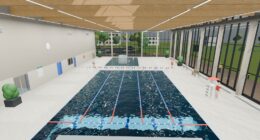
The design uses cinema black, beam white, sand amber and credit gold, with condensed display lettering for titles and monospace text for controls and labels. Letterbox bars, grain, registration marks and a projected beam reinforce the screening-room conceit. The described build also layers visual effects over a locally stored poster image. Its intended ambient video was unavailable, so the page uses that still image with effects instead; the dioramas and atmospheric layers are code-generated, but the hero visual is not.
FABLE / 175 · ROOM 125 · PROJECT ANALYSIS
How AI Shapes the Exhibition-Like Ending of “After Action”
After Action turns 24 fictional web experiences into the closing credits of an imagined Wing V theater. Its moving roll, chapter controls, linked index, and CSS-built scenes make browsing feel like a staged ending. The project is fictional and does not report real military activity.
01 / Browse by sequence
A Credit Roll Becomes the Gallery
Instead of presenting 24 projects as a conventional grid, the exhibition connects them through pacing, sequence, and a shared fictional production.
Navigation · Motion
One moving track
JavaScript tracks elapsed time and moves the credits with a transform. Chapter stops coordinate a time display, location marker, section label, and jump controls.
Visitor control
Choose the pace
Visitors can pause or move between sections, making the timed presentation navigable instead of leaving every link to pass by in an uncontrolled scroll.
Alternate route
A stationary index
The moving names are removed from keyboard focus. A separate linked register offers another way to reach the same projects without following the roll.
02 / The exhibition rhythm
Credits, Pauses, Miniature Scenes
Roughly every eight productions, the credits give way to a small sand-table tableau: a visual interlude built from code.
Enter the theater
A poster still, letterbox bars, grain, registration marks, and a projected beam establish the screening-room conceit.
Follow the roll
A continuous track links 24 fictional web experiences as productions in an imagined Wing V film.
Pause at a scene
Tilted terrain, contour gradients, and raised markers suggest a shield, a catapult arc, and two keys near a shared lock.
Return or browse
Chapter controls, manual motion options, and the linked register provide routes through the collection.
03 / What the interface claims
Designed Intent, Not Verified Results
The source describes interaction and accessibility features, but does not provide independent test results for the live site.
The widths and motion behaviors are stated targets in the brief, not measured test results. The source says reduced-motion settings allow manual scrolling and that animation pauses when the tab is hidden or the theater is not actively playing.
04 / Source boundaries
What Is Known — and What Is Not
The supplied account mixes a project description with an art-direction brief. Their claims should be read at that level.
| Topic | Described in the source | Not established |
|---|---|---|
| Visual construction | Terrain scenes and atmospheric layers are code-generated; the hero uses a local poster still. | Whether ambient video has since been restored. |
| Accessibility | A linked index, keyboard focus styles, reduced-motion support, and pause behavior are specified. | Independent testing of accessibility, contrast, or tap targets. |
| Responsive design | Targets are given for 390, 834, and 1,440 pixel layouts. | Measured performance or layout results across devices. |
| AI contribution | The material calls the exhibition AI-built and includes a brief for an AI coding agent. | Which AI systems produced which parts or a documented development history. |
| Project status | A live room is listed at fable-25-830.netlify.app/sites/aftermath/. | Publication date, named builder, later changes, or future milestones. |
05 / Key questions
Inside the Imagined Theater
A concise guide to the project’s format, technology, and limits.
What is After Action?
A fictional, AI-built exhibition page presenting 24 web experiences as productions in an imagined Wing V theater.
How are the projects presented?
Through a continuous, navigable credit roll with chapter controls and links, interrupted by miniature CSS-built scenes. A stationary linked index provides another route.
Are all visuals generated with code?
No. The terrain scenes and atmospheric layers are code-generated, while the theater hero uses a locally stored still image.
What remains unknown?
The account does not establish whether video was restored, whether the live implementation changed, or whether its accessibility and performance targets were independently tested.
A Credit Roll Becomes the Gallery
After Action makes the way visitors browse part of the exhibition’s subject. A standard grid would expose 24 projects as separate items; the credit roll instead connects them through sequence, pacing and a shared fictional production. Its format turns the act of moving through a portfolio into a staged ending, with each miniature acting as a break in the credits rather than a separate gallery tile.
The technical choices also show how a visually elaborate concept can include alternate routes and motion controls. The stationary linked register supports navigation outside the moving credits, reduced-motion settings offer manual scrolling, and animation pauses when the page is hidden or the theater is not actively playing. Those details matter because a cinematic interface can otherwise make content harder to reach or read. The source describes design intentions and implementation, not independent testing of accessibility or performance.
As an affiliate, we earn on qualifying purchases.
From FABLE Brief to Theater
The project is identified in the supplied material as “After Action — Wing V Debrief Theater”, room 125 in a collection of 175. Its underlying art-direction brief calls for an end-credits cinema over a sand-table, with all 24 Wing V rooms credited as productions and linked to their own site paths. The brief specifies a single-page build using HTML, CSS and JavaScript, with no frameworks, build step, CDNs or external requests.
The brief also sets a design and engineering target: responsive layouts at 390, 834 and 1,440 pixels, keyboard focus styles, readable contrast, reduced-motion support and animation that stops when a browser tab is hidden. These are stated requirements, not measurements independently verified by the source. The page’s accessible linked index and code-generated scenes are described separately from the local poster image, making clear that “built with code” does not mean every visual is generated procedurally.
““War, staged. Craft, real. — WING V / FABLE 125””
— The project’s art-direction brief
As an affiliate, we earn on qualifying purchases.
What the Source Does Not Verify
The supplied account does not give a publication date, identify a named individual as the builder, or provide independent evaluation of the live site. It describes the interaction and accessibility features, but does not report test results confirming that the page meets its stated responsive, contrast, tap-target or frame-rate targets across devices.
The source says the ambient video was unavailable in the described build and that a local still image stands in for it. It does not say whether video has since been restored or whether the live implementation has changed. The project’s fictional Wing V setting should not be read as evidence of real military activity or a real company.
interactive web experience development kit
As an affiliate, we earn on qualifying purchases.
As an affiliate, we earn on qualifying purchases.
The Live Room and Its Index
The project is available at fable-25-830.netlify.app/sites/aftermath/, according to the supplied material. Visitors can follow the timed credit roll, use its chapter controls or choose the stationary linked register to browse the 24 productions. The source gives no announced release schedule, planned update or next milestone, so further changes to the room remain unknown.
As an affiliate, we earn on qualifying purchases.
Key Questions
What is After Action?
After Action is a fictional, AI-built exhibition page that presents 24 web experiences as productions in an imagined Wing V theater. The supplied source explicitly says it is not a real company or an account of real military activity.
How does the exhibition present the 24 projects?
It uses a continuous, navigable credit roll with chapter controls and links, interrupted by miniature CSS-built scenes. A stationary linked index provides another route through the projects.
What role does AI play in the project?
The material describes an AI-built exhibition and includes an art-direction brief for an AI coding agent. It does not specify which AI systems produced which parts of the work or independently document the development process.
Are all the visuals generated with code?
No. The source says the terrain scenes and atmospheric layers are code-generated, while the theater’s hero uses a locally stored still image. An intended ambient video was unavailable in the described build.
What is still unknown about the live site?
The supplied account does not establish whether the ambient video has since been restored, whether the implementation has changed, or whether the stated performance and accessibility targets have been independently tested.
Source: ThorstenMeyerAI.com
Halloween Picks
halloween
As an affiliate, we earn on qualifying purchases.