
📊 Full opportunity report: How Youth-Services Vendors Can Document Parental Consent on IdeaNavigator AI — validation score, market gap, and execution plan.

Get business pricing on tech for your team
- Business-only prices and quantity discounts
- Tax-exempt purchasing
- Multiple users, one account, clear invoices
TL;DR
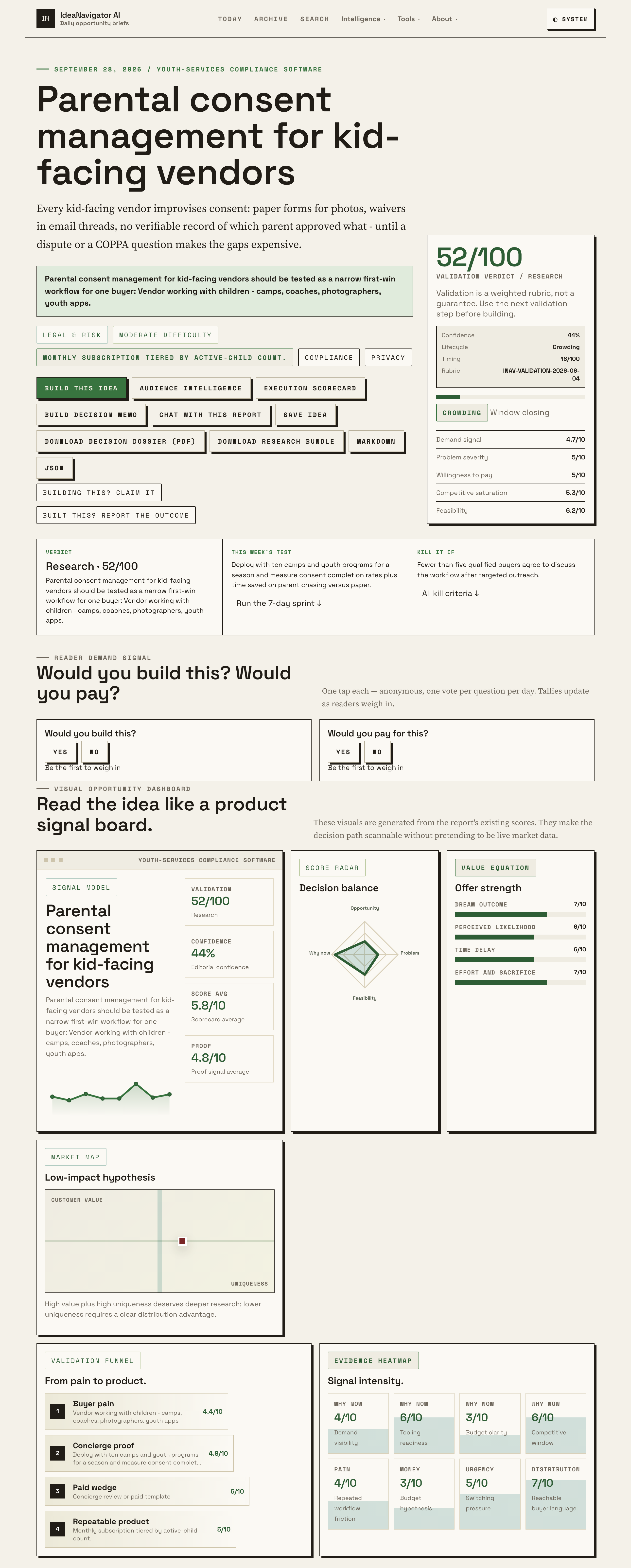
IdeaNavigator AI has published a product blueprint recommending that vendors serving children — camps, coaches, photographers and youth apps — replace improvised paper and email consent with verifiable digital consent records. The proposal cites expanding children’s privacy enforcement and growing parent challenges over photo and data use as the driving pressure.
IdeaNavigator AI has published a product blueprint arguing that vendors who work with children — camps, coaches, photographers and youth apps — should replace improvised paper forms and email-thread waivers with verifiable digital parental consent records. The proposal frames parental consent management as a narrow, buildable first product for the youth-services compliance software market, and says expanding COPPA enforcement and state privacy laws have turned sloppy consent practices into an expensive liability for even the smallest operators.
According to the blueprint, the core problem is that most kid-facing vendors have no systematic way to prove which parent approved what. Photo permissions live on paper forms, liability waivers sit in email threads, and medical authorizations are collected verbally or on documents that are rarely retained. The result, the analysis states, is that “no verifiable record of which parent approved what” exists until a dispute or a COPPA question makes the gaps expensive.
The proposed minimum viable product is a vendor-branded consent flow that parents complete on their phones. It would cover four consent categories — photo use, data collection, medical authorization and liability — with identity verification scaled to the risk level of each consent type. Every child would have a per-child consent ledger, and the system would track when consents expire and allow instant audit export so a vendor can produce records on demand when a parent, regulator or insurer asks.
The business model proposed is a monthly subscription tiered by active-child count, which the blueprint positions as affordable for small seasonal operators while scaling with larger programs. The recommended validation path is direct: deploy with ten camps and youth programs for one season and measure consent completion rates and time saved chasing parents, compared against paper-based workflows.
Why Small Youth Vendors Face Rising Consent Risk
The blueprint’s central claim is that the regulatory environment around children’s data has shifted faster than the operational practices of small vendors. COPPA updates and a growing patchwork of state privacy laws have expanded what counts as regulated children’s data collection, and the analysis notes that parents are increasingly challenging photo and data use directly. For a camp director or independent photographer, a single contested photo release with no retrievable record can mean legal costs that dwarf the price of a subscription tool.
For software builders and investors, the significance is that the blueprint identifies a wedge market: a narrow, repetitive workflow with a clear buyer, a measurable before-and-after, and low technical complexity relative to healthcare or financial compliance. If the ten-program validation season confirms that digital flows improve completion rates and cut administrative time, the same ledger-and-expiry architecture could extend to schools, sports leagues and childcare providers — segments the analysis groups under youth-services compliance software.
Top picks for "youth servic vendor"
As an affiliate, we earn on qualifying purchases.
The Paper-and-Email Status Quo Being Replaced
Youth-serving organizations have historically handled consent through paper registration packets, printed photo releases and emailed waivers, often collected once per season and stored inconsistently. This works tolerably until something goes wrong — a custody dispute over photos, a medical decision made without documented authorization, or a regulator asking a youth app vendor to demonstrate parental consent under COPPA.
At the same time, children’s privacy enforcement has broadened. COPPA, the U.S. federal rule governing data collection from children under 13, has seen updated rules and stepped-up enforcement attention, while a number of states have passed their own minors’ privacy statutes. Large platforms have built consent infrastructure in response, but the blueprint’s premise is that small independent vendors have been left to improvise, creating the gap a targeted product could fill.
What the Blueprint Has Not Yet Proven
The proposal is a concept document, not a shipping product — no company, vendor deployment or completion-rate data currently exists behind it. The claim that parents are increasingly challenging photo and data use is presented as market reasoning rather than cited research, and the breadth of recent COPPA and state-law enforcement against small youth vendors is not quantified in the analysis.
Several operational questions remain unanswered: what identity verification method would satisfy regulators at each risk tier, how consent ledgers would hold up as legal evidence in a custody or liability dispute, whether seasonal camps will pay recurring subscriptions during off-months, and how the tool would handle divorced or shared-custody situations where approval authority is contested. None of these are addressed in the published blueprint.
The Ten-Camp Validation Season
The blueprint’s own next step is a field validation with ten camps and youth programs over a single season, tracking two metrics: consent completion rates on mobile flows versus paper, and administrative hours saved chasing parents for signatures. Builders acting on the concept would need to recruit those pilot programs, define the risk-tier verification levels, and decide pricing before the summer season, since camp registration windows are when consent volume peaks.
For vendors serving children, the practical near-term takeaway is narrower: audit what consent records currently exist, identify which consents have expired or were never documented, and watch whether regulators in their state extend minors’ privacy rules to their category. The wider youth-services compliance software space will show whether subscription consent tooling becomes standard or remains a niche product.
Source: IdeaNavigator AI
Key Questions
A vendor-branded mobile consent flow covering photo use, data collection, medical and liability consents, with risk-tiered identity verification, a per-child consent ledger, expiry tracking and instant audit export, sold as a monthly subscription tiered by active-child count.
Who is the target customer for this consent platform?
Small vendors working with children — camps, coaches, photographers and youth apps — that currently rely on paper forms and email waivers and lack verifiable consent records.
Why is parental consent documentation becoming more urgent for these vendors?
According to the blueprint, expanding COPPA enforcement and state children’s privacy laws, combined with parents more frequently challenging photo and data use, are pushing even small operators toward defensible consent records.
Has this product been built or tested?
No. It is a product concept. The proposed validation step is a pilot with ten camps and youth programs over one season, measuring completion rates and time saved versus paper workflows.
How would the proposed consent records be verified?
The blueprint calls for identity verification scaled to the risk tier of each consent type, but it does not specify the verification methods or whether they would satisfy regulators — an open question flagged as unresolved.
Source: IdeaNavigator AI
Fall Picks
fall essentials
As an affiliate, we earn on qualifying purchases.