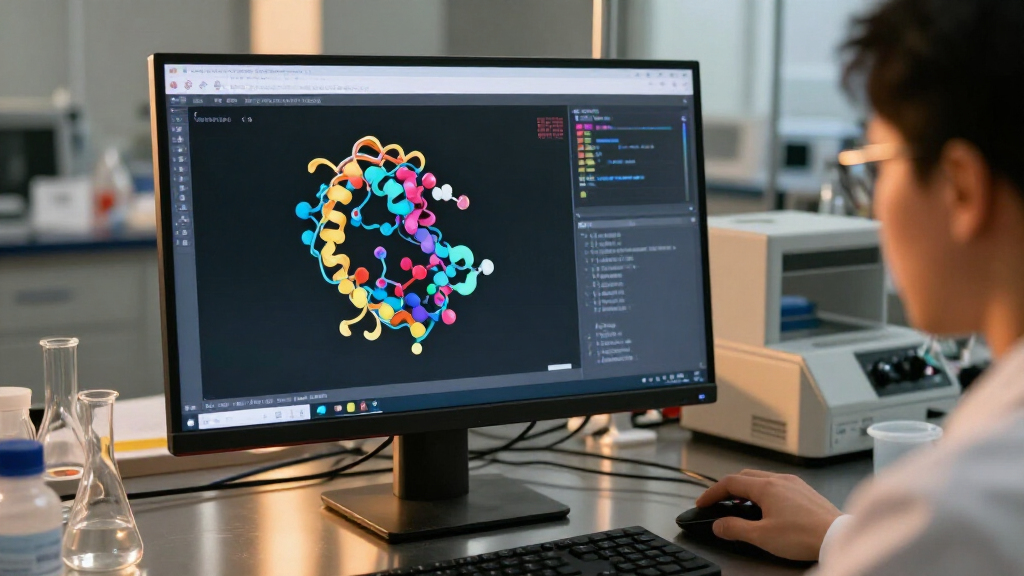

🔍 Read the full analysis: Could AI Help Researchers Discover New Drug Prospects? on ThorstenMeyerAI.com

Get business pricing on tech for your team
- Business-only prices and quantity discounts
- Tax-exempt purchasing
- Multiple users, one account, clear invoices
TL;DR
OpenAI introduced MedChemBench, a benchmark built from 99 problems in published medicinal chemistry research, to test how AI models interpret chemical structures and experimental results. The company reports that GPT-6.2 Astra earned 84.5% of available credit in its xhigh comparison, but the benchmark does not show whether AI-selected compounds will work in laboratory studies or patients.
OpenAI has introduced MedChemBench, a test of whether AI models can interpret molecular structures and experimental findings in published medicinal chemistry research, as described in the original analysis. The company reports that GPT-6.2 Astra earned 84.5% of available credit in its xhigh comparison, but the result measures performance on benchmark questions—not whether AI can identify a drug that is safe and effective in people.
The benchmark contains 99 problems drawn from 117 papers and patents, covering 761 distinct molecular structures, a related challenge to using AI to help researchers map the brain. Each problem gives a model information available at a selected point in a research program, such as the biological target, researchers’ goals, compounds studied and some experimental results. Models are tested on reconstructing structures, reasoning from evidence, ranking or selecting compounds, and predicting numerical or categorical properties.
In OpenAI’s reported comparison at the xhigh reasoning setting, GPT-6.2 Astra earned 84.5% of available credit, GPT-6 Astra 83.3%, GPT-6.1 Sol 82.0% and GPT-5.6 Sol 58.2%. These are company-reported scores; the supplied source does not describe an independent evaluation. It says GPT-6 Astra did better at reconstructing structures and explaining experimental evidence than at selecting compounds or predicting numerical properties.
One example draws on work involving PRMT5 inhibitors, compounds studied in cancer drug discovery, a field where AI could support faster drug development. Models were given structures and earlier results, then asked to predict cell activity, cell-barrier permeability and breakdown by liver enzymes in a laboratory assay. In later results withheld from the models, compound 23 blocked PRMT5 in cells at a lower concentration, while compound 24 crossed the barrier more readily and degraded more slowly in the assay. The example highlights that compounds can differ across several desired properties.
Can AI help scientists identify promising drug candidates?
MedChemBench tests how AI models reason about medicinal chemistry research. Strong benchmark scores do not show that AI-selected compounds will work as medicines in patients.
What the benchmark tests
Models work from evidence available at a point in a research program.
Read the molecule
Reconstruct molecular structures accurately before interpreting results.
Explain findings
Connect experimental evidence to scientific conclusions.
Compare compounds
Rank candidates and predict measured properties.
Reported model scores
OpenAI’s comparison at the xhigh reasoning setting reports credit earned on benchmark questions.
Why tradeoffs matter
A candidate can be stronger on one measure and weaker on another.
- Blocked PRMT5 in cells at a lower concentration.
- Crossed the cell barrier more readily.
- Degraded more slowly in a liver enzyme assay.
Testing AI Against Drug-Design Tradeoffs
Medicinal chemistry requires researchers to compare compounds whose strengths do not always align. A molecule that acts strongly on a target may not reach the relevant tissue effectively or may break down quickly. A benchmark that asks models to reason across multiple measured properties tests a more involved task than predicting one score on its own.
MedChemBench could help researchers compare model capabilities and identify weaknesses before using AI as a research aid. The practical question, however, is whether strong benchmark performance helps scientists make better choices about which compounds to test. The scores do not measure laboratory reproducibility, safety, effectiveness in people or whether an AI suggestion can lead to a medicine.
Products Worth Considering

Jackery Solar Generator 1000 v2 with 200W Solar Panel, 1024Wh LiFePO4 Battery
Apple Watch Series 12 GPS 42mm Smartwatch

Sonos Era 100 Wireless Smart Speaker with Alexa, Black
As an affiliate, we earn on qualifying purchases.
How MedChemBench Scores Chemistry
The benchmark presents models with a snapshot of a research program and asks them to reason from the evidence available at that point. OpenAI says it awards partial credit for predictions close to reported measurements and checks whether models accurately repeat results already provided in a question. This approach assesses answers against findings in source studies; it does not test whether those findings can be reproduced.
Structure reconstruction matters because mistakes in atom connections, ring size or stereochemistry can change which molecule is being analyzed. In a task involving an 18-atom ring, OpenAI reports that GPT-6 Astra reconstructed the structure correctly in all ten responses at xhigh. GPT-5.6 Sol and GPT-5.6 Luna failed in all ten, with reported errors including a 15-atom ring and a structure split into disconnected fragments. GPT-6 Astra received 95.4% of available credit on the structure component.
The source says 11 GPT models were evaluated at different reasoning-effort settings. GPT-6 Astra scored 83.3% overall at xhigh and 83.8% at max effort; OpenAI reports that higher reasoning settings improved scores, while differences between models remained. These findings apply to the benchmark and settings described, not to AI drug discovery as a whole.
What the Scores Do Not Establish
The supplied description does not include an independent assessment of MedChemBench or show how well its scores predict performance on unpublished research, laboratory experiments or clinical development. It also does not provide enough information to assess the full scoring design, the range of tasks across all 99 problems, or how results vary among areas of medicinal chemistry.
It remains unclear whether the model rankings would hold under other evaluation methods or when researchers use the systems in real drug-discovery workflows. The benchmark compares model answers with selected findings from source studies. That is different from showing that a suggested compound is a promising medicine, and the reported scores do not establish that an AI-generated research choice improves outcomes.
Independent Tests Would Clarify Use
A useful next step would be to test models on new medicinal chemistry problems not drawn from the benchmark materials, using methods and scoring reviewed independently. Researchers could also examine whether model suggestions help prioritize experiments or improve decisions when combined with laboratory data.
The supplied source does not announce a timeline or a specific follow-up evaluation. Until such evidence is available, MedChemBench is best understood as a test of performance on selected research questions—not proof that AI can discover a drug that will succeed in patients.
Key Questions
What is MedChemBench?
MedChemBench is a benchmark introduced by OpenAI to test AI models on medicinal chemistry problems drawn from published papers and patents. Its tasks include interpreting molecular structures, reasoning from experimental evidence and predicting compound properties.
How did GPT-6.2 Astra perform?
OpenAI reports that GPT-6.2 Astra earned 84.5% of available credit in its xhigh comparison. That is a company-reported score on this benchmark, not an independent assessment of drug-discovery performance.
Does the benchmark show AI can find medicines that work?
No. MedChemBench tests answers against selected research findings. It does not establish that AI-selected compounds will succeed in new laboratory studies or prove safe and effective in people.
What kinds of chemistry problems does it test?
The benchmark covers 99 problems from 117 papers and patents. Tasks include reconstructing molecular structures, explaining experimental evidence, comparing compounds and predicting measured properties.
What evidence would clarify whether the scores are useful?
Independent tests on new research problems and studies of whether AI suggestions improve experiment selection or research decisions would help show how well benchmark performance carries over to practical work.
Primary source: OpenAI · via ThorstenMeyerAI.com