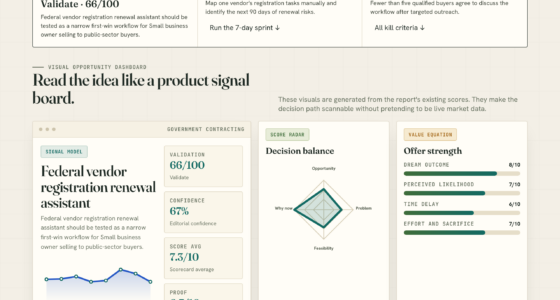

📊 Full opportunity report: Glasspane: One Dataset, Three Views on ThorstenMeyerAI.com — validation score, market gap, and execution plan.

Get business pricing on tech for your team
- Business-only prices and quantity discounts
- Tax-exempt purchasing
- Multiple users, one account, clear invoices
TL;DR
Glasspane has launched a demonstration of its ‘One Dataset, Three Views’ approach, emphasizing transparency and trust in infrastructure monitoring. The tool offers role-aware perspectives over a unified data source, aiming to improve external credibility.
Glasspane has introduced a demonstration of its ‘One Dataset, Three Views’ concept, emphasizing transparency in infrastructure monitoring. The tool aims to provide role-specific perspectives over a single, shared dataset to foster trust among clients, auditors, and internal teams. This approach shifts the focus from uptime to demonstrable trust, addressing a core challenge in modern system management.
The demonstration is an open-source, self-hostable prototype built on mock data to illustrate the core idea. It offers three tailored views — for executives, business managers, and engineers — all derived from the same underlying data. Each view presents only the information relevant to its audience, promoting transparency without overwhelming users with unnecessary details.
According to the developers, this design aims to turn trust into an asset by enabling external parties to verify system health independently. The tool also emphasizes model transparency, showing how AI interpretations are derived and making failures visible. It is built to be open-source under AGPL-3.0, allowing users to verify and run the software locally, ensuring data privacy and source transparency.
Glasspane — one dataset, three views
Most tools answer “is it up?” Glasspane answers a harder one: how do you prove it’s fine to someone who isn’t you? Transparency itself, made the product.
Independent commentary, produced with AI assistance under human editorial oversight. The views are the author’s own and may change. Glasspane is open source under AGPL-3.0, provided “as is” without warranty; see the repository LICENSE. It is a demo / MVP — the views and figures shown run on illustrative, mock data and do not represent a live production deployment. AI interpretation of telemetry may contain errors and should be independently verified. Product and company names are trademarks of their respective owners; mention does not imply endorsement.
Implications for Transparency and External Trust
This development signals a shift toward transparency as a core product feature in infrastructure monitoring. By enabling external stakeholders to access verifiable, role-specific views, Glasspane could reduce the need for repeated reassurance and improve trustworthiness. Its open-source, self-hosted design aligns with growing demands for data sovereignty and accountability, especially in AI-augmented systems.
infrastructure monitoring dashboard software
As an affiliate, we earn on qualifying purchases.
As an affiliate, we earn on qualifying purchases.
Positioning Within the Monitoring and Transparency Ecosystem
Glasspane’s approach addresses a common pain point: traditional dashboards primarily serve internal teams, while external verification often relies on static reports. Its concept builds on recent trends emphasizing transparency and AI interpretability. The project is currently a demo/MVP, showcasing the potential of role-aware, verifiable data views but has not yet been tested in large-scale or production environments. It fits within a broader movement toward open-source, self-hosted, and trustworthy monitoring tools.
“Our goal is to make trust in infrastructure demonstrable, not just assumed. By showing the same data through role-specific lenses, we aim to create a transparent, verifiable view for external stakeholders.”
— Thorsten Meyer, developer behind Glasspane
role-specific data visualization tools
As an affiliate, we earn on qualifying purchases.
As an affiliate, we earn on qualifying purchases.
Limitations and Unanswered Questions About Glasspane
Since the current implementation is a demo using mock data, it remains unclear how well the approach will scale or perform in real-world, complex systems. The effectiveness of role-specific views in actual operational environments and their acceptance by external auditors or clients is still untested. Additionally, reliance on AI interpretation introduces risks if models are inaccurate or opaque, and the handling of model failures is still being evaluated.
open-source system monitoring tools
As an affiliate, we earn on qualifying purchases.
As an affiliate, we earn on qualifying purchases.
Next Steps Toward Production and Adoption
Developers plan to refine the prototype, incorporating real data and testing in live environments. Further work will focus on validating the approach with actual users, assessing scalability, and addressing AI transparency concerns. The project may also explore integrations with existing monitoring tools and expanding its open-source community.
self-hosted data transparency platform
As an affiliate, we earn on qualifying purchases.
As an affiliate, we earn on qualifying purchases.
Key Questions
What is the main goal of Glasspane’s ‘One Dataset, Three Views’?
The goal is to provide role-specific, transparent views over a single dataset to foster external trust and verifiability in infrastructure monitoring.
Is Glasspane ready for production use?
No, currently it is a demo/MVP built with mock data. Further development and testing are needed before production deployment.
How does Glasspane ensure trust in AI interpretations?
It emphasizes model transparency by showing how AI derives insights and surfaces failures, allowing users to verify the models themselves.
Can users verify the source code and data?
Yes, Glasspane is open-source under AGPL-3.0, and it is designed to be self-hosted, enabling users to verify the code and keep data local.
What are the potential challenges for adopting this approach?
Scaling the prototype to real-world systems, ensuring AI model accuracy, and convincing stakeholders of the value of transparency as a product are key challenges.
Source: ThorstenMeyerAI.com
Halloween Picks
halloween
As an affiliate, we earn on qualifying purchases.