
📊 Full opportunity report: How Storefront Marketplaces Link Local Economies With Commercial Real Estate on IdeaNavigator AI — validation score, market gap, and execution plan.

Get business pricing on tech for your team
- Business-only prices and quantity discounts
- Tax-exempt purchasing
- Multiple users, one account, clear invoices
TL;DR
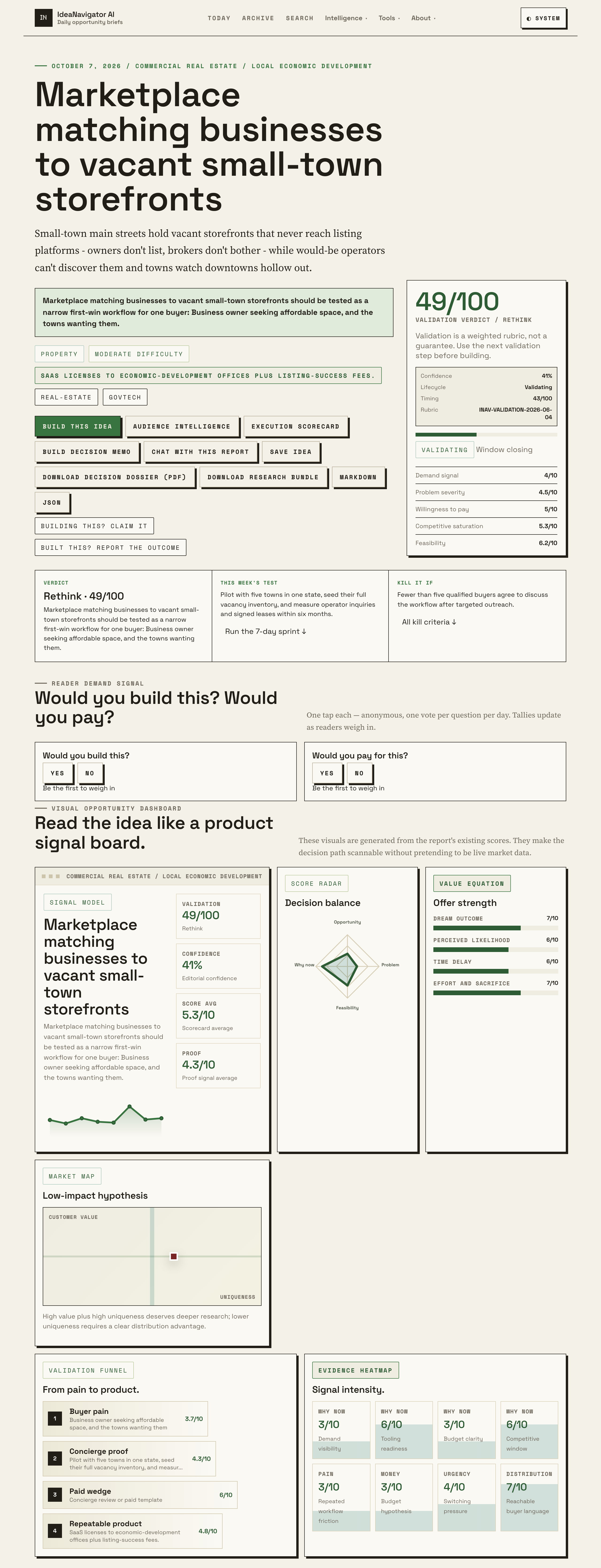
IdeaNavigator AI has outlined a proposed marketplace to match small-town businesses with vacant storefronts and route prospective tenants to local economic-development offices. The concept has not been reported as a launched service: its proposed test is a five-town pilot measuring inquiries and signed leases over six months.
IdeaNavigator AI has proposed a digital marketplace linking business operators with vacant storefronts in small towns, with local economic-development offices helping connect matches to available grants. According to the proposal, the concept is an untested pilot opportunity, not a functioning platform or a confirmed public program; its suggested first test would cover five towns in one state and track inquiries and signed leases over six months.
In its proposal, IdeaNavigator AI says the service would let towns and property owners list vacant commercial spaces with photos, floor area, rent and information about incentives. Business operators could browse listings using town profiles and foot-traffic data, then contact local development offices through the marketplace. The proposal says those offices could attach details of available grants to relevant matches.
The proposal identifies small-business operators seeking affordable premises and towns hoping to attract tenants to empty storefronts as the intended users. It suggests a revenue model combining software subscriptions, or SaaS licenses, paid by economic-development offices with fees tied to successful listings. It does not identify pricing, a platform operator, participating towns or a grant program.
To test whether the model works, IdeaNavigator AI recommends a pilot in five towns in one state, with the full inventory of vacant storefronts entered into the system. The proposal says the pilot would measure operator inquiries and signed leases over six months. Those are proposed evaluation measures; no pilot has been confirmed and no results are available.
Connecting Storefronts to Local Demand
IdeaNavigator AI’s proposal argues that, if tested successfully, the marketplace could make commercial spaces easier for prospective operators to find and give towns a more direct way to present available properties and incentives. The proposal identifies a visibility gap: some storefronts are not advertised on listing platforms, while owners may not list them and brokers may not pursue them.
For local governments, the approach could bring property information and economic-development assistance into one search and referral process. For business owners, a fuller inventory might reduce the time spent locating affordable space. These are potential benefits described by the proposal, not demonstrated outcomes; the proposed pilot would need to show whether listings generate inquiries that lead to signed leases.
commercial storefront listing software
As an affiliate, we earn on qualifying purchases.
As an affiliate, we earn on qualifying purchases.
Why Small-Town Listings Go Missing
IdeaNavigator AI’s proposal describes a mismatch between vacant main-street properties and operators who might use them. It says that when owners do not advertise spaces and brokers do not take them on, would-be tenants may have difficulty learning that a property is available. Towns, meanwhile, may lack a central inventory through which to promote vacancies and local support.
The proposal identifies remote-work migration as a reason small-town commercial interest may have returned, and says economic-development offices have grant money aimed at matching businesses with space. It provides no data on migration, grant amounts, current demand or how many vacant storefronts are affected. Its focus, as described by IdeaNavigator AI, is a narrowly defined matching workflow rather than a broad commercial property platform.
As an affiliate, we earn on qualifying purchases.
Pilot Status and Demand Remain Unknown
IdeaNavigator AI’s proposal confirms no launch, participating towns or operating marketplace. It does not name a developer, set a schedule, identify specific grants or provide evidence that economic-development offices have agreed to pay for licenses. It also gives no estimate of the number of eligible storefronts or potential users.
The proposal does not specify how foot-traffic figures would be collected or standardized, how listing details would be verified, or how grant eligibility would be matched to businesses. It is also unclear how success fees would be defined and whether leases could be attributed to the platform. Until a pilot is run, the level of demand and the service’s commercial viability remain untested.
As an affiliate, we earn on qualifying purchases.
A Five-Town Test Would Measure Leases
IdeaNavigator AI proposes selecting five towns in one state, assembling a complete inventory of vacant storefronts and inviting operators to browse and make inquiries. The proposal says organizers would track both inquiries and signed leases over six months to assess whether the marketplace moves businesses from discovery to occupancy.
No timetable or organizers have been announced, so it is not clear whether or when that test will begin. Any assessment would need to distinguish simple listing activity from completed leases and clarify how participating towns’ grants and incentives affect outcomes. For now, the marketplace remains a proposal for a focused test, rather than a confirmed service.
Source: IdeaNavigator AI proposal
real estate tenant management platform
As an affiliate, we earn on qualifying purchases.
As an affiliate, we earn on qualifying purchases.
Key Questions
Is the storefront marketplace already operating?
No operating platform or launch is confirmed. IdeaNavigator AI presents the idea as a proposal for a marketplace connecting small-town property listings with business operators.
Who would use the proposed marketplace?
According to IdeaNavigator AI’s proposal, the intended users are business owners seeking affordable space, property owners with vacant storefronts, and local economic-development offices that want to attract businesses.
What information would storefront listings include?
The proposal says listings would include photos, size, rent and information about incentive programs. Operators could also browse using town profiles and foot-traffic data.
How would the proposal be tested?
IdeaNavigator AI recommends a pilot across five towns in one state, with all known vacancies entered and operator inquiries and signed leases measured over six months.
What is still unknown about the idea?
The proposal names no towns, launch date, platform operator, grant programs or pricing. There is also no evidence yet that the proposed service would lead to leases or support a viable business model.
Source: IdeaNavigator AI
Halloween Picks
halloween
As an affiliate, we earn on qualifying purchases.