
📊 Full opportunity report: A Technology Trend In Mapping: StreetComplete’s OpenStreetMap Quests on IdeaNavigator AI — validation score, market gap, and execution plan.

Get business pricing on tech for your team
- Business-only prices and quantity discounts
- Tax-exempt purchasing
- Multiple users, one account, clear invoices
TL;DR
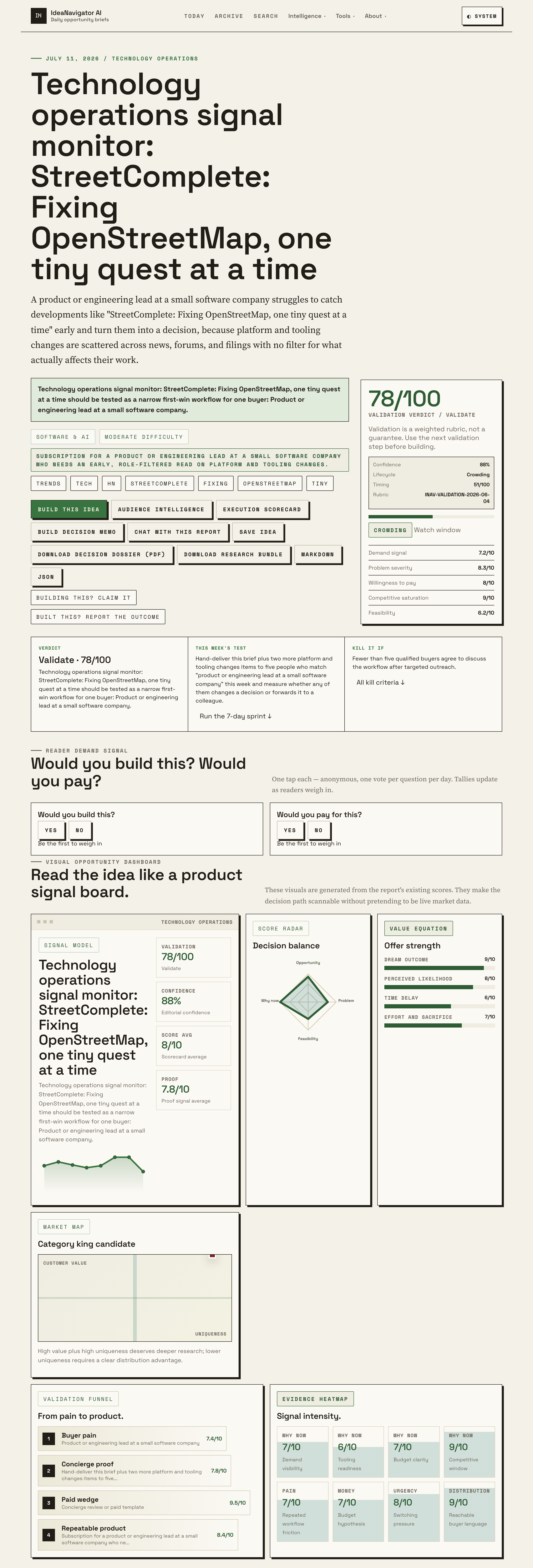
StreetComplete, an app that turns OpenStreetMap editing into small location-based ‘quests,’ drew strong attention on Hacker News, where a signal monitor scored the discussion 88/100. The pattern points to growing interest in gamified, low-friction micro-contribution tools for crowdsourced data.
The Android app StreetComplete, which converts OpenStreetMap editing into small, location-based tasks called “quests,” has been flagged as an emerging technology trend after a Hacker News discussion about the app scored an 88/100 signal on a technology operations monitoring feed operated by IdeaNavigator AI. The score, which reflects discussion intensity and relevance ranking rather than user metrics, marks the app as one of the more visible recent examples of gamified micro-contribution tools that lower the barrier to maintaining large crowdsourced datasets.
StreetComplete works by detecting incomplete or outdated data in OpenStreetMap (OSM) — the free, collaborative world map used by platforms including Facebook, Amazon, and countless navigation apps — and presenting users with simple, answerable questions when they are physically near the relevant location. A typical quest might ask whether a shop is still open, what the surface of a footpath is made of, or whether a bench exists at a marked spot. Users answer from a short list of options rather than editing raw map data, which is the traditional and comparatively technical way to contribute to OSM.
The app’s core design choice is that contributors never see the underlying map editing interface. According to the project’s own framing, which was the subject of the Hacker News thread — titled “StreetComplete: Fixing OpenStreetMap, one tiny quest at a time” — the goal is to let anyone improve map data in seconds without learning OSM’s tagging system. Each answered quest feeds a verified edit into the map, and the app awards points and unlocks achievements to encourage continued participation.
The IdeaNavigator AI signal monitor, which surfaces platform and tooling developments relevant to technology decision-makers, ranked the StreetComplete discussion at 88 out of 100, placing it among higher-signal items tracked in the technology operations category that week. The monitor recommended the item specifically as a candidate workflow test for a product or engineering lead at a small software company, on the grounds that same-day, role-filtered reads of tooling trends can inform build-or-adopt decisions faster than generic weekly roundups.
Why Micro-Contribution Tooling Is Drawing Attention
The StreetComplete pattern matters beyond mapping because it demonstrates a repeatable model: take a dataset that depends on volunteer contributions, identify the smallest useful unit of work, and wrap it in an interface that requires no domain expertise. For product and engineering teams, this is a proven approach to sustaining data quality at scale when paid staff cannot cover every data point. OpenStreetMap’s global road and amenity data is maintained this way, and tools that widen the contributor base directly affect how current that data remains.
For small software companies, the relevance is twofold. First, apps like StreetComplete affect the freshness of OSM-derived data that many products quietly depend on, from geocoding to routing. Second, the quest mechanic itself — decompose a task, verify with photos or on-site presence, gamify completion — has been applied to other domains including translation, image labeling, and accessibility auditing. The 88/100 Hacker News signal suggests developers and technology leaders are actively discussing the model, not just the app.
OpenStreetMap’s Long-Standing Contributor Problem
OpenStreetMap was founded in 2004 and has since grown into one of the largest collaborative geodata projects in existence, but its contributor base has always been unevenly distributed: a small fraction of highly active mappers produce most edits, and traditional editing requires familiarity with tagging conventions and desktop editors such as JOSM or iD. Mobile-first simplification tools have historically been the main route to broadening participation.
StreetComplete is free, open-source, and Android-only, and its quests are deliberately constrained to changes a passerby can verify on site — a design that limits both the scope of edits and the risk of careless contributions. The app has cycled through Hacker News and mapping-community attention repeatedly over the years; what is new in this cycle is the strength of the measured signal and the framing of the app as part of a broader micro-contribution tooling trend rather than a niche mapping utility.
“StreetComplete: Fixing OpenStreetMap, one tiny quest at a time.”
— Hacker News thread title
What the 88/100 Score Does and Does Not Show
The 88/100 signal score is a proprietary relevance measure from IdeaNavigator AI’s monitoring feed, not an industry benchmark or a measure of StreetComplete’s user growth. The app’s current download figures, monthly active contributors, and edit volume were not included in the tracked item, so the actual scale of recent adoption is unclear.
It is also unverified whether the Hacker News attention translates into sustained new contributors to OpenStreetMap or into broader adoption of quest-style mechanics by other platforms. The monitor’s own validation proposal — delivering the brief to five matching technology leads and measuring whether it changes a decision — is a plan, not a completed result. Whether small software companies will act on this trend, and how, remains to be seen.
Watching the Trend From Here
IdeaNavigator AI’s proposed next step is a narrow validation: hand-deliver the StreetComplete brief alongside two comparable platform and tooling items to five people matching the target role this week, then measure whether any recipient changes a decision or forwards the material to a colleague. That outcome would test whether high-signal monitoring of this kind has practical value for small-team technology leaders.
For readers tracking the underlying trend, the indicators to watch are StreetComplete’s release notes and contributor statistics on OpenStreetMap, whether comparable quest-style apps expand to iOS or other data domains, and whether discussion of micro-contribution mechanics continues to rank highly on developer forums in coming weeks.
Source: IdeaNavigator AI
Key Questions
What is StreetComplete?
A free, open-source Android app that lets users improve OpenStreetMap by answering small, multiple-choice questions — quests — about nearby map features, without needing to know how OSM editing works.
Why did StreetComplete trend this week?
A Hacker News discussion of the app scored an 88/100 relevance signal on IdeaNavigator AI’s technology operations monitoring feed, flagging it as a notable example of micro-contribution tooling.
Does the 88/100 score mean the app is growing fast?
No. The score measures discussion intensity and relevance in the monitor’s own ranking system. User growth, download numbers, and edit volume were not part of the tracked item and remain unknown.
Why should a small software company care?
Many products rely on OpenStreetMap-derived data, so contributor tools affect data freshness. Separately, the quest mechanic — small verified tasks with gamified incentives — is a transferable pattern for managing crowdsourced or distributed data work.
Can I use StreetComplete on iOS?
No. StreetComplete is an Android-only app. Users on other platforms would need to contribute to OpenStreetMap through its standard web or desktop editors.
Source: IdeaNavigator AI
Halloween Picks
halloween
As an affiliate, we earn on qualifying purchases.