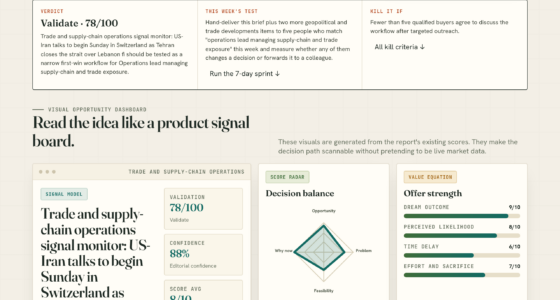
📊 Full opportunity report: Outcome-First Decisions: The Friction Is the Feature on ThorstenMeyerAI.com — validation score, market gap, and execution plan.

Get business pricing on tech for your team
- Business-only prices and quantity discounts
- Tax-exempt purchasing
- Multiple users, one account, clear invoices
TL;DR
Outcome-First Decisions is a decision-making approach that prioritizes testing and evidence before committing resources. It offers a structured, five-verdict system and a buyer evidence ladder to improve decision accuracy and speed. This method aims to reduce wasted effort and build a calibrated decision record over time.
Outcome-First Decisions is a decision framework that forces businesses to test and validate ideas before allocating significant resources. It aims to prevent costly commitments based on vague optimism or incomplete evidence, making decision-making faster and more reliable. This approach is gaining traction among startups and established firms seeking to reduce wasted effort and improve decision accuracy.
The core of Outcome-First Decisions is a structured process that provides a clear verdict—worth doing, test first, change, defer, or drop—based on evidence rather than assumptions. It incorporates a Buyer Evidence Ladder that ranks evidence from opinion to repeat purchase, ensuring decisions are based on reliable signals like actual payment, not just expressed interest. The process involves quick tests that can be run within a week, leading to actionable next steps. It also logs decisions and confidence levels, creating a calibrated record that improves over time.
Developed as an open-source skill, it is designed to integrate into AI agents, making decision support accessible and adaptable across industries. It features industry overlays tailored for sectors like SaaS, healthcare, or e-commerce, providing relevant proof tests and scoring defaults. In emergencies, it shifts into a crisis mode, offering rapid verdicts and immediate actions, bypassing standard scoring and planning processes.
The Friction Is the Feature
Most tools help you do more. This one helps you do less — and proves the “less” is the part that earns. It turns a fuzzy decision into a verdict, a one-week proof test, and three actions for today.
Missing one? It doesn’t cheer you forward — it asks the smallest question that fills the gap. When the evidence is an opinion, the answer is “test first,” not a 12-week plan. That’s $250 to learn the truth instead of three months.
A click is not a customer. A “great idea” is not revenue. The skill reads where your evidence sits and designs the cheapest test that moves you up exactly one rung.
So your next “80%” gets discounted accordingly — and the rungs you habitually skip get flagged. You’re not just deciding; you’re building a calibrated instrument out of your own track record.
- Triggered by runway, missed payroll, a lost biggest customer.
- A one-line verdict and three actions with hour-level deadlines.
- The dollar number below which the business closes.
- Scoring tables and framework talk disappear — busywork in an emergency.
- Every active bet with its evidence rung, capacity cost, and kill date.
- At most two unproven bets at once. No bet without a kill date.
- Killed capacity reallocated by name, not vaguely “freed up.”
- Numbers carry provenance — no verdict rides on a half-remembered figure.
mkdir -p ~/.claude/skills && unzip outcome-first-decisions.zip -d ~/.claude/skills/
The honest tradeoff: it will not flatter you. Thin evidence, it says so; an idea that should die, it says so plainly. If you want reassurance, it’s the wrong tool. If you want fewer, better-aimed bets and a verdict you can defend — the friction is the feature.
Independent commentary, produced with AI assistance under human editorial oversight. The views are the author’s own and may change. Outcome-First Decisions is a decision-support tool, not business, financial, legal, or investment advice; its verdicts are one input to your own judgment, not a guarantee of outcomes, and dollar figures are illustrative. Software provided under its stated open-source licence, as-is, without warranty. Product, model, and company names are trademarks of their respective owners; mention does not imply endorsement.
Impact of Evidence-Driven Decision Making on Business Efficiency
This approach addresses a common pain point: the tendency to spend months planning or debating decisions without testing their validity. By focusing on testing first and building a calibrated record, companies can reduce wasted effort, improve success rates, and make faster, more confident choices. Over time, this method helps organizations develop a more accurate understanding of their decision-making patterns, leading to better strategic agility and resource allocation.
As an affiliate, we earn on qualifying purchases.
Shift Toward Evidence-Based Business Decisions
Traditional decision-making often relies on opinions, assumptions, or incomplete data, leading to costly failures. Recent trends emphasize rapid experimentation and validated learning, especially in startups and tech companies. The emergence of tools like Outcome-First Decisions reflects a broader move toward structured testing and evidence gathering before scaling efforts. This framework builds on principles from lean startup methodologies and decision science, aiming to formalize and accelerate validation processes.
“Most costly decisions are those that look promising but lack concrete evidence. Our approach turns that around—test first, decide later.”
— Thorsten Meyer, creator of the framework
business testing and validation tools
As an affiliate, we earn on qualifying purchases.
As an affiliate, we earn on qualifying purchases.
Unresolved Questions About Implementation and Scalability
It is not yet clear how widely this decision framework will be adopted across different industries or how it performs in highly complex or regulated environments. Some critics question whether quick tests can replace comprehensive planning in strategic decisions. Additionally, the effectiveness of the approach in large organizations with entrenched decision processes remains to be seen.
As an affiliate, we earn on qualifying purchases.
Next Steps for Adoption and Validation of the Framework
Ongoing efforts include integrating Outcome-First Decisions into more AI tools and testing its effectiveness in real-world scenarios. Further validation studies and case reports are expected to emerge over the coming months, providing insights into its impact on decision accuracy and resource efficiency. Broader industry adoption will likely depend on demonstrated success and ease of integration.
As an affiliate, we earn on qualifying purchases.
Key Questions
How does Outcome-First Decisions differ from traditional planning?
It emphasizes testing and evidence gathering before making commitments, rather than relying on assumptions or lengthy plans. It focuses on quick validation and actionable next steps.
Can this approach work in large, complex organizations?
Its effectiveness in large organizations is still uncertain. While promising for startups and smaller teams, scaling the process may require adaptation and further validation.
What industries are best suited for this decision framework?
It is designed to be adaptable across sectors, with industry overlays for SaaS, healthcare, e-commerce, and more. Its core principles are broadly applicable wherever rapid validation is valuable.
What are the main benefits of using Outcome-First Decisions?
Faster decision-making, reduced wasted effort, improved decision reliability, and the ability to build a calibrated decision record over time.
Source: ThorstenMeyerAI.com
Halloween Picks
halloween
As an affiliate, we earn on qualifying purchases.