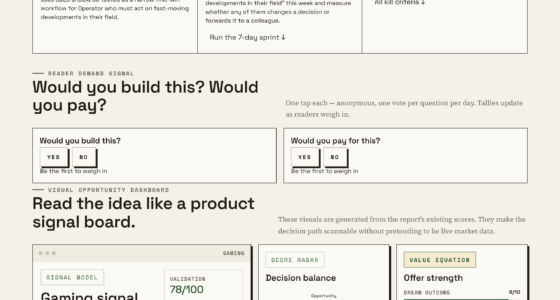
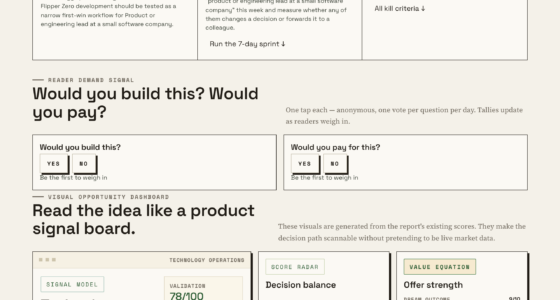
📊 Full opportunity report: Tracking The Pulse Of U.S.–Belgium Trade And Supply-Chain Operations on IdeaNavigator AI — validation score, market gap, and execution plan.

Get business pricing on tech for your team
- Business-only prices and quantity discounts
- Tax-exempt purchasing
- Multiple users, one account, clear invoices
TL;DR

IdeaNavigator AI has proposed testing a focused monitor that turns U.S.–Belgium trade and supply-chain developments into short, role-specific briefs for operations leaders. Its cited Google Trends signal is 88/100, but the proposal does not identify a specific trade event, explain the score’s basis or establish that companies have acted on the idea.
IdeaNavigator AI has proposed testing a monitor that would track geopolitical and trade developments involving the United States and Belgium and convert relevant items into short briefs for supply-chain operations leaders. The proposal cites a Google Trends signal of 88/100, but does not identify a particular trade disruption or provide evidence that the score reflects a change in trade flows.
The suggested product is aimed at an operations lead managing supply-chain and trade exposure. It would watch Google Trends and similar feeds, filter developments for that role, and summarize each relevant item under three questions: what changed, why it matters and what to do. The U.S.–Belgium phrase is offered as an example of a topic the monitor might track, not as a reported policy action or supply-chain incident.
IdeaNavigator AI describes the problem as one of fragmented information: trade and geopolitical developments may appear across news, forums and filings, while operations staff need to identify which items could affect their work. The proposed business model is a subscription, although no pricing, product launch date, customer base or operating company is specified.
For an initial check, the proposal recommends hand-delivering the brief and two other geopolitical or trade updates to five people matching the intended user profile during the week. It suggests measuring whether a recipient changes a decision or forwards a brief to a colleague. No recipients, completed interviews or test outcomes are reported.
Testing Alerts Against Operations Decisions
The proposal addresses a practical challenge for companies exposed to cross-border trade: a development can matter to a particular supplier, route or compliance obligation without warranting attention across an entire organization. A role-specific brief could help an operations manager separate potential operational signals from general news, if it is accurate, timely and clear about what is verified.
At this stage, however, the material describes a product idea and a validation plan, not an operating alert service or a documented trade-risk event. The stated 88/100 figure may indicate interest in a search topic, but without the query, time period, geography settings, comparison baseline or methodology, readers cannot tell what it measures. It should not be read as an 88% chance of disruption or as evidence that U.S.–Belgium trade has changed.
The proposed five-person test is designed to look for signs of usefulness in real work: a changed decision or a forwarded brief. Those responses could provide early feedback, but a small test would not establish market demand, reliability or business impact. For companies, the value would depend on whether alerts connect to their actual suppliers and exposures rather than merely flagging broad geopolitical discussion.
As an affiliate, we earn on qualifying purchases.
A Proposed U.S.–Belgium Monitoring Workflow
The proposal is framed as a narrow first test in the trade and supply-chain operations market. Instead of building a general news roundup, it would focus on a defined audience and ask whether selected developments are useful to that audience’s decisions. The suggested output is a concise, actionable brief rather than a raw feed of search trends or headlines.
The supplied description says geopolitical and trade developments can move quickly and argues that a same-day, role-filtered read may be more useful than a weekly roundup. That is the proposal’s rationale; no comparison of delivery times or operational outcomes is supplied. It also does not name a specific tariff, regulation, port issue, diplomatic development or company exposure involving the United States and Belgium.
The geographic phrase appears in the proposed monitor’s name and example query. The available details do not say that U.S.–Belgium trade is facing a new disruption, nor do they provide trade data, official announcements or company reports supporting such a claim. The development being reported here is the suggestion to test a monitoring workflow, not a confirmed change in bilateral trade operations.
As an affiliate, we earn on qualifying purchases.
The Signal and Test Results Are Unreported
The proposal does not explain how Google Trends produced the 88/100 score, which search term or time window it covers, or what comparison the score uses. Without those details, it is not possible to assess whether it represents a recent increase in attention, a geographic pattern or another measure. It also does not establish a link between search interest and a change in trade or supply-chain conditions.
No independent operational data, government statement, company disclosure or named expert assessment is provided to confirm a U.S.–Belgium trade development. The monitor itself is described as something to build, and there is no information confirming that a working service exists. The proposed test has no reported results, so whether target users would act on or share the briefs remains unknown.
Other unanswered questions include how the system would verify claims, distinguish an emerging risk from speculation, handle conflicting reports and tailor alerts to an individual company’s suppliers or routes. The proposal gives no details on data sources beyond Google Trends and similar feeds, nor on update frequency, safeguards against false alarms, subscription price or plans for expansion.
geopolitical trade analysis reports
As an affiliate, we earn on qualifying purchases.
As an affiliate, we earn on qualifying purchases.
Five-User Trial Is the Proposed Next Step
The next step set out in the proposal is to deliver the U.S.–Belgium brief and two additional developments to five people who fit the intended operations-lead profile during the week. The suggested measures are whether any recipient changes a decision or forwards an item to a colleague. No trial date beyond that relative timing, participant list or outcome has been announced.
If carried out, the test could show whether the format is relevant enough to prompt follow-up from a small group of potential users. It would not by itself confirm that the Google Trends signal predicts trade exposure, or that a subscription product can provide reliable coverage at scale. Further details about the monitored feeds, the handling of uncertain reports and users’ actual operational needs would be needed to assess the proposal.
Source: IdeaNavigator AI
supply chain decision support tools
As an affiliate, we earn on qualifying purchases.
As an affiliate, we earn on qualifying purchases.
Key Questions
Has a new U.S.–Belgium trade disruption been reported?
No specific disruption is identified. The proposal uses U.S.–Belgium developments as the focus for a possible monitoring workflow; it does not report a new trade measure or supply-chain incident.
What does the 88/100 Google Trends signal mean?
The proposal gives the score but does not provide its search term, time window, comparison baseline or calculation method. It cannot be treated as a measure of disruption risk or trade volume.
What would the proposed monitor do?
It would watch Google Trends and similar feeds, filter geopolitical and trade updates for operations leaders, and produce briefings on what changed, why it matters and what to do.
Has the monitor been launched or tested?
The available description presents it as an idea to build and proposes a hand-delivered test with five potential users. It provides no launch confirmation or test results.
How would the initial test measure usefulness?
The proposed measures are whether a recipient changes a decision or forwards a brief to a colleague. No participant responses or results have been reported.
Source: IdeaNavigator AI
Halloween Picks
halloween
As an affiliate, we earn on qualifying purchases.