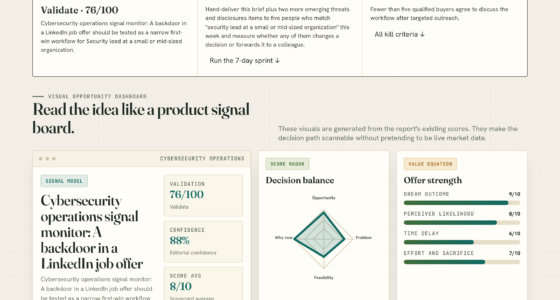

📊 Full opportunity report: The Alliance Cannot Fight Through A Black Box — Why Huawei Was Only The Warning on ThorstenMeyerAI.com — validation score, market gap, and execution plan.

Get business pricing on tech for your team
- Business-only prices and quantity discounts
- Tax-exempt purchasing
- Multiple users, one account, clear invoices
TL;DR
NATO’s reliance on civilian infrastructure and foreign supply chains, exemplified by Huawei, exposes vulnerabilities that threaten military security. The core issue is control over critical systems, not just origin.
NATO is increasingly aware that dependency on foreign, opaque supply chains like Huawei’s presents a strategic risk to its military and civilian infrastructure. This recognition follows years of concern about supply chain security and the vulnerabilities posed by non-transparent vendors, especially in critical sectors.
Recent assessments by the European Commission and UK government highlight that suppliers like Huawei and ZTE pose significant risks beyond technical vulnerabilities, due to their potential influence through security laws, ownership, and governance structures. The UK announced plans to remove all Huawei equipment from its 5G networks by 2027, citing concerns about supply chain restructuring under US sanctions and the inability to guarantee future security.
Germany and other European nations are also moving to phase out Huawei components from critical networks, acknowledging that embedded dependencies can turn into strategic vulnerabilities. The cost and complexity of removing deeply integrated vendors demonstrate that supply chain dependencies are not merely procurement issues but national security concerns.
This situation underscores a broader shift: the recognition that control over supply chains, not just the origin of hardware, determines security. The core problem is whether NATO and allied nations can operate, repair, and update systems without reliance on potentially hostile or influenceable foreign entities.
Friendly fire at alliance scale: what Chinese equipment in NATO networks actually means
Yesterday: Ukraine may have turned a Russian unit’s identification layer against its own jet. Today’s question doesn’t require that to be true. It requires only that the concept be plausible — and then asks what it means when NATO’s own identification layer is built on equipment from a country whose law compels its companies to cooperate with intelligence on demand.
Any Chinese entity — any company, any employee, anywhere — must assist national intelligence work when asked. No carve-out for foreign deployments. No judicial review. No refusal option. When Beijing asks Huawei for access, Huawei must provide it. The law doesn’t distinguish between Shenzhen and Stuttgart. It doesn’t distinguish between civilian and NATO. This is not theoretical. It is operational law.
Requires no reconnaissance. The companies manufactured and installed the equipment. They have the source code, firmware, manufacturing tolerances, and update pipeline — the reconnaissance was completed before the adversary was even identified as one. A stronger position than what InformNapalm claims Ukraine achieved.
The question isn’t whether China will use this access. It’s whether NATO can afford to assume it won’t. Three things follow. Replacement is genuinely hard — banning without building the supply chain produces capability gaps, not security. The identification layer is where the exposure is sharpest — a Chinese motor is a supply-chain risk; a Chinese sensor or processor in an IFF system is an identification-layer risk, the same class the BARS Moscow story made visible. And the open-weight argument applies here — but stops short: open weights give you visibility into the classification model; they don’t give you visibility into the silicon it runs on. NATO has thirty-two members, each with its own procurement history. Together they’ve built an identification layer with distributed, unaudited, legally-accessible dependencies on a potential adversary. BARS Moscow required weeks of reconnaissance. The reconnaissance for NATO’s version was completed in the factory.
Implications of Supply Chain Dependencies for NATO Security
The dependency on opaque supply chains like Huawei’s reveals a fundamental vulnerability in NATO’s military and civilian infrastructure. As civilian assets constitute a large part of military logistics, communication, and support, control over these systems directly impacts operational security. The case of Huawei exemplifies how dependency can transfer leverage to strategic competitors, potentially enabling influence or disruption during crises. This recognition is prompting NATO and allied nations to rethink supply chain security as integral to defense planning, not just procurement.
hardware supply chain security devices
As an affiliate, we earn on qualifying purchases.
As an affiliate, we earn on qualifying purchases.
Growing Awareness of Supply Chain Risks in NATO and Europe
Since 2023, Western countries have increasingly identified foreign vendors like Huawei as security threats, citing influence risks through ownership, legal frameworks, and supply chain opacity. The European Commission’s 2026 ICT Supply Chain Security Toolbox formalizes this approach, emphasizing the importance of assessing critical suppliers’ transparency and control. The UK’s decision to phase out Huawei from 5G networks by 2027 marked a significant policy shift, reflecting a broader understanding that dependency on foreign vendors can undermine strategic autonomy.
Historically, NATO’s focus was on hardware and software vulnerabilities; now, the emphasis has shifted toward systemic control over supply chains that support military and civilian infrastructure. The realization that supply chain dependencies can become strategic vulnerabilities has prompted a reevaluation of procurement and operational practices across member nations.
“Huawei and ZTE presented materially higher risks than other 5G suppliers, considering influence through laws, ownership, and governance.”
— European Commission
As an affiliate, we earn on qualifying purchases.
Unclear Scope of Supply Chain Control Challenges
It remains unclear how NATO and allied nations will effectively implement controls over complex, multi-layered supply chains, especially when components and software originate from multiple jurisdictions. The precise policies, technological solutions, and legal frameworks needed to guarantee future independence are still under development. Additionally, the full extent of vulnerabilities posed by existing dependencies has yet to be quantified comprehensively.
As an affiliate, we earn on qualifying purchases.
Next Steps in Strengthening Supply Chain Security
NATO and its member states are expected to develop more rigorous assessment frameworks for critical suppliers, emphasizing transparency and control. Policies to phase out high-risk vendors like Huawei are likely to expand, with investments in domestic and trusted supply chains. Ongoing research into supply chain resilience and international cooperation will shape future defense and infrastructure strategies. The goal is to reduce dependencies that could be exploited during conflicts, ensuring operational autonomy.
As an affiliate, we earn on qualifying purchases.
Key Questions
Why is supply chain security critical for NATO?
Because civilian infrastructure and supply chains underpin military operations, control over these systems directly affects operational security and resilience during conflicts.
What makes Huawei a symbol of supply chain vulnerability?
Huawei’s involvement in critical infrastructure and concerns about influence through ownership and legal systems made it a visible example of dependency risks that could be exploited during crises.
How are European countries responding to supply chain risks?
They are implementing policies to restrict or remove high-risk vendors like Huawei from critical networks, emphasizing transparency, control, and supply chain resilience as part of national security strategies.
What challenges remain in controlling supply chain dependencies?
Implementing effective controls involves technological, legal, and logistical hurdles, especially when components are sourced from multiple countries and involve complex global supply networks.
Will NATO develop new standards for supply chain security?
Yes, NATO and member states are expected to formalize standards and assessment procedures to better identify and mitigate supply chain vulnerabilities in future defense planning.
Source: ThorstenMeyerAI.com
Halloween Picks
halloween
As an affiliate, we earn on qualifying purchases.