🔍 Read the full analysis: 8 Best High Refresh Gaming Monitors For Smooth, Responsive Play In 2027 on ThorstenMeyerAI.com

Get business pricing on tech for your team
- Business-only prices and quantity discounts
- Tax-exempt purchasing
- Multiple users, one account, clear invoices
TL;DR
This buyer’s guide compares eight high-refresh gaming monitors for different budgets, PCs and play styles, from MSI’s 4K 320Hz model to compact 1080p options and a QD-OLED pick. The source lists specifications and intended use cases, but does not provide prices, independent test results or confirmation that every model is available in 2027.
ThorstenMeyerAI.com’s 2027 monitor guide compares eight gaming displays for buyers weighing smooth motion against resolution, panel type and screen size, as detailed in the original analysis. The MSI MAG 272URDFA E16 is the guide’s overall pick for its stated 4K resolution and 320Hz refresh rate, while the other models target QHD, QD-OLED, 1080p, curved and ultrawide setups. The source describes product specifications and selection criteria, but does not report independent performance testing or confirm current prices and availability.
The guide argues that a high refresh number alone does not determine which monitor is the best fit. A display’s resolution affects the graphics workload: 4K demands more GPU power than QHD or 1080p, so a 320Hz panel is useful only to the extent a PC can produce high frame rates in the games being played. The guide treats QHD as a middle ground and 1080p as a lower-demand choice for competitive play, themes also covered in this high-refresh monitor guide.
Its eight picks span several formats. Alongside MSI’s 4K model are the AOC Q27G41ZE, a 27-inch QHD monitor rated at 240Hz natively with a 260Hz overclocked mode, and Samsung’s Odyssey OLED G6, identified as a QD-OLED option. Four models—the ASUS VG259QM5A, Dell SE2426HG, Sceptre 34-inch ultrawide and 32-inch SANSUI—are named in the source’s takeaways and format discussion, as is the curved AOC C27G4ZH. For more OLED options, see this OLED gaming monitor guide. The source does not provide full specifications for every pick in the supplied material.
The guide says it considered refresh rate, resolution, panel type, adaptive-sync support where specified, connectivity and adjustment details, as well as whether screen size suits a typical desk setup. It also says it does not assume features that product details fail to specify. No testing methodology, measured response times, brightness readings or direct comparisons from lab testing are included in the material provided.
The 8 picks
- 1
 Samsung 27" Odyssey OLED G6 (G61SH) QD-OLED Gaming MonitorView on Amazon →
- 2
 msi MAG 272URDFA E16 27-inch 3840 x 2160 (UHD) Gaming Office Monitor, 320Hz,…View on Amazon →
- 3
 Sceptre C345B-QU240T 34-inch Curved Ultrawide Gaming MonitorView on Amazon →
- 4
 SANSUI 32 Inch Curved 240Hz Gaming Monitor High Refresh Rate, FHD 1080PView on Amazon →
- 5
 AOC 27" Gaming Monitor QHD 240Hz Overclocked IPS NVIDIA G‑Sync Q27G41ZEView on Amazon →
- 6
 AOC C27G4ZH 27-Inch Curved FHD Gaming MonitorView on Amazon →
- 7
 ASUS TUF Gaming VG259QM5A 24.5-Inch 1080p 240Hz Gaming MonitorView on Amazon →
- 8
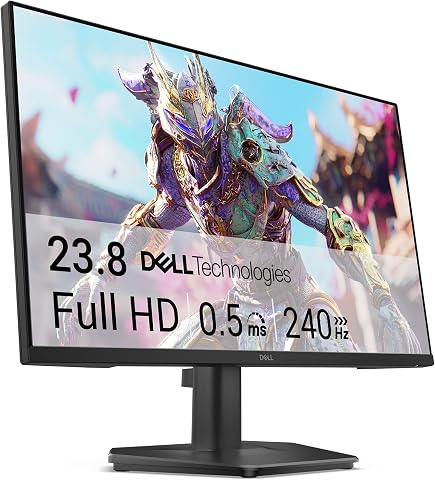 Dell 24 240Hz Gaming Monitor – SE2426HG – 23.8-inch FHD (1920×1080) 240Hz Dis…View on Amazon →
Match Refresh Rate to Your PC
The practical value of a high-refresh display depends on the frame rate a computer can sustain, not just the monitor’s maximum rating. Buyers considering the MSI’s 4K and 320Hz combination should check performance in their own games and at their intended settings. A system that cannot approach high frame rates at 4K may not make full use of the panel’s headline refresh rate.
Resolution and screen size matter for image clarity as well as performance. The guide notes that 1080p on a 24-inch-class screen can suit close-up competitive play, while the same resolution on a larger 27- or 32-inch display can look less crisp at a typical desk distance. QHD offers a sharper alternative without the same rendering burden as 4K. These differences can help buyers avoid paying for specifications that do not fit their PC, seating distance or game library.
Panel and shape also change the experience. Samsung’s QD-OLED is presented as a premium panel alternative, while curved and ultrawide models offer a more enveloping format. The source cautions that ultrawide support varies by game, so the larger view may not work equally well across a player’s library. Those are format and compatibility tradeoffs, not a guarantee of better performance.
Products Worth Considering

Apple iPad mini (A17 Pro) 128GB Wi-Fi 6E – Starlight

Jackery Explorer 1000 v2 Portable Power Station

Sony WH-1000XM4C Wireless Noise-Cancelling Headphones, Black
As an affiliate, we earn on qualifying purchases.
Eight Picks, Different Tradeoffs
The guide’s list is not a ranking based solely on maximum refresh rate. It places the MSI MAG 272URDFA E16 first for its uncommon combination of 4K and 320Hz, then identifies the AOC Q27G41ZE as a more conventional 27-inch QHD speed choice. Its 240Hz native mode is presented as the baseline; the 260Hz overclock is an extra capability rather than the central reason to buy it.
The Samsung Odyssey OLED G6 fills a different role through its stated QD-OLED panel. For buyers prioritizing high frame rates with a less demanding resolution, the source points to 24-inch-class 1080p models, including the ASUS VG259QM5A and Dell SE2426HG. It also includes larger-format choices: a 34-inch Sceptre ultrawide, a 32-inch SANSUI and the 27-inch curved AOC C27G4ZH. The material supplied does not give all specifications for these displays, so details beyond those stated should be checked against current manufacturer listings.
The source recommends matching resolution to the GPU, choosing a refresh rate the system can use, and considering viewing distance before selecting a screen size. It also advises checking ultrawide support in the games a buyer plays and looking for adaptive-sync support when frame rates vary. These points frame the list as a set of use-case recommendations, not a claim that one monitor will suit every player.
“The MSI combines 4K resolution and 320Hz refresh.”
— ThorstenMeyerAI.com guide
Prices and Test Results Not Given
The supplied source does not state prices, release dates, stock status or retailer availability, and it does not establish that all eight models will be sold or remain available in 2027. Several listed displays are not accompanied here by complete specifications, including full resolution and refresh details for every model. Buyers should verify current manufacturer specifications before purchasing.
The guide also does not provide measured response times, input lag, brightness, color accuracy or side-by-side test results. Its rankings are presented as recommendations based on stated product traits and use cases. The claims should not be read as independent proof that one display performs better in every game or setup. The source mentions adaptive-sync support only where specified and does not confirm it for every pick.
Verify Current Models Before Buying
Readers comparing the list should check each manufacturer’s current specification page and retailer listing for availability, price, native resolution and refresh rate. They should also confirm whether an advertised overclock requires a setting change, whether adaptive sync is supported, and which ports and stand adjustments are included.
Before choosing, compare the PC’s performance in the games played most often and consider desk depth, viewing distance and screen format. For an ultrawide, check compatibility with specific games; for a large 1080p screen, consider whether its pixel density suits close viewing. The source provides no follow-up testing or market update, so changes to prices and availability remain to be established.
Key Questions
Which monitor is the guide’s overall pick?
The guide names the MSI MAG 272URDFA E16 as its overall pick, citing its stated 4K resolution and 320Hz refresh rate. It also says buyers need a capable graphics card to make use of high frame rates at 4K.
Is the AOC Q27G41ZE a 260Hz monitor?
The source lists 240Hz as its native refresh rate and says the monitor has an overclocked 260Hz mode. It does not provide further details about how that mode is enabled or tested.
Does a higher refresh rate mean a game will run at that frame rate?
No. A monitor’s refresh rate describes how often its display can update; the computer must also render frames at a sufficient rate. The guide recommends checking performance in the games and settings a buyer actually uses.
Which models are aimed at 1080p competitive gaming?
The source points to the ASUS VG259QM5A and Dell SE2426HG among its 24-inch-class 1080p choices. It presents lower-resolution screens as a way to reduce GPU demands, but the supplied material does not include full specifications for each model.
Are the eight monitors confirmed to be available in 2027?
The source does not provide release dates, current stock information or prices. Check manufacturer and retailer listings for current availability and specifications before making a purchase.
Source: ThorstenMeyerAI.com