
Choosing an AI social media management resource depends on what you need AI to do: organize a solo workflow, explain the basics, support client work, or give you repeatable prompts. From the information available, The AI Social Media Manager is my strongest pick for a one-person content system, while AI-Powered Social Media Marketing is the clearest fit for readers who want prompts and workflows for Instagram, TikTok, and Facebook. For a beginner seeking a broader introduction across platforms, AI-Powered Digital & Social Media Marketing and Business Automation is the more accessible starting point.
These are books and guides, not software platforms. They can help readers plan, create, and improve social media work with AI, but the supplied descriptions do not identify specific software integrations, analytics dashboards, scheduling features, or detailed technical instructions. My ranking rewards the clearest match between a guide’s stated focus and a buyer’s likely job. The main tradeoff is breadth versus practical direction: some titles span several platforms and marketing topics, while others focus on a solo workflow, an agency model, or prompt-led publishing.
Key Takeaways
- Best overall for solo operators: The AI Social Media Manager is explicitly organized around planning, creating, repurposing, and growing social media as a one-person system.
- Best for prompt-led execution: AI-Powered Social Media Marketing is the only listed guide whose description specifically promises step-by-step prompts and workflows for Instagram, TikTok, and Facebook.
- Best beginner orientation: AI-Powered Digital & Social Media Marketing and Business Automation covers several major platforms and is described as beginner-friendly, though experienced marketers may find it basic.
- Best agency fit: AI-Powered Content Creation & Social Media Management Agency connects AI content automation with attracting clients and delivering campaigns, but it is less suited to someone managing only personal accounts.
- Expect strategy, not software: The product details do not name specific tools or provide technical setup information, so buyers seeking a scheduler, analytics suite, or integrations should look for a software product instead.
| The AI Social Media Manager: The One-Person System for Planning, Creating, Repurposing, and Growing Your Social Media with AI |  | Best Overall for Solo Operators | Format: Book | Primary focus: AI-supported social media management | Workflow scope: Planning, creating, repurposing, and growth | VIEW LATEST PRICE | See Our Full Breakdown |
| AI-Powered Social Media Marketing: Step-by-Step Prompts and Workflows to Grow on Instagram, TikTok, and Facebook Without Burning Out |  | Best for Prompt-Led Workflows | Format: Book | Primary focus: AI prompts and social media workflows | Stated platforms: Instagram, TikTok, and Facebook | VIEW LATEST PRICE | See Our Full Breakdown |
| AI-Powered Digital & Social Media Marketing and Business Automation | 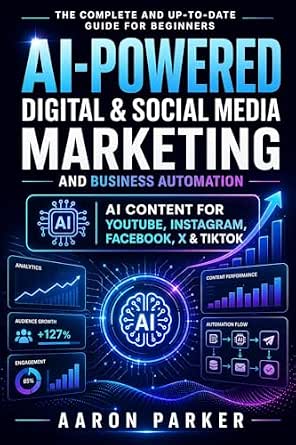 | Best for Beginners Across Multiple Platforms | Format: Book | Primary focus: AI-powered digital and social media marketing | Additional topic: Business automation | VIEW LATEST PRICE | See Our Full Breakdown |
| AI-Powered Content Creation & Social Media Management Agency: How to Automate Content With AI, Attract High-Paying Clients, Deliver Viral Social Media Campaigns |  | Best for Agency Owners and Client Services | Format: Book | Primary focus: AI-assisted content creation and social media management | Business model: Agency and client services | VIEW LATEST PRICE | See Our Full Breakdown |
| Effective Use of AI Tools for Social Media Managers |  | Best for General Workflow Ideas | Format: Book | Primary audience: Social media managers | Primary focus: Using AI tools in social media workflows | VIEW LATEST PRICE | See Our Full Breakdown |
| AI social media management tool | Format | Primary focus | Intended audience | Named tools |
|---|---|---|---|---|
| The AI Social Media Manager: T | Book | AI-supported social media management | Solo entrepreneurs and social media managers | Not specified in the supplied description |
| AI-Powered Social Media Market | Book | AI prompts and social media workflows | — | Not specified in the supplied description |
| AI-Powered Digital & Social Me | Book | AI-powered digital and social media marketing | Beginners | — |
| AI-Powered Content Creation & | Book | AI-assisted content creation and social media management | Agency owners and social media service providers | Not specified in the supplied description |
| Effective Use of AI Tools for | Book | Using AI tools in social media workflows | — | — |
More Details on Our Top Picks
The AI Social Media Manager: The One-Person System for Planning, Creating, Repurposing, and Growing Your Social Media with AI
This is my lead recommendation because its stated scope maps closely to the full cycle a solo social media manager has to handle: planning, creating, repurposing, and growing. Rather than focusing only on prompts or marketing theory, it frames AI as support for a one-person operating system. That focus gives it a clearer role than the broader beginner guide, which spans many channels and digital marketing topics but is described as more introductory.
The emphasis on repurposing is especially relevant for individuals with limited time. A guide that treats creation and reuse as connected tasks may help readers think beyond producing a fresh post for every channel. Still, the description does not identify specific tools or give detailed technical instructions. Buyers should treat the book as a workflow and strategy resource, not a software manual with setup steps or platform-specific automation recipes.
Compared with AI-Powered Social Media Marketing, this title offers a wider one-person management frame, while the latter has the more explicit promise of step-by-step prompts for three named platforms. Compared with the agency-focused title, this is the better fit for someone whose priority is managing their own presence rather than selling content services to clients. Its main limitation is that readers may need some prior familiarity with AI tools to turn the framework into a working routine.
Pros:- Organizes social media work around planning, creation, repurposing, and growth
- Designed for the constraints of individuals and small teams
- Presents AI as a time-saving part of a broader operating system
- Has a more defined solo-manager focus than the wider marketing guides
Cons:- The supplied details do not include detailed technical instructions or named tools
- May be less comfortable for readers with no prior familiarity with AI
- Its stated scope centers on digital media strategies
Best for: Solo entrepreneurs, independent creators, and one-person social media managers who want a joined-up approach to planning, creation, repurposing, and growth.
Not ideal for: Readers who need detailed technical setup, named software recommendations, or a beginner-only explanation of AI fundamentals.
- Format:Book
- Primary focus:AI-supported social media management
- Workflow scope:Planning, creating, repurposing, and growth
- Intended audience:Solo entrepreneurs and social media managers
- Team fit:Individuals and small teams
- Technical detail stated:No detailed technical instructions listed
- Named platforms:Not specified in the supplied description
- Named tools:Not specified in the supplied description
Our verdict“I rank it first for solo operators who want a broad AI-supported social media workflow, provided they do not expect a software setup manual.”
AI-Powered Social Media Marketing: Step-by-Step Prompts and Workflows to Grow on Instagram, TikTok, and Facebook Without Burning Out
Readers who want a practical starting point for producing social content may prefer this title over the broader systems guide. Its clearest differentiator is the promise of step-by-step prompts and workflows for Instagram, TikTok, and Facebook. That concrete framing can help a buyer who wants a repeatable way to move from an idea toward a post, rather than a general discussion of AI’s place in marketing.
The burnout angle also gives it a distinct audience. It presents efficiency as a way to maintain a sustainable publishing routine, not simply to maximize output. This makes it a strong match for creators who feel pulled across several channels. However, the supplied description does not specify analytics instruction, detailed platform-by-platform tactics, or named tools. Its promise is about workflows and prompts, not a full technical playbook for measuring results or automating an account.
Compared with The AI Social Media Manager, this book appears narrower in its named platform coverage but more explicit about prompt-based execution. Compared with the beginner-oriented digital marketing guide, it gives a more focused path through three social platforms, while the other title ranges into YouTube and broader business automation. I place it second because the prompt-and-workflow promise is unusually actionable, but the first-ranked title addresses more of the overall solo-management cycle.
Pros:- Explicitly promises step-by-step prompts and workflows
- Names Instagram, TikTok, and Facebook as its focus platforms
- Frames efficiency around avoiding burnout
- Offers a narrower execution focus than a general AI marketing guide
Cons:- The supplied details do not describe detailed analytics or measurement methods
- No specific tools or technical setup instructions are identified
- Its named platform scope is narrower than the multi-platform beginner guide
Best for: Creators and small business owners who publish on Instagram, TikTok, or Facebook and want repeatable prompts and routines that support a sustainable workload.
Not ideal for: Readers seeking detailed analytics, advanced technical automation, broad coverage of every major network, or a complete business marketing curriculum.
- Format:Book
- Primary focus:AI prompts and social media workflows
- Stated platforms:Instagram, TikTok, and Facebook
- Workflow style:Step-by-step prompts and routines
- Audience emphasis:Creators and social media marketers
- Workload angle:Growth without burnout
- Analytics detail stated:No detailed platform-specific analytics listed
- Named tools:Not specified in the supplied description
Our verdict“I recommend it to social creators who value a prompt-led routine more than a broad management framework or technical analytics instruction.”
AI-Powered Digital & Social Media Marketing and Business Automation
This is the most approachable-sounding entry for a reader who is new to AI-assisted marketing and wants a broad overview before choosing a more specialized workflow. Its description calls out clear explanations for beginners and names YouTube, Instagram, Facebook, X, and TikTok. That breadth is useful for someone still deciding where their audience is, or for a small business that publishes across several channels and wants to understand how AI might fit into its marketing work.
The tradeoff is that breadth can come at the expense of depth. The supplied details say the book lacks advanced AI-tool information and does not offer detailed technical instructions. An experienced marketer looking for a precise automation build, a tool-by-tool comparison, or platform-specific analytics may find the material too introductory. It also covers digital marketing and business automation, so its focus is less tightly centered on the day-to-day social management system promised by the top-ranked book.
Compared with AI-Powered Social Media Marketing, this title covers more named platforms and is the better orientation guide, while the prompt-focused option sounds more direct for turning ideas into posts on Instagram, TikTok, and Facebook. Compared with Effective Use of AI Tools for Social Media Managers, it has more explicit platform breadth and a clearer beginner audience. I rank it third because its accessibility and reach are useful, but the description suggests less actionable depth for readers already running campaigns.
Pros:- Described as beginner-friendly with clear explanations
- Names YouTube, Instagram, Facebook, X, and TikTok
- Connects social media marketing with broader digital marketing and automation
- Provides a wider platform overview than the more focused prompt guide
Cons:- May be too basic for experienced marketers
- The supplied information does not include detailed technical instructions
- Advanced AI tools are not a stated strength
Best for: Beginners, small business owners, and generalist marketers who want an introduction to AI-assisted marketing across several major social platforms.
Not ideal for: Experienced marketers who need advanced AI workflows, specific software instructions, or detailed implementation guidance.
- Format:Book
- Primary focus:AI-powered digital and social media marketing
- Additional topic:Business automation
- Stated platforms:YouTube, Instagram, Facebook, X, and TikTok
- Intended audience:Beginners
- Explanation style:Clear introductory explanations
- Advanced tool coverage:Described as limited
- Technical instructions stated:No detailed instructions listed
Our verdict“I would choose this as an introductory cross-platform guide, not as an advanced manual for building specific AI automations.”
AI-Powered Content Creation & Social Media Management Agency: How to Automate Content With AI, Attract High-Paying Clients, Deliver Viral Social Media Campaigns
This title is the clear specialist choice for readers who manage social media as a service business. Its description joins content automation with client acquisition and campaign delivery, giving it a commercial angle that the solo-focused books do not share. A freelancer who wants to turn AI-assisted production into a more organized client offering may find that orientation more relevant than a guide about managing a personal brand or learning general platform basics.
The same focus makes it less suitable for many other buyers. The supplied description says it may be better for agency owners than beginners, and it does not name specific software or provide detailed technical instructions. The promise of viral campaigns should be read as an ambition, not a dependable outcome: no campaign can be guaranteed to spread. Readers looking for a grounded, tool-specific production workflow will need to verify whether the full book supplies those details before relying on it for implementation.
Compared with The AI Social Media Manager, this book is aimed at client work and agency growth rather than a one-person in-house system. Compared with Effective Use of AI Tools for Social Media Managers, it has a more explicit business-development component, while the latter is framed around improving a manager’s workflow and engagement. I place it fourth because its audience fit is strong but narrow, and the supplied description leaves technical depth unclear.
Pros:- Connects AI content automation with agency operations
- Addresses attracting clients as well as delivering social campaigns
- Offers a distinct business-service focus within this lineup
- May suit freelancers building a client-facing content workflow
Cons:- Its agency focus may not match personal or in-house social media needs
- The supplied description does not name specific tools or software
- The viral-campaign framing cannot promise a particular campaign result
Best for: Social media agency owners and freelancers who want to connect AI-assisted content production with client acquisition and campaign delivery.
Not ideal for: Personal creators, beginners seeking introductory explanations, or buyers who need named tools and step-by-step technical automation instructions.
- Format:Book
- Primary focus:AI-assisted content creation and social media management
- Business model:Agency and client services
- Workflow topics:Content automation and campaign delivery
- Growth topic:Attracting clients
- Intended audience:Agency owners and social media service providers
- Named tools:Not specified in the supplied description
- Technical instructions stated:No detailed tool instructions listed
Our verdict“I recommend it for agency-minded readers who prioritize client services, while noting that its technical implementation detail is not established by the supplied information.”
Effective Use of AI Tools for Social Media Managers
This guide is the most directly aimed at people with social media manager in their job title. Its stated topics—streamlining content creation, boosting engagement, and automating strategies—give it a practical workflow orientation without tying it to one named platform or business model. That can suit a manager who wants to think through where AI may reduce repetitive work before choosing individual tools or adapting processes to a particular account.
Its generality is also the main reason it lands fifth. The description does not identify specific products, technical steps, or platform coverage, and it may require prior AI knowledge. A reader who wants explicit prompts has a stronger match in AI-Powered Social Media Marketing; someone new to the subject may be better served by the beginner-friendly AI-Powered Digital & Social Media Marketing and Business Automation. This title sits between those approaches, with a relevant job audience but fewer concrete details in the supplied description.
It is not a poor fit simply because it is broad: managers working across different accounts may value advice that is not limited to Instagram, TikTok, or a solo business. But buyers should not infer that “latest technology” means named integrations or detailed software tutorials. I would treat it as a high-level resource for considering content and engagement workflows, then pair it with current platform documentation or a specific tool guide if implementation is the goal.
Pros:- Addresses social media managers directly
- Focuses on content creation, engagement, and automation
- Can be relevant across different account types and platforms
- Has a broader manager-workflow angle than the agency-specific guide
Cons:- No specific tools or product features are identified in the supplied details
- The description does not include detailed technical instructions
- May require prior AI knowledge
Best for: Social media managers who want general ideas for applying AI to content creation, engagement, and workflow automation across accounts.
Not ideal for: Readers who need named AI products, technical walkthroughs, platform-specific analytics, or a first introduction to AI concepts.
- Format:Book
- Primary audience:Social media managers
- Primary focus:Using AI tools in social media workflows
- Content topic:Streamlining content creation
- Engagement topic:Strategies to support engagement
- Automation topic:AI-supported social media strategy automation
- Named platforms:Not specified in the supplied description
- Technical detail stated:No detailed instructions listed
Our verdict“I see it as a general workflow resource for working managers, but its lack of named tools and technical detail makes it less concrete than the prompt-focused pick.”

How We Picked
I ranked these five titles by how clearly each one serves a specific social media management need, rather than treating them as interchangeable AI manuals. The strongest match receives the top spot when its stated scope gives a reader a coherent operating approach: planning and content work for an individual, repeatable prompts for a creator, or client delivery for an agency. I also considered whether a description names a recognizable audience and whether it explains the platforms or workflow it addresses.
Because the supplied information does not include excerpts, named software, publication details, or feature-by-feature comparisons, I do not claim that any guide teaches particular apps, technical integrations, or measurable growth results. I treat terms such as “viral” as part of a title’s promise, not as a guaranteed outcome. Each entry is judged on its described focus, audience, breadth, and stated limitations. That makes the ranking useful for choosing a learning resource, while keeping clear that none of these listings is a substitute for social media management software.
I gave extra weight to actionable structure when the description specifically mentions a system, step-by-step workflows, or practical automation. I also lowered the standing of broad or advanced-sounding titles when their supplied details do not name tools or technical instructions. A buyer who needs hands-on software setup will find that gap across this lineup, so I call it out rather than assuming the books contain material that has not been specified.
| AI social media management tool | Primary focus | Intended audience |
|---|---|---|
| The AI Social Media Manager: T | AI-supported social media management | Solo entrepreneurs and social media managers |
| AI-Powered Social Media Market | AI prompts and social media workflows | — |
| AI-Powered Digital & Social Me | AI-powered digital and social media marketing | Beginners |
| AI-Powered Content Creation & | AI-assisted content creation and social media management | Agency owners and social media service providers |
| Effective Use of AI Tools for | Using AI tools in social media workflows | — |
Factors to Consider When Choosing AI Social Media Management Tools
Before choosing one of these titles, separate two different needs: learning how to work with AI in social media, and buying software that performs social media tasks. The listed products are books. Their descriptions point to strategies, systems, prompts, and workflows; they do not establish that any one includes a scheduler, publishing interface, analytics dashboard, or integrations. I would choose by the work you need to improve, then check the book’s available sample or contents if you need a particular tool or level of instruction.
Start with your role, not the AI label
A solo creator, an in-house social media manager, and an agency owner do not share the same daily workload. For a person handling everything alone, The AI Social Media Manager has the most directly relevant scope because it covers planning, creation, repurposing, and growth together. If your work is mainly client service and business development, the agency title addresses attracting clients and delivering campaigns. If you are new to social marketing, the beginner-focused digital marketing guide is likely a gentler introduction.
I would avoid choosing only because a title promises growth or automation. Ask what needs to change in your week: generating post ideas, reshaping one asset for several channels, managing approvals, reducing repetitive writing, or explaining AI to a team. The more precisely you can name that task, the easier it is to match a guide’s stated focus to your needs. A broad title may offer context; a narrow one may offer a more relevant framework, but neither description alone confirms that it contains a ready-to-copy procedure.
Decide how much structure you need
Some buyers want a general system they can adapt, while others need prompts and ordered steps. The top-ranked one-person system is framed around an end-to-end management process. AI-Powered Social Media Marketing is more explicit about prompts and workflows, making it the more direct match for a reader who wants a repeatable content routine on its named platforms. The beginner guide, by contrast, is described as explaining AI marketing across a wider set of channels.
Those distinctions matter because “AI social media management” can mean many things. A planning framework might help you decide what to publish and how to reuse material, while prompts can help you draft or adapt content. Neither automatically solves approvals, publishing, audience research, or reporting. I would favor the book that describes the type of structure you want, rather than assuming that every title covers the whole process equally.
Match platform coverage to your actual channels
If you work across YouTube, Instagram, Facebook, X, and TikTok, the beginner-oriented guide names the broadest platform range in its description. If your main focus is Instagram, TikTok, and Facebook, the prompt-led title makes those channels explicit. The other three product descriptions do not identify a platform list, so I would not assume they include tailored advice for any particular network.
Platform coverage is more than a checklist. Formats, audience habits, and publishing conventions can differ, so buyers who need channel-specific execution should confirm that a book addresses the details they care about. A guide that discusses social media generally may still help with planning or workflow design, but it may not answer a specific question about short-form video, channel analytics, or account settings. For those needs, look for evidence in a sample chapter or contents page before buying.
Treat prompts and automation as different needs
Prompts help shape the instructions you give an AI tool; automation links repeated steps or reduces manual work. The prompt-focused book expressly describes step-by-step prompts and workflows. Several other titles mention automation or time savings, but their supplied descriptions do not name integrations or explain technical setup. I would not treat a strategy discussion as proof that a guide teaches you to connect an AI assistant to a scheduler, content calendar, or reporting tool.
If your goal is to establish a reliable writing process, prompt guidance may be enough to create a useful starting routine. If you need technical automation, check for named software, setup instructions, account permissions, and maintenance guidance. Those details are absent from the product information here, so a buyer with an implementation requirement should seek a more technical resource or software documentation alongside any book in this list.
Think about your experience level
The beginner guide is the clearest match for someone who wants introductory explanations across digital and social marketing. The one-person system may suit a reader who already knows the basics of AI and wants to apply them to a wider management process. The agency title is positioned for agency owners, while Effective Use of AI Tools for Social Media Managers may ask readers to bring prior AI familiarity. The prompt-led guide may appeal to readers ready to put instructions into practice, although its description does not establish how much background it assumes.
When a description signals limited technical detail, that is not necessarily a flaw for every reader. A beginner may value a plain-language overview more than a dense configuration guide. A specialist, by contrast, may need concrete methods and will likely want more than high-level advice. I would use your current skill level to decide whether you need orientation, a repeatable process, or technical implementation—and avoid expecting one book to serve all three roles.
Separate a learning resource from management software
These products are described as books, not software subscriptions or apps. The listings do not specify publishing queues, approval workflows, platform connections, performance dashboards, or AI content-generation interfaces. If you need a tool that directly schedules posts or reports on engagement, this roundup is not a software comparison. A book can inform how you use tools, but it does not replace the tool itself.
I would also be cautious about claims tied to growth or virality. A strategy can support better planning and more consistent publishing, but audience response depends on the content, platform, timing, competition, and many factors beyond a guide. Choose based on the quality and relevance of the learning framework, not a guarantee of reach. For a software purchase, compare platform support, team permissions, approval steps, analytics, data handling, and how the product fits your existing workflow.
Check for the level of detail you expect
Across the supplied descriptions, a recurring limitation is the lack of detailed technical instructions or named AI tools. That makes the stated audience and workflow focus more reliable comparison points than assumptions about specific features. If a particular app, integration, prompt library, or analytics method is essential to your decision, look for confirmation in the book’s contents or an available excerpt rather than inferring it from words such as “automation” or “AI-powered.”
For readers who want strategic guidance, the listed scopes still provide meaningful differences: solo management, prompt-led publishing, beginner cross-platform orientation, agency services, and general manager workflows. My ranking reflects those distinctions. It does not imply that the higher-ranked titles have verified technical capabilities that the descriptions do not mention.
Frequently Asked Questions
Are these AI social media management software tools?
No. All five products in this roundup are books or guides, not software platforms. Their described value is education about planning, content creation, repurposing, prompts, automation, or agency work. None of the supplied descriptions confirms that the product itself schedules posts, connects accounts, tracks analytics, or generates content inside an app. If you need those functions, compare software products separately and use a guide as supporting instruction.
Which guide is the best starting point for a solo creator?
I would start with The AI Social Media Manager if you want one framework for planning, creating, repurposing, and growing your presence. It has the clearest one-person focus in this lineup. If your immediate need is a set of prompts and routines for Instagram, TikTok, and Facebook, the prompt-led book may be a better match. The choice comes down to a broader management system versus a more specific execution workflow.
Which title is most suitable for someone new to AI marketing?
AI-Powered Digital & Social Media Marketing and Business Automation is the clearest beginner option based on its description, which calls out clear explanations and multiple named platforms. Its breadth can help a new reader understand where AI fits in digital and social marketing. The tradeoff is that it may feel too basic for experienced marketers, and the supplied details do not promise advanced tool instruction or technical setup.
Do any of these books teach specific AI apps or integrations?
The supplied product information does not name specific AI applications, software integrations, or technical setup steps for any of the five books. Several descriptions mention AI tools, automation, or workflows, but those terms alone do not establish that a title contains detailed implementation instructions. If you need guidance for a particular app or integration, check its contents or sample material before choosing, and consult current software documentation for setup details.
Which guide is the best fit for a social media agency?
AI-Powered Content Creation & Social Media Management Agency is the most directly aimed at agency owners because its description connects AI content automation with attracting clients and delivering campaigns. That makes it more relevant to a service business than the solo-operator or beginner guides. Its focus is narrower, however, and the available description does not identify specific tools or technical instructions. A manager serving an in-house team may find the general workflow guide more applicable.
Conclusion
My top recommendation depends on the job you need the book to do. Choose The AI Social Media Manager if you run your own channels and want a joined-up system for planning, creation, repurposing, and growth. Pick AI-Powered Social Media Marketing if you want prompts and workflows centered on Instagram, TikTok, and Facebook. For a first introduction across several networks, the beginner-focused digital and social marketing guide is the more approachable choice.
Agency owners should look first at the agency-specific title, while working social media managers who want general ideas for content, engagement, and automation may prefer Effective Use of AI Tools for Social Media Managers. I would keep one limitation in view whichever book you choose: these listings describe learning resources, not management software, and they do not establish named tools or detailed technical setup. Match the guide to your audience, experience, and workflow needs—and seek a separate software solution if direct publishing, integrations, or analytics are your priority.