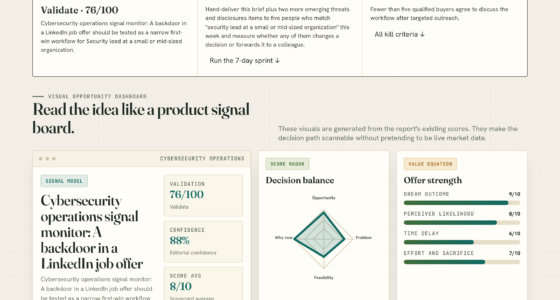

📊 Full opportunity report: The Time Machine Is Open: What The ColdCard Hack Tells Us About The New Security Era on ThorstenMeyerAI.com — validation score, market gap, and execution plan.
TL;DR
A firmware vulnerability in a widely used hardware wallet was exploited to drain over $70 million in Bitcoin from nearly 1,200 wallets. This incident highlights emerging security risks in hardware devices and raises questions about AI’s role in cybersecurity. The event underscores the need for enhanced digital safeguards across all sectors.
On 30 July, hackers drained 1,082 Bitcoin, worth approximately $70 million, from nearly 1,200 wallets using a previously undiscovered firmware bug in a popular hardware wallet. This breach, carried out in less than an hour, exposes critical vulnerabilities in hardware security devices and has significant implications for digital asset safety.
The attack exploited a flaw introduced in a firmware update shipped in March 2021, which rerouted the device’s key generation process from a hardware-based random-number generator to a deterministic software fallback. This change drastically reduced the entropy of generated private keys, making them more predictable and searchable. Once the flaw was understood, attackers could generate private keys offline, match them to public blockchain addresses, and identify wallets with balances. The breach was executed with a script that systematically drained funds from targeted wallets, resulting in losses exceeding $70 million.
CoinKite, the maker of the affected hardware wallet, confirmed that the root cause was an engineering error. Its CEO, Rodolfo Novak, acknowledged that an AI-assisted code review conducted weeks earlier failed to detect the vulnerability, illustrating a new challenge in software security. While there is no public evidence that AI was used directly in the attack, industry experts suggest AI may have contributed to the rapid discovery or tooling involved in the breach.
A firmware error shrank the pool that “random” keys were drawn from. A searchable pool is a drainable one. Here is the mechanism, conceptually — no operational detail.
A March 2021 firmware update rerouted key generation from the device’s hardware random-number generator to a deterministic software fallback — drawing seeds from a dramatically smaller universe.
Once the flaw is understood, the whole attack runs on an ordinary machine — no internet needed until the final move.
Implications for Hardware Wallet Security
This incident underscores a fundamental risk in hardware-based security: even trusted devices can harbor critical flaws. The breach demonstrates how a small firmware mistake can lead to massive financial losses, eroding confidence in hardware wallets. It also signals a shift toward more sophisticated attack vectors that leverage AI and automation, prompting a reevaluation of security protocols across digital asset management and beyond.

Trezor Safe 7 - Crypto Hardware Wallet with Bluetooth, Color Touchscreen, Transparent Secure Element, Quantum-Ready (Charcoal Black)
- Dual-chip architecture: Maximum protection with TROPIC01 and Secure Element
- Quantum-ready security: Protection against future quantum threats
- High-resolution color touchscreen: Easy navigation and transaction review
As an affiliate, we earn on qualifying purchases.
As an affiliate, we earn on qualifying purchases.
Background of Firmware Vulnerabilities in Crypto Devices
Hardware wallets are designed to protect private keys by keeping them offline, relying on secure firmware and hardware components. The March 2021 firmware update introduced a flaw by replacing hardware-based key generation with a deterministic process, reducing entropy and increasing vulnerability. Despite prior audits, the bug remained dormant for over five years, highlighting the challenge of detecting subtle security flaws in complex firmware systems. The attack on July 30 is now viewed as a wake-up call about the evolving landscape of digital security threats.
"This is the sober reality of a new AI paradigm, where AI-assisted code review can surface latent bugs faster than seasoned experts."
— Rodolfo Novak, CEO of CoinKite

CaseSack Bitcoin Hardware Wallet Case for Trezor Bitcoin Wallet, with customized Protection Inlay
- Product Compatibility: For Trezor Bitcoin Wallet
- Design Features: Compact, lightweight, all-in-one organization
- Protection Level: Shock, scratch, water resistant
As an affiliate, we earn on qualifying purchases.
As an affiliate, we earn on qualifying purchases.
Unclear Role of AI in the Attack and Discovery
There is no direct evidence that AI was used to find or execute the attack. While experts suspect AI-assisted tools may have contributed to the rapid discovery or tooling, this remains speculative. The precise mechanisms and whether AI played an active role are still unknown, and investigations are ongoing.

ColdTi - Titanium Bitcoin Seed Plates for Ultra-Secure Ethereum and Crypto Seed Phrase Storage (2 Plates w / 1 Scribe & Anti-Tamper Seals) - Premium Seed Phrase Metal.
- Enhanced Security Compatibility: Works with major hardware wallets
- Premium Titanium Material: Rust-proof, water-proof, high melting point
- Complete Seed Storage Kit: Includes 2 seed plates, holographic stickers, scribe
As an affiliate, we earn on qualifying purchases.
As an affiliate, we earn on qualifying purchases.
Future Security Measures and Industry Response
Manufacturers and security researchers are expected to review firmware development and incorporate more rigorous AI-assisted audits. Industry-wide efforts may focus on detecting subtle bugs before deployment and enhancing hardware security standards. Additionally, legal and regulatory discussions around digital asset safety are likely to intensify, aiming to prevent similar breaches in the future.

TANGEM Crypto Wallet Pack of 3 – Trusted Cold Storage Hardware Wallet
- Proven Security: 9+ years, military-grade EAL6+ security
- Universal Crypto Access: Manage 90 blockchains with one tap
- Wide Cryptocurrency Support: Access 14,100+ coins, tokens, NFTs
As an affiliate, we earn on qualifying purchases.
As an affiliate, we earn on qualifying purchases.
Key Questions
Could this vulnerability affect other hardware wallets?
Yes, if other devices use similar firmware update processes or have comparable entropy reduction flaws, they could be at risk. Manufacturers are expected to review their firmware for similar vulnerabilities.
Is AI responsible for the breach?
There is no confirmed evidence that AI directly caused or executed the attack. However, AI-assisted tools may have played a role in discovering or tooling the vulnerability, according to industry experts.
What can users do to protect themselves now?
Users should stay informed about firmware updates, verify device security practices, and consider diversifying storage methods for digital assets. Regularly reviewing security protocols is advised.
Will this lead to changes in hardware wallet security standards?
It is likely. The incident highlights the need for more rigorous testing, better entropy management, and possibly integrating AI tools more effectively into security audits to prevent similar flaws.
Source: ThorstenMeyerAI.com