
TL;DR

Get business pricing on tech for your team
- Business-only prices and quantity discounts
- Tax-exempt purchasing
- Multiple users, one account, clear invoices
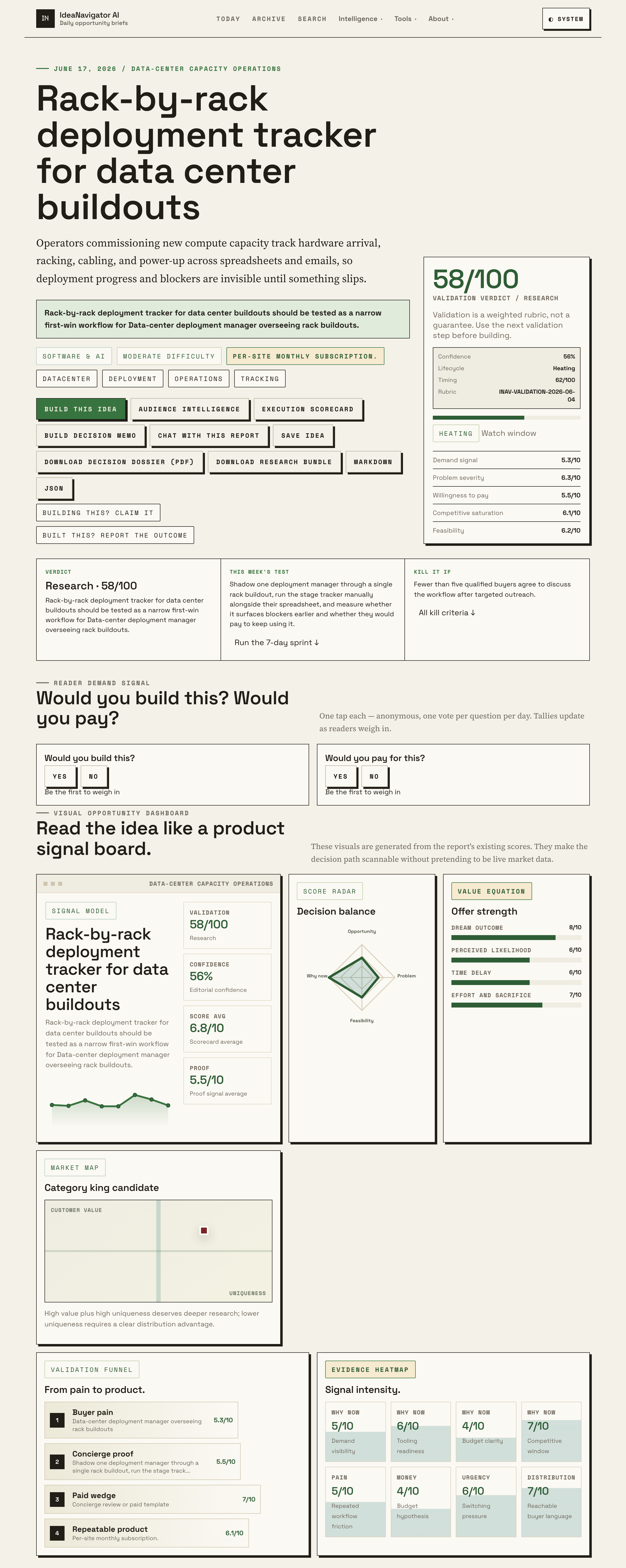
A prototype rack-by-rack deployment tracker for data centers is under trial, aiming to streamline buildout management. It tracks hardware stages and highlights blockers in real time, addressing a critical industry need.
A new rack-by-rack deployment tracker for data center buildouts is being tested as a workflow solution to improve project oversight and reduce delays. The tool targets data center deployment managers overseeing rack installations, aiming to address the current reliance on spreadsheets and emails for tracking hardware deployment progress. Ensuring Data Center Reliability Through Proper Equipment Replacement Timing. This initiative responds to the surge in data center construction driven by AI demand and aims to streamline operations on a per-site basis.
The proposed Minimum Viable Product (MVP) is a simple deployment board where managers log each rack through fixed stages: delivered, racked, cabled, powered, and validated. The tool provides a live percentage of completion and highlights stalled racks, offering real-time visibility into the deployment process. This approach contrasts with current methods that often involve manual tracking via spreadsheets, which can obscure progress and delay identification of issues.
According to an anonymous source involved in the testing, the tracker will be validated by shadowing a deployment manager during a single rack buildout, which highlights the importance of proper equipment management. The tracker will be run manually alongside existing spreadsheets to assess whether it surfaces blockers earlier and if the deployment manager would be willing to pay for ongoing use. The service is planned to operate on a per-site monthly subscription model, targeting data center capacity operators seeking more efficient management tools.
Potential Impact on Data Center Deployment Efficiency
This development could significantly improve the management of data center buildouts, especially as industry demand accelerates. By providing real-time tracking and early blocker detection, the tracker may reduce delays, improve resource allocation, and enable more predictable project timelines. For operators, this tool represents a step toward more automated, transparent workflows, which are increasingly vital as data centers scale rapidly to meet AI-driven demand.
rack deployment tracking software for data centers
As an affiliate, we earn on qualifying purchases.
As an affiliate, we earn on qualifying purchases.
Growing Pressure for Faster Data Center Construction
The data center industry is experiencing record growth, driven largely by the surge in AI applications requiring massive compute capacity. This has led to a rapid increase in new buildouts, often on compressed timelines. Currently, many operators rely on manual tracking methods, which can obscure project status and delay issue resolution. The idea of a dedicated rack-by-rack deployment tracker has emerged as a potential solution to these challenges, with initial testing underway to validate its effectiveness.
Previous efforts have focused on broader project management tools, but the specific need for detailed, stage-by-stage tracking at the rack level has become evident as buildouts become more complex and time-sensitive. Industry insiders see this tracker as a promising tool to fill a critical gap in operational oversight.
data center hardware management tools
As an affiliate, we earn on qualifying purchases.
As an affiliate, we earn on qualifying purchases.
Unconfirmed Long-Term Adoption and Pricing Model
It is not yet clear whether the tracker will be adopted widely across the industry or how effective it will be in real-world scenarios. The subscription pricing model and the actual impact on project timelines remain to be validated through further testing and user feedback. Additionally, how the tool will integrate with existing workflows and whether it can scale to large, complex deployments are still under evaluation.
rack installation progress monitor
As an affiliate, we earn on qualifying purchases.
As an affiliate, we earn on qualifying purchases.
Next Steps in Validation and Industry Rollout
The next phase involves shadowing deployment managers during actual rack buildouts to measure the tracker’s effectiveness in surfacing issues early. Based on these results, developers will refine the tool before considering broader deployment. If successful, the tracker could become a standard component of data center operations, with plans to expand its features and customer base.
data center buildout project management tools
As an affiliate, we earn on qualifying purchases.
As an affiliate, we earn on qualifying purchases.
Key Questions
How does the rack-by-rack deployment tracker work?
The tracker logs each rack through fixed stages—delivered, racked, cabled, powered, validated—and provides real-time updates on progress and stalled racks, helping managers identify issues early.
Will this tracker replace existing project management tools?
It is designed to complement current workflows by providing detailed, stage-by-stage visibility at the rack level, not to replace broader project management systems.
What is the pricing model for the tracker?
The plan is to offer a per-site monthly subscription, but pricing details are still under development and will depend on the final product features and industry feedback.
When will the tracker be available for wider use?
The current phase involves testing and validation; a broader rollout is expected after successful trials, likely within the next year, depending on feedback and development progress.
What benefits does this tracker offer over manual tracking?
It offers real-time visibility, early detection of blockers, and streamlined communication, which can significantly reduce delays and improve buildout predictability.
Source: IdeaNavigator AI
Halloween Picks
halloween
As an affiliate, we earn on qualifying purchases.