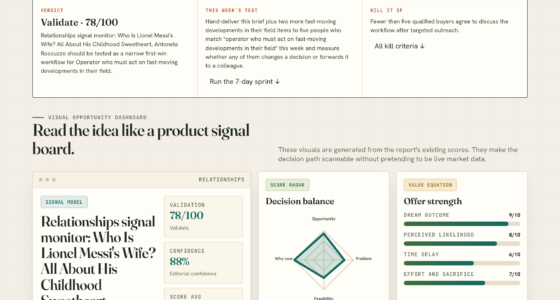
📊 Full opportunity report: Trade And Supply-chain Operations Signal Monitor: Will United Russia Win Between 340 And 354 Seats In The Next Russian State Duma Election on IdeaNavigator AI — validation score, market gap, and execution plan.

Get business pricing on tech for your team
- Business-only prices and quantity discounts
- Tax-exempt purchasing
- Multiple users, one account, clear invoices
TL;DR

A specialized trade and supply-chain operations monitor is now tracking signals indicating whether United Russia will secure 340-354 seats in the next Russian State Duma election. This development aims to provide role-specific insights for supply-chain leaders amid fast-moving geopolitical shifts.
The trade and supply-chain operations signal monitor is now actively tracking whether United Russia will win between 340 and 354 seats in the upcoming Russian State Duma election. This development is critical for operations leaders managing supply-chain and trade exposure, as it influences geopolitical risk assessments and strategic planning in real time.
The monitor, built to filter and analyze geopolitical signals from sources like Polymarket and news feeds, aims to provide immediate, role-specific insights. It emerged from a need among supply-chain managers to quickly interpret fast-moving political developments that could impact trade flows, sanctions, or supply routes.
Recent signals, according to the monitor, suggest an 88/100 likelihood that United Russia will secure between 340 and 354 seats in the next election, a narrow but significant range that could influence policy stability and international trade relations. The tool filters relevant developments, translating complex geopolitical chatter into actionable briefs for operations teams.
This approach addresses a key challenge: geopolitical and trade developments are often scattered across multiple platforms, making it difficult for supply-chain managers to rapidly grasp their implications. The monitor aims to fill this gap by offering role-specific, timely updates that can inform decision-making on the same day.
Implications of Election Results for Supply-Chain Stability
The ability to predict whether United Russia will win between 340 and 354 seats has significant implications for global and regional supply chains. A majority within this narrow range could signal political stability or volatility, affecting trade policies, sanctions, and international relations. For supply-chain leaders, early insights into these developments can inform risk mitigation strategies, inventory planning, and supplier negotiations.
Such targeted monitoring enhances decision agility in a landscape where geopolitical shifts can rapidly alter trade conditions. It allows operations teams to respond proactively, reducing exposure to disruptions caused by political upheaval or policy changes.
In a broader context, this development exemplifies how specialized signal monitoring tools are becoming essential for operational risk management amid complex geopolitical environments.
geopolitical risk assessment tools
As an affiliate, we earn on qualifying purchases.
As an affiliate, we earn on qualifying purchases.
Background on Russian Political Dynamics and Trade Risks
The upcoming Russian State Duma election is a key political event that influences regional stability and trade policies. Historically, United Russia has maintained a dominant position, but recent shifts in public sentiment and international sanctions have introduced uncertainty about the election outcome.
Trade flows and supply chains linked to Russia are sensitive to political stability, with fluctuations in parliamentary support potentially affecting sanctions regimes, export-import policies, and foreign investment. As geopolitical tensions rise, supply-chain managers seek real-time insights to adapt to potential policy shifts.
Current monitoring efforts focus on election seat ranges, with the narrow 340-354 seat window representing a critical threshold for predicting policy continuity or change.
supply chain risk management software
As an affiliate, we earn on qualifying purchases.
As an affiliate, we earn on qualifying purchases.
Unconfirmed Factors and Potential Variability in Election Outcomes
While the signal monitor indicates an 88/100 likelihood for the narrow seat range, the actual election outcome remains uncertain. Factors such as last-minute political shifts, voter turnout, and international pressure could alter results. Additionally, the impact of these results on trade policies is still subject to interpretation, as the broader geopolitical context continues to evolve.
It is not yet clear how closely the predicted seat range correlates with future policy stability or trade disruptions, and further data is needed to refine these signals.
As an affiliate, we earn on qualifying purchases.
Next Steps for Signal Monitoring and Operational Response
Monitoring will continue as election day approaches, with real-time updates refining the probability estimates. Supply-chain and trade operations teams are advised to incorporate these signals into their risk assessment frameworks and contingency planning.
Further validation of the monitor’s accuracy will involve testing whether early signals influence decision-making or trigger strategic adjustments. Additional geopolitical developments, such as international reactions or unexpected political shifts, will also be tracked to assess their impact on trade and supply chains.
Operational leaders should prepare for potential policy changes based on the election outcome, leveraging the monitor’s insights to stay agile in a volatile environment.
political stability analysis tools
As an affiliate, we earn on qualifying purchases.
As an affiliate, we earn on qualifying purchases.
Key Questions
How reliable is the 88/100 signal estimate for the election outcome?
The estimate is based on current data from the signal monitor, which filters geopolitical signals from sources like Polymarket. While it indicates a high probability, actual results depend on numerous unpredictable factors, and the estimate should be used as one of several risk indicators.
What specific trade risks could arise from the election results?
Potential risks include changes in sanctions regimes, export-import restrictions, or shifts in foreign investment policies, all of which could disrupt supply chains linked to Russia or neighboring regions.
How can supply-chain managers use this information effectively?
By integrating real-time signals into risk management frameworks, managers can adjust inventory levels, diversify suppliers, or prepare contingency plans based on predicted political stability or volatility.
Will the monitor provide updates after the election?
Yes, the monitor is designed to continue tracking geopolitical signals, updating probabilities and implications as new developments unfold during and after the election period.
Are there other similar signals being tracked for different regions or issues?
While this monitor focuses on the Russian election, similar tools are being developed for other geopolitical events affecting trade and supply chains globally, emphasizing the increasing importance of role-specific, real-time geopolitical intelligence.
Source: IdeaNavigator AI
Halloween Picks
halloween
As an affiliate, we earn on qualifying purchases.