📊 Full opportunity report: Retirement Care Planner on IdeaNavigator AI — validation score, market gap, and execution plan.
Listen free for 30 days with Audible
Thousands of audiobooks and originals — cancel anytime.
Start your free trialAs an affiliate, we earn on qualifying purchases.
TL;DR
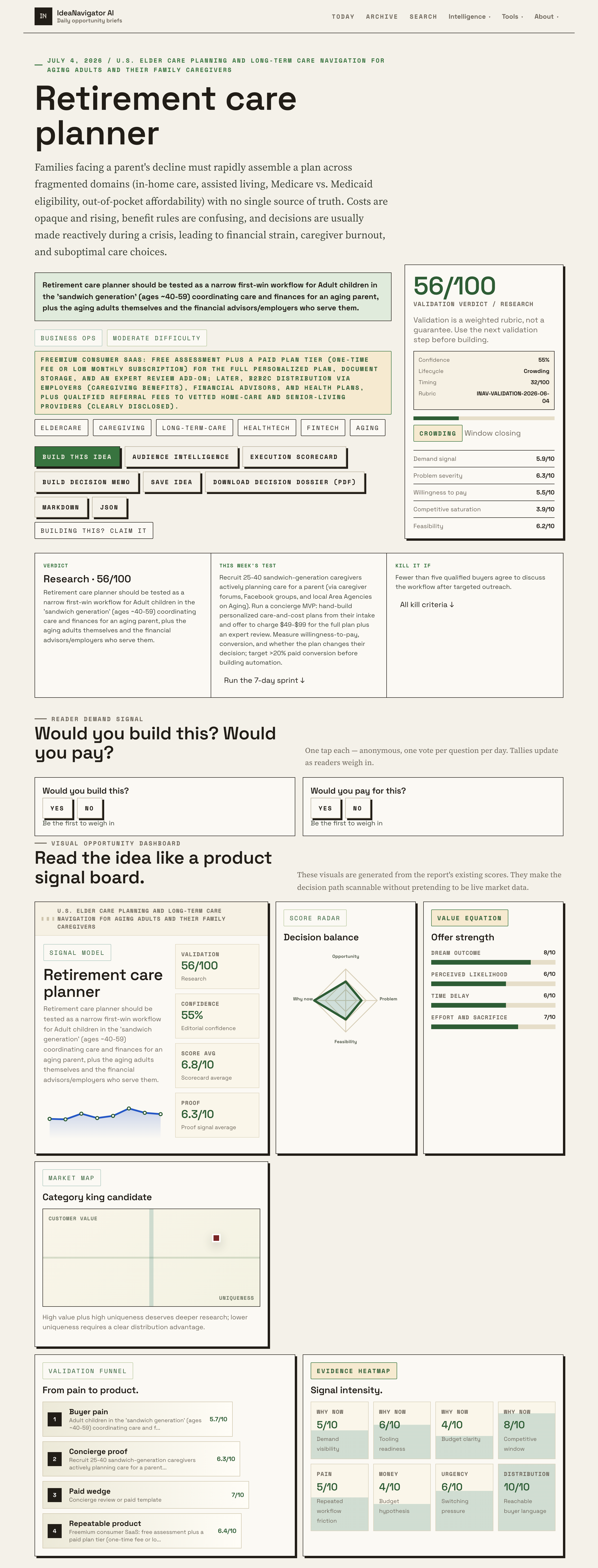
A pilot program is launching a retirement care planner web app designed for adult children managing aging parents’ care. It aims to provide personalized cost and care options. The initiative seeks to validate demand and usability among caregivers.
A new digital retirement care planner is being tested as a focused, initial workflow for adult children in the ‘sandwich generation’ to coordinate care and finances for aging parents. The tool aims to address widespread challenges in fragmented elder care decision-making, offering personalized guidance based on individual family situations. This development reflects an urgent need as demographic trends and rising costs make long-term care planning increasingly complex and urgent.
The retirement care planner is designed as a guided web application that, after a brief intake, generates a personalized care and cost plan for aging parents. It includes localized cost comparisons for options like in-home care, assisted living, and nursing homes, as well as explanations of Medicare and Medicaid eligibility, affordability projections, and prioritized action checklists with vetted local providers.
The initiative is currently in the pilot phase, recruiting 25-40 caregivers actively involved in planning. The initial offering is a concierge MVP, providing personalized plans for a fee of $49 to $99, with the goal of measuring willingness to pay, conversion rates, and whether the plans influence decision-making. The project aims to validate whether families will pay for structured guidance amid rising elder care costs, which have surged in recent years, with median assisted living costs reaching $6,200 per month and nursing home costs around $115,000 annually.
This effort is part of broader efforts to modernize elder care planning by integrating technology, reduce reactive crisis-driven decisions, and alleviate caregiver burnout. The platform also envisions future monetization through freemium models, employer-sponsored caregiving benefits, and referral fees from vetted service providers.
Why a Digital Retirement Care Tool Matters Now
This development is significant because it addresses the urgent need for structured, accessible elder care planning amid rising costs and demographic shifts. As nearly 73 million Americans will be 65+ by 2030, and with a high likelihood of requiring long-term care, families face mounting financial and emotional pressures. The tool aims to reduce decision fatigue, improve care quality, and potentially lower costs by providing clear, localized options. Its success could lead to broader adoption, transforming how families and providers approach elder care management and easing the strain on caregivers and the healthcare system.

Age In Place At Home: Adapting The Home Environment For All Generations
As an affiliate, we earn on qualifying purchases.
As an affiliate, we earn on qualifying purchases.
Rising Costs and Complexity Drive Need for Planning Tools
Recent years have seen sharp increases in elder care costs, with median assisted living expenses reaching $6,200 monthly and nursing home costs around $115,000 annually. Meanwhile, the U.S. population is aging rapidly, with nearly 73 million people over 65 projected by 2030. Currently, families often make care decisions reactively, facing opaque costs, complex benefit rules, and fragmented service options. This has led to financial strain, caregiver burnout, and suboptimal care choices. Existing planning approaches are often manual, inconsistent, and reactive, creating a clear market opportunity for digital, data-driven solutions.
Early efforts to develop elder care planning tools have faced challenges, but recent technological advances and increased demand have renewed interest. The current pilot aims to test whether a guided, personalized approach can meet families’ needs effectively and affordably, setting the stage for broader deployment.
“Families are overwhelmed by the complexity and costs of elder care, often making decisions in crisis mode. A guided digital tool could change that.”
— an anonymous researcher

Bedroom Dementia Sign Metal Tin Sign 8×12 Inch for Home, Assisted Living, Memory Care Facility, Bedroom Door, Resident Room Wall Decor
- Product Type: Bedroom Metal Sign
- Material: Sturdy Metal Construction
- Design: Bright Yellow Background with Black Text
As an affiliate, we earn on qualifying purchases.
As an affiliate, we earn on qualifying purchases.
Uncertainties Around Adoption and Effectiveness
It remains unclear how many caregivers will be willing to pay for such personalized planning services, and whether the plans generated will significantly influence their decisions. The pilot is still recruiting participants, and results on user engagement, satisfaction, and cost savings are not yet available. Additionally, the scalability of the platform and its integration into existing elder care ecosystems are still being tested.

The Medicaid Planning Guidebook: Fourth Edition
As an affiliate, we earn on qualifying purchases.
As an affiliate, we earn on qualifying purchases.
Next Steps in Validation and Broader Deployment
The project will continue recruiting caregivers for the pilot, aiming to gather data on willingness-to-pay, plan utility, and decision impact. If results are positive, the team plans to refine the platform, expand testing, and explore partnerships with employers, financial advisors, and elder care providers. Success could lead to a wider rollout and integration into elder care benefits and services, ultimately transforming long-term care planning for millions of families.

Quicken WillMaker & Trust 2026 – Estate Planning Software – Will, Living Trust, Health Care Directive, Financial, Power of Attorney – Legally Binding- CD – PC/Mac & Online
- Versatile Installation Options: CD, download, or online access
- Comprehensive Estate Planning Tools: Wills, trusts, POA, health directives
- Legally Binding Documents: Create legally valid estate plans
As an affiliate, we earn on qualifying purchases.
As an affiliate, we earn on qualifying purchases.
Key Questions
What is the main goal of the retirement care planner?
The primary goal is to provide families with personalized, localized elder care and cost options, helping them make informed decisions and plan financially for long-term care needs.
How does the platform generate personalized plans?
It collects basic information about the parent’s health, location, finances, and family situation, then uses public data and guidelines to produce a tailored care and cost comparison, eligibility explanations, and action checklist.
Who is the target user for this tool?
Adult children in the ‘sandwich generation’ (ages approximately 40-59) who are actively involved in coordinating care and finances for their aging parents.
When will the platform be widely available?
The current phase is pilot testing; broader availability depends on pilot outcomes. If successful, further development and partnerships are planned over the next year.
What are the potential benefits of using this tool?
It could reduce decision-making stress, improve care quality, lower costs, and help families avoid reactive crises by providing proactive, data-driven guidance.
Source: IdeaNavigator AI
Pool season Picks
robotic pool cleaners
As an affiliate, we earn on qualifying purchases.