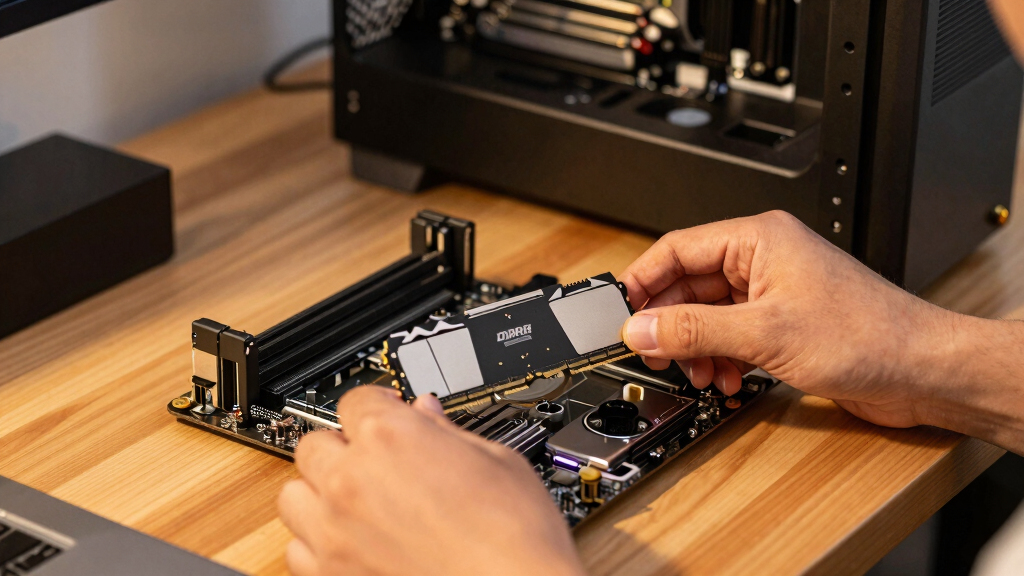

📊 Full opportunity report: DDR5 Now, DDR6 Soon: A Buyer’s Field Guide on ThorstenMeyerAI.com — validation score, market gap, and execution plan.
Listen free for 30 days with Audible
Thousands of audiobooks and originals — cancel anytime.
Start your free trialAs an affiliate, we earn on qualifying purchases.
TL;DR
In 2026, DDR5 remains the best choice for most buyers due to high prices and limited benefits from waiting. DDR6 is not yet practical for mainstream use and won’t be affordable until at least 2027-2030.
Consumers and builders should buy DDR5 memory now for 2026 and beyond, as forecasts indicate that waiting for DDR6 will not be cost-effective or practical until at least 2027.
Market forecasts suggest that DDR5 prices will remain high until 2028, making waiting for a price drop unwise for most buyers. DDR6, which promises significant performance improvements, will not be available at mainstream prices until 2027 or later and will require new platforms, including a new CPU, chipset, and modules, as DDR6 is not backward compatible with DDR5.
For current builds, the recommended DDR5 configuration is DDR5-6000 with CL30 timings, which balances performance and cost. Higher speeds like DDR5-8000 are generally unnecessary for most users, as they offer minimal real-world gains. Capacity-wise, 32GB is sufficient for most tasks, with 64GB recommended for heavier multitasking or content creation. Buying more than 64GB is discouraged unless specialized workloads justify it, as excess capacity can lock in high prices without immediate use.
Manufacturers have phased out DDR4, and its current cost per gigabyte is comparable to DDR5, making DDR4-based systems a poor investment for new builds. Instead, new systems should adopt DDR5 to ensure future compatibility and performance.
DDR5 now, DDR6 soon
A buyer’s field guide. The 20-year instinct — wait for prices to drop, or wait for the next generation — is broken this cycle. Buy the DDR5 you actually need now; don’t wait for DDR6. Here’s the reasoning.
Driven to end-of-life, production slashed. Same money, dead-end socket. Leave a working DDR4 box alone — but never start a new build on DDR4 to “save.”
A framework, not a gamble. Buy the DDR5 you need now, at the sweet spot, in the capacity you’ll actually use — don’t buy DDR4, don’t wait for DDR6. The two costliest mistakes in this market are the ones that feel prudent: waiting for a price drop that isn’t coming, and waiting for a next-gen part that launches dearer than what’s on the shelf. Next: The SSD Squeeze.
Why Buying DDR5 Now Is the Best Choice in 2026
Most consumers and builders will benefit from purchasing DDR5 now because DDR6 is still in development, expensive, and incompatible with current platforms. Waiting for DDR6 delays performance upgrades and incurs higher costs, while the current DDR5 market offers a practical, cost-effective solution for the foreseeable future. This decision impacts overall system performance, upgrade plans, and budget management.
As an affiliate, we earn on qualifying purchases.
Market Trends and Development Timeline for DDR Memory
Historically, memory prices tend to drop after new generations launch, but in 2026, forecasts indicate that DDR5 prices will remain high until at least 2028. DDR6, expected to offer doubled bandwidth and new physical form factors, is staged for release starting in 2026 for enterprise and AI applications, with mainstream adoption projected around 2027–2030. Its initial high cost and platform requirements mean it is not suitable for most users in 2026.
Previous memory upgrades, such as DDR4 to DDR5, took several years to become mainstream and affordable, a pattern unlikely to change in the near term for DDR6. The slow adoption curve emphasizes the importance of investing in current-generation memory for immediate performance gains.
“DDR6 will require entirely new platforms, and early adoption will come with significant costs and instability.”
— Industry sources

Crucial 32GB DDR5 RAM Kit (2x16GB), 5600MHz (or 5200MHz or 4800MHz) Laptop Memory 262-Pin SODIMM, Compatible with Intel Core and AMD Ryzen 7000, Black – CT2K16G56C46S5
- Memory Capacity: 32GB DDR5 RAM Kit (2x16GB)
- Memory Speed: 5600MHz, 5200MHz, or 4800MHz
- Performance Boost: Enhances multitasking and responsiveness
As an affiliate, we earn on qualifying purchases.
As an affiliate, we earn on qualifying purchases.
Uncertainties Around DDR6 Adoption and Pricing
While DDR6 promises higher bandwidth and new features, its exact pricing, availability, and compatibility timeline remain uncertain. The transition to DDR6 depends on motherboard and CPU manufacturers adopting the new standard, which could be delayed or disrupted by market conditions or technological challenges.
It is not yet clear when DDR6 will become affordable or widespread enough for mainstream consumers to consider an upgrade. Early modules and platforms are expected to be limited and expensive, with full adoption not until at least 2027–2030.

CORSAIR Vengeance LPX DDR4 RAM 32GB (2x16GB) Up to 3200MHz CL16-20-20-38 1.35V Intel XMP AMD EXPO Computer Memory – Black (CMK32GX4M2E3200C16)
- Maximum Speed Note: Requires overclocking and BIOS adjustments
- High Performance Chips: Hand-sorted for overclocking potential
- Wide Compatibility: Optimized for Intel and AMD DDR4 motherboards
As an affiliate, we earn on qualifying purchases.
As an affiliate, we earn on qualifying purchases.
Key Milestones to Watch for DDR6 Readiness
Consumers should monitor JEDEC standard approvals and motherboard manufacturer compatibility lists for DDR6 modules and controllers. The first compatible systems and modules are expected to appear in late 2026 or early 2027, primarily targeting enterprise and high-end workstation markets. Mainstream adoption will likely follow in 2027–2028, with prices gradually decreasing as the ecosystem matures.
Until then, investing in current DDR5 platforms remains the most practical approach for most users, with upgrades aligned to actual workload requirements rather than speculative future needs.

ADATA DDR5 5600 SO-DIMM Memory Module – 16GB High Bandwidth Laptop Memory Module (RAM) – High-Speed 5600MHz – Automatic Error Correction – Compatible with AMD & Intel Platforms – AD5S560016G-S
- High-Speed DDR5 Memory: 5600MHz performance for fast computing
- 16GB Capacity: High bandwidth laptop memory expansion
- Broad Compatibility: Works with AMD and Intel platforms
As an affiliate, we earn on qualifying purchases.
As an affiliate, we earn on qualifying purchases.
Key Questions
Should I buy DDR4 or DDR5 in 2026?
Buy DDR5 for new builds or upgrades in 2026. DDR4 is end-of-life, and current prices make DDR4-based systems a poor investment for future-proofing.
Is waiting for DDR6 worth it?
For most users, waiting for DDR6 is not advisable in 2026 due to high costs, platform incompatibility, and limited immediate benefits. DDR6 is expected to be more practical around 2027–2030.
What DDR5 speed should I aim for?
DDR5-6000 with CL30 timings offers a good balance of performance and cost for most users. Higher speeds like DDR5-8000 generally do not provide meaningful real-world improvements.
How much capacity do I need?
For most users, 32GB is sufficient for gaming and general use, while 64GB is better for content creation and heavy multitasking. Avoid overbuying capacity that may sit unused for years.
Will DDR6 be compatible with current systems?
No, DDR6 will require new motherboards and CPUs. It is not backward compatible with DDR5 or DDR4 platforms, so a full platform upgrade is necessary.
Source: ThorstenMeyerAI.com
Pool season Picks
robotic pool cleaners
As an affiliate, we earn on qualifying purchases.