
📊 Full opportunity report: How LFM2.5 Encoders Accelerate Long-Context AI Inference On CPUs on ThorstenMeyerAI.com — validation score, market gap, and execution plan.

Get business pricing on tech for your team
- Business-only prices and quantity discounts
- Tax-exempt purchasing
- Multiple users, one account, clear invoices
TL;DR
Liquid AI has launched two new language encoder models, LFM2.5-Encoder-230M and 350M, claiming significant CPU inference speed improvements on long inputs. These models aim to enhance document processing tasks without dedicated hardware. Independent testing is awaited to confirm performance claims.
Liquid AI has introduced two general-purpose language encoder models, LFM2.5-Encoder-230M and LFM2.5-Encoder-350M, claiming they deliver up to 3.7 times faster inference on long inputs using ordinary CPUs. For details on how these models achieve such speedups, see the original analysis. This development could significantly impact document-heavy AI workloads, enabling faster processing without specialized hardware.
The new models support an 8,192-token context window, making them suitable for tasks involving lengthy documents such as contracts, transcripts, and support conversations. Liquid AI reports that, in tests, the 230M model processes 8,192 tokens in approximately 28 seconds, compared to over 90 seconds for ModernBERT-base, according to company claims. The models are derived from Liquid AI’s LFM2.5 decoder backbones, converted into bidirectional encoders through architectural adjustments, including masked-language training with 30% masked tokens.
These models are designed for classification, extraction, routing, and token-labeling tasks, with evaluations indicating competitive performance on benchmarks like GLUE and SuperGLUE. Their architecture is inspired by recent advances in efficient long-context encoding, as detailed in the original analysis. Liquid AI emphasizes their suitability for CPU-based workloads, especially where long input processing and inference speed are critical. However, independent verification of these performance metrics is still pending, and the models are currently available via Hugging Face for developers to test and fine-tune. For more technical insights, see the original analysis.
Potential Impact on CPU-Based Long-Text AI Tasks
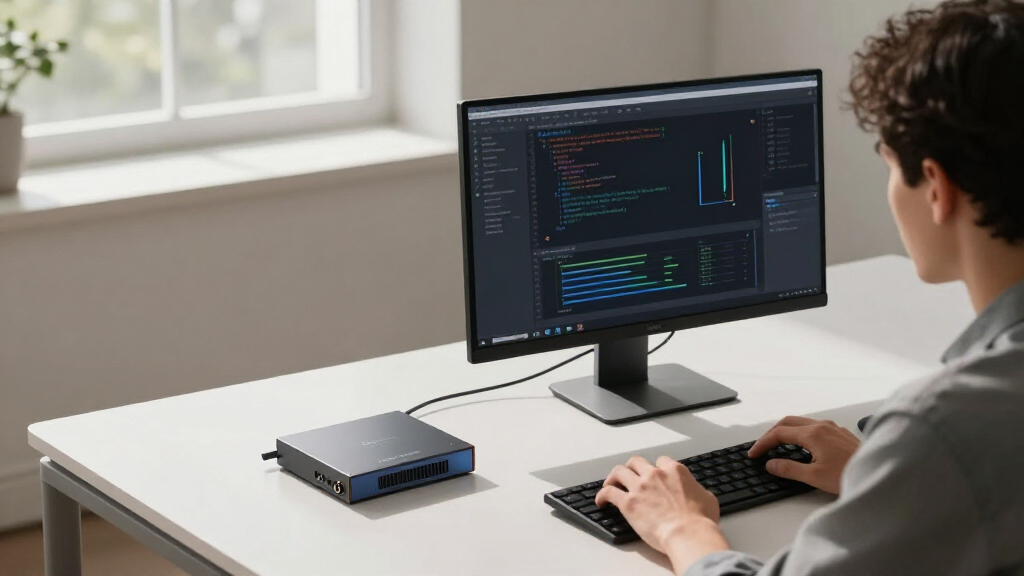
If independently validated, the reported speed improvements could transform how organizations handle document processing tasks. Faster inference on CPUs makes real-time classification, routing, and extraction feasible at scale without investing in specialized accelerators, reducing costs and hardware complexity. This development could benefit sectors like legal, finance, and customer support, where processing large documents efficiently is essential.
CPU AI inference acceleration hardware
As an affiliate, we earn on qualifying purchases.
As an affiliate, we earn on qualifying purchases.
Development of Liquid AI’s Encoder Models and Benchmarks
Liquid AI previously developed LFM2.5-Retrievers for multilingual search, now extending their architecture to general-purpose encoders. The models are trained in two stages: initial masked-language learning on 1,024-token sequences, followed by extension to 8,192 tokens with diverse data, aiming to improve factual, legal, and multilingual accuracy. The company reports that the 350M model ranks fourth among 14 models on benchmark tests, with the 230M outperforming several BERT variants, including ModernBERT-base.
The models’ release aligns with a broader industry push towards efficient, long-context AI models capable of running on standard hardware, addressing a key limitation of many large language models that require GPUs or TPUs for effective deployment.
“Today, we release two new encoder models on Hugging Face: LFM2.5-Encoder-230M and LFM2.5-Encoder-350M.”
— Liquid AI spokesperson
As an affiliate, we earn on qualifying purchases.
Unverified Performance Claims and Testing Conditions
It remains unclear how the models will perform across different hardware architectures, software stacks, and real-world workloads. The reported benchmarks are company-provided, with no independent replication yet available. Details on memory consumption, fine-tuning costs, and accuracy in diverse scenarios are still unknown, raising questions about the consistency of the claimed speed advantages.
As an affiliate, we earn on qualifying purchases.
Awaiting Independent Benchmark Validation and Real-World Testing
Future steps include independent benchmarking of the models across various CPU setups and workloads. Developers are expected to run tests using the Hugging Face library, with results needed to confirm the speed and accuracy claims. Monitoring how these models perform in practical applications such as contract analysis, policy filtering, and multilingual classification will determine their industry impact.
high-performance AI encoders for long texts
As an affiliate, we earn on qualifying purchases.
As an affiliate, we earn on qualifying purchases.
Key Questions
What are the main features of Liquid AI’s LFM2.5 encoders?
The models support 8,192 tokens, are designed for classification and extraction tasks, and claim to provide faster CPU inference for long texts compared to existing models like ModernBERT-base.
How do the models compare in speed and accuracy?
According to Liquid AI, the 230M model is approximately 3.7 times faster than ModernBERT-base on long inputs, but independent tests are needed to verify these claims.
Can these models replace GPU-based large language models?
They are intended for CPU-based workloads involving long texts, where speed and resource efficiency are critical, but may not match the capabilities of large generative models for open-ended tasks.
When will independent performance evaluations be available?
There is no specific timeline yet; testing is expected to follow the models’ release, with results providing clarity on their real-world performance.
What industries could benefit from these models?
Legal, financial, customer support, and compliance sectors could see improvements in document processing speed and efficiency.
Source: ThorstenMeyerAI.com
Halloween Picks
halloween
As an affiliate, we earn on qualifying purchases.