
🔍 Read the full analysis: What An Economist Says About AI’s Costs And Returns on ThorstenMeyerAI.com

Get business pricing on tech for your team
- Business-only prices and quantity discounts
- Tax-exempt purchasing
- Multiple users, one account, clear invoices
TL;DR
Apollo chief economist Torsten Slok argues that available aggregate data show no clear financial payoff from AI for companies outside the technology sector. That finding is not proof that AI produces no returns: company-level results vary, and some task-specific studies report measurable gains, while AI infrastructure spending and financing needs continue to grow.
Apollo chief economist Torsten Slok said in an October 24 research note that available data show no visible financial payoff from AI for companies outside the technology sector, even as spending on data centers, chips and cloud capacity accelerates. The claim describes broad economic indicators, not a finding that every non-tech company has earned zero from AI, and it has sharpened questions about whether returns will catch up with the costs.
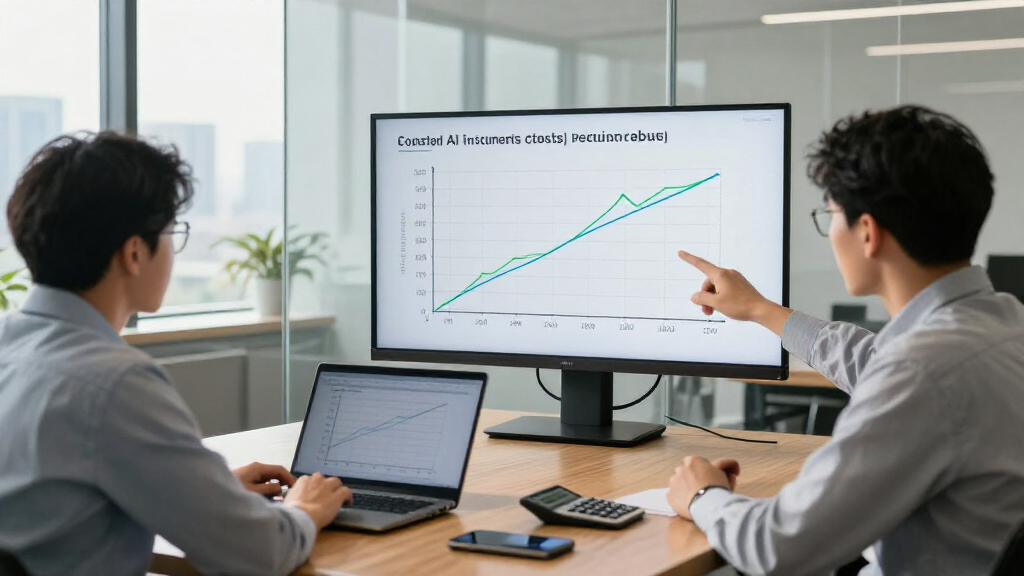
Apollo’s note, titled No Signs of AI Payoff Outside the Tech Sector, compares the seven largest US technology companies — Alphabet, Amazon, Apple, Meta, Microsoft, Nvidia and Tesla — with the other 493 companies in the S&P 500. Apollo’s charts show revenue per worker and profit margins rising for the seven, while those measures have been broadly flat for the other group. The note also points to San Francisco Federal Reserve productivity measures that, Apollo says, show no clear AI-driven lift in productivity growth so far.
The data do not directly isolate AI’s effect. A flat average for 493 companies could conceal firms gaining and losing, and the comparison cannot separate AI from other forces such as labor costs, tariffs or interest rates. Apollo also cites spending data from Ramp, a corporate-card and spending platform, whose customers are not the same as the S&P 500. In that dataset, the top 10% of firms account for most measured spending on model inference, neocloud services and products from OpenAI and Anthropic.
The investment totals show the scale of the build-out. Meta reported $34.91 billion in capital expenditures in the third quarter and narrowed its 2026 spending forecast to $135 billion-$145 billion. Its October 22 filing lists roughly $355.73 billion in leases not yet started and $454.52 billion in non-cancelable contractual commitments, plus up to $14.72 billion in contingent cloud purchases. These items total about $825 billion, but are future commitments rather than cash already spent, and not all are exclusively for AI.
Infographic 01 · The “zero” in numbers
What “zero financial payoff” actually measures.
Apollo’s headline rests on five charts. Here are their numbers, and what they can and cannot prove.
Who pays for AI? Share of spending by the top 10% of firms
Ramp customer data via Apollo · non-AI categories in grey for comparison
Spending is concentrated in every category, not only AI; AI is the most extreme.
What the five charts do and do not show
shown not shown
- Shown: revenue per worker and margins rising for the 7 tech giants, flat for the other 493
- Shown: no AI lift yet in US productivity statistics (San Francisco Fed TFP, output per hour)
- Shown: AI spending sits in few, mostly venture-funded firms (Ramp, 85,000+ US businesses)
- Not shown: that AI caused the gap; rates, tariffs and wages move the same lines
- Not shown: gains inside single functions, which can cancel out in an average
- Not shown: the S&P 493 itself in the Ramp data; those are Ramp’s customers
“The AI story will be decided in the S&P 493, not the Mag 7.”Torsten Slok, Apollo chief economist, 24 Oct 2026 (opinion)
Sources: Apollo Daily Spark (24 Oct 2026) with charts by Bloomberg, Macrobond, SF Fed, BLS and Ramp; Apollo (20 Oct 2026); Ramp AI Index. Values with ≈ are read off Apollo’s charts. Assessment: Thorsten Meyer.
Powered by Thorsten Meyer AI
The Cost of AI Infrastructure
The gap between investment and measurable returns matters to companies deciding whether to expand AI use, and to investors financing the infrastructure behind it. Large commitments create obligations over time, while the revenue or productivity gains that might justify them remain difficult to identify across much of the corporate economy. If returns stay concentrated among technology companies and a limited number of users, other firms may face pressure to explain the expense or rein it in.
Financing is another pressure point. The source material reports that SpaceX borrowed $40 billion to buy AI chips and that insurance costs for debt associated with Meta and CoreWeave rose. Those developments do not by themselves establish that borrowers cannot meet their obligations, but they point to greater attention to how AI infrastructure is funded. Forecasts for major technology companies’ future capital spending are projections, not confirmed spending commitments.
There is also evidence that AI can improve specific tasks. The material cites a customer-support study reporting 14% more issues resolved per hour, with a 34% gain among novice workers, and retail experiments reporting sales changes ranging from zero to 16.3%, depending on workflow. These are task-level results, not proof of economy-wide gains. The distinction matters: a tool can help in a particular operation without yet lifting a company’s overall margins or productivity statistics.
Products Worth Considering

Jackery Explorer 300 Portable Power Station, 292Wh

Jackery Explorer 2000 v2 Portable Power Station with Two 200W Solar Panels

Amazon Kindle Paperwhite Signature Edition (12th Generation, 2024), 32 GB, Metallic Black
As an affiliate, we earn on qualifying purchases.
What Apollo’s Data Covers
Slok’s note was published October 24 and drew coverage from outlets including TechCrunch, PYMNTS and Bloomberg over the following days. Its central comparison is between the Magnificent Seven and the remaining S&P 500 companies, using revenue per worker, margins and productivity indicators. Apollo’s conclusion concerns what can be seen in aggregate measures; it is not a controlled estimate of AI’s causal effect on each business.
The note also describes AI spending as concentrated. Ramp data cited by Apollo show the top 10% of the platform’s firms accounting for 99.5% of recorded model-serving and inference spending, 99.0% of neocloud spending and 95.6% of spending on OpenAI and Anthropic. Apollo says 80.4% of the top 1% of AI spenders in the dataset are venture-backed, compared with 13.1% of the median spender. Those figures describe Ramp’s customer base and should not be treated as a census of all US companies.
Other evidence points in the same direction on broad productivity, but not to a settled verdict on individual uses. The source material says a survey of nearly 9,000 executives found 83% reported no productivity impact so far, with an average reported impact of 0.2% a year. Survey responses and national productivity series measure different things from controlled experiments in customer support or retail. Together, they suggest that reported gains may be real in some workflows while remaining hard to detect across firms and the wider economy.
“AI has delivered zero financial payoff to corporate America outside of tech.”
— Torsten Slok, Apollo chief economist, in the October 24 Daily Spark note
Returns Remain Hard to Isolate
The available figures do not establish how much AI has caused changes in revenue, margins or productivity. The S&P 500 comparison is an aggregate, and the Ramp figures represent that platform’s customers. How much of the measured spending is producing durable gains, and how much is experimentation or infrastructure capacity ahead of demand, remains unclear.
Meta’s approximately $825 billion figure combines leases and contractual commitments extending over time; it is not a bill due immediately and is not all AI-related. The source material also does not provide enough detail to assess the terms or repayment risks of SpaceX’s borrowing, or to quantify the effects of higher debt-insurance costs for Meta and CoreWeave. The specific methods and time periods behind some cited task-level results are not fully set out.
Slok’s word “zero” is stronger than what aggregate indicators alone can prove. A lack of a visible economy-wide signal is not the same as proof of no benefit in any company, and current figures cannot settle whether returns will rise as tools improve or adoption spreads.
Evidence to Watch in Results
Investors and businesses will be watching upcoming company filings and earnings for clearer links between AI investment and revenue, margins or productivity. For Meta, later reports can show how capital spending compares with cash generation and whether its stated commitments change. Actual spending, future obligations and forecasts should be tracked separately as companies update their plans.
Broader productivity data and more detailed studies of particular workflows may help clarify whether reported task-level improvements spread across organizations. Until then, Apollo’s note offers a reading of current aggregate trends, not a final verdict on AI’s economic value. The main test is whether companies outside the technology sector can show sustained, attributable gains that justify the costs.
Key Questions
What did Torsten Slok mean by “zero financial payoff”?
Slok was describing aggregate trends outside the technology sector: Apollo’s charts show revenue per worker and profit margins broadly flat for the other 493 S&P 500 companies. The figures do not prove that no individual non-tech company has benefited from AI.
Does Apollo’s analysis prove AI has no productivity benefits?
No. The note says broad productivity measures do not yet show a clear AI-driven boost. Some task-level studies cited in the source material report gains, but they do not establish an economy-wide effect or explain results at every company.
What is included in Meta’s roughly $825 billion figure?
It combines about $355.73 billion in leases not yet started, $454.52 billion in non-cancelable contractual commitments and up to $14.72 billion in contingent cloud purchases. These are future obligations, not cash already paid, and the total is not exclusively for AI.
Where have companies reported measurable AI gains?
The source material cites customer-support results of 14% more issues resolved per hour, rising to 34% for novice workers, and retail experiments with sales changes from zero to 16.3% depending on the workflow. Those figures concern specific applications, not a general return for all businesses.
What evidence could clarify whether AI spending is paying off?
Future company filings, earnings results and productivity data may show whether AI investment is linked to durable gains in revenue, margins or output. More detail on study methods and how results carry over from individual tasks to whole organizations would also help.
Source: ThorstenMeyerAI.com