
📊 Full opportunity report: A Look At IEP Negotiation Rehearsal Tools Built For Parents on IdeaNavigator AI — validation score, market gap, and execution plan.

Get business pricing on tech for your team
- Business-only prices and quantity discounts
- Tax-exempt purchasing
- Multiple users, one account, clear invoices
TL;DR
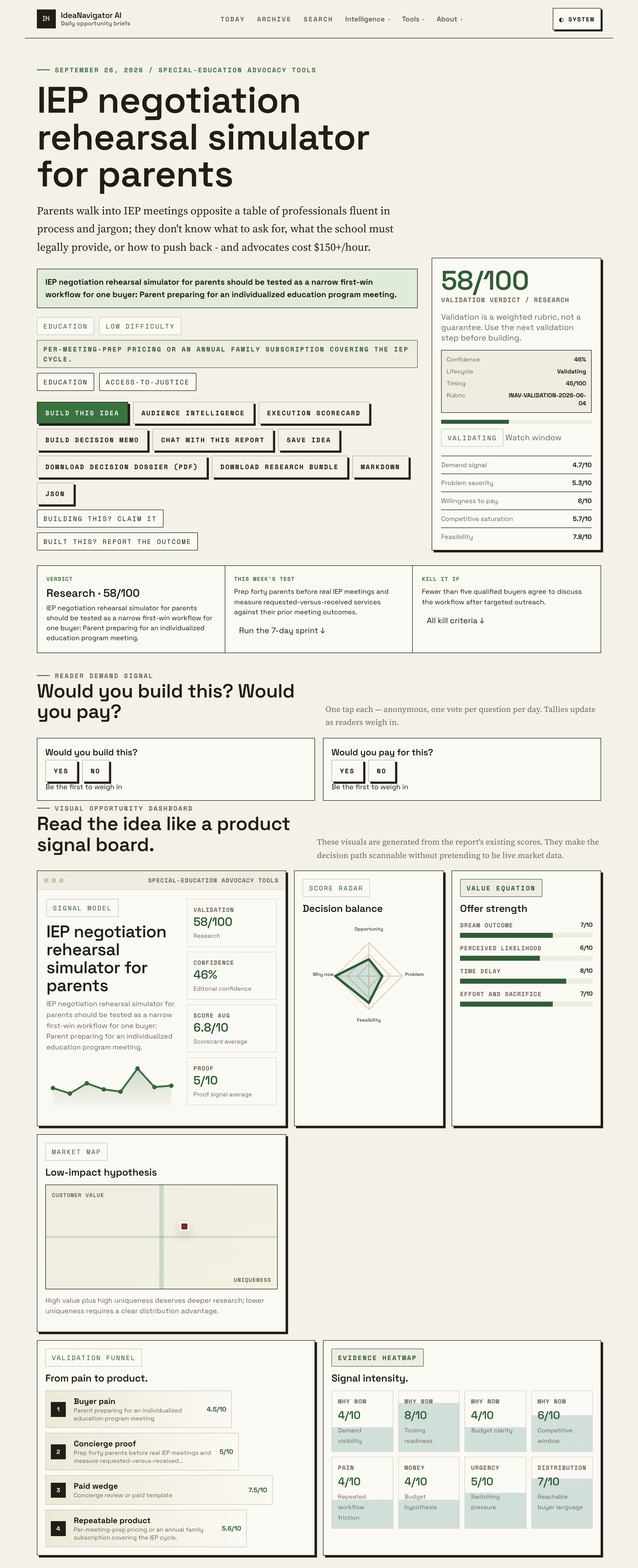
IdeaNavigator AI has outlined a proposed IEP meeting preparation simulator for parents, rather than announcing a launched product or validated service. The concept would use uploaded education documents, plain-language explanations and simulated negotiation practice; its effectiveness and legal accuracy have not been established.
IdeaNavigator AI has outlined a proposed rehearsal simulator for parents preparing for individualized education program meetings, describing a tool that would explain education documents, help form service requests and let users practice responses to school officials. The concept addresses a high-stakes meeting where families may face unfamiliar procedures and terminology, but no launch, working product or measured results are reported.
According to the IdeaNavigator AI proposal, the tool is designed for one situation: a parent getting ready for an IEP meeting. Its planned workflow would let a parent upload a current IEP and evaluation reports. The simulator would then explain relevant information in plain language, produce a list of possible requests with legal grounding, and stage a practice meeting that includes realistic pushback. These are proposed functions; the proposal provides no evidence that a system currently performs them.
IdeaNavigator AI says parents can find themselves across the table from professionals familiar with special education processes and terminology, while families may be unsure what to ask for or how to challenge a decision. The proposal also cites advocacy services costing $150 or more per hour. That figure is presented as part of the opportunity case; the proposal supplies no location, date range or pricing survey.
The proposal suggests two possible payment models: a fee for preparing for one meeting or an annual family subscription spanning an IEP cycle. For an initial validation effort, IdeaNavigator AI proposes preparing 40 parents before real meetings and comparing services requested with services received against each parent’s prior meeting outcomes. The proposal reports that no participants have been recruited and provides no comparison findings.
A Lower-Cost Route to Meeting Preparation
If built and shown to work, a rehearsal tool could give parents a structured way to prepare between meetings, including those who cannot afford repeated one-to-one advocacy support. Practicing how to state a request and answer disagreement may help families enter discussions with clearer priorities. The proposal’s focus on a single user and a single task also gives developers a concrete way to test whether families find the service useful.
The possible benefit depends on reliability. An explanation of legal rights must reflect the family’s circumstances and applicable rules, and generated requests could mislead if they overstate what a school is required to provide. A polished role-play may improve confidence without changing the services a student receives. The proposal’s comparison of requested and received services could offer an initial outcome measure, but 40 families would not by itself establish broad effectiveness, especially without details on participant selection, prior outcomes or other factors affecting decisions.
From Meeting Jargon to Practice
An IEP is an individualized education program used to describe special education and related services for an eligible student. Meetings can involve parents and school personnel discussing the student’s needs, goals and services. IdeaNavigator AI’s concept assumes that a parent may need help both understanding written reports and speaking up during a meeting. It combines those needs in a sequence: review documents, identify questions or requests, then rehearse the conversation.
IdeaNavigator AI frames the timing around two conditions: language models can now support realistic role-play, and special education identification is rising while district resources are under pressure. The proposal supplies no dates, statistics or independent evidence for those trends. They are part of its rationale, not verified findings in this report. The concept also does not specify which jurisdictions it would serve, although legal requirements can vary by location and a family’s specific circumstances.
Accuracy and Outcomes Remain Open
IdeaNavigator AI’s proposal names no product, launch schedule, price or technical demonstration. It is unclear how the tool would protect sensitive student records uploaded by families, check that legal explanations remain current, or distinguish general information from advice tailored to an individual case. The proposal does not identify a legal review process or explain how users would be directed to qualified help when a question falls outside the simulator’s limits.
The proposal also leaves its central effectiveness question unanswered: whether rehearsal changes meeting outcomes, parent understanding, or both. Comparing requested and received services with a parent’s previous meeting could be informative, but those measures alone would not show why an outcome changed. IdeaNavigator AI provides no study design, timeline, consent process or plan for evaluating differences among families.
Testing the Proposed Workflow
IdeaNavigator AI’s stated next step is to prepare 40 parents for real IEP meetings and compare the services they request and receive with outcomes from their earlier meetings. Before those results could be assessed, the project would need to establish whether the simulator exists in usable form, how families would be recruited, what records would be collected and how legal accuracy and privacy would be handled. The proposal gives no pilot date or findings.
For now, the development described by IdeaNavigator AI is a product proposal aimed at a specific unmet need. Whether it becomes a service, earns parents’ trust and produces useful preparation remains unknown.
Source: IdeaNavigator AI
Key Questions
Has the IEP rehearsal simulator launched?
No launch is reported. IdeaNavigator AI describes a proposed product and possible pilot, without a release date or working demonstration.
What would the proposed tool do?
According to IdeaNavigator AI’s proposal, parents would upload an IEP and evaluation reports. The planned system would explain them in plain language, suggest requests with legal grounding and simulate meeting discussion, including pushback.
How would the project test the idea?
IdeaNavigator AI proposes preparing 40 parents before actual meetings, then comparing their requested and received services with their own prior meeting outcomes. The proposal reports no completed study.
Would the simulator replace an education advocate?
IdeaNavigator AI presents the concept as a lower-cost preparation option. The proposal provides no evidence that it can replace individualized support from an advocate, attorney or other qualified professional.
Source: IdeaNavigator AI
Fall Picks
fall essentials
As an affiliate, we earn on qualifying purchases.