
TL;DR

Get business pricing on tech for your team
- Business-only prices and quantity discounts
- Tax-exempt purchasing
- Multiple users, one account, clear invoices
Qblox says it has connected NVIDIA DGX Spark to its quantum system controller through NVIDIA NVQLink, reporting round-trip latency below 7.2 microseconds on DGX Spark. The integration is intended to support GPU-based calibration and quantum error correction, but the announcement does not provide independent verification or details from a deployed quantum system.
Qblox said it has integrated NVIDIA’s DGX Spark computer with its quantum system controller using NVIDIA NVQLink, reporting round-trip latency below 7.2 microseconds on DGX Spark. The company says the connection is designed to bring GPU computing into the real-time control loop for quantum hardware, supporting workloads such as calibration and quantum error correction.
In a company announcement reported by The Quantum Insider on October 22, 2026, Qblox also reported round-trip latency below 4.0 microseconds when using an NVIDIA RTX PRO 6000 Blackwell GPU. These figures are company-reported measurements; the announcement describes them as measured hardware performance but does not include a full test protocol, workload specification or independent assessment.
The system combines Qblox’s Q1 sequence processors and LINQ connectivity with GPU computing, using NVIDIA’s CUDA-Q software platform. Qblox says the design can let GPU-based calibration routines update qubit parameters while experiments are running, rather than only between runs. It also says syndrome data used in quantum error correction can be sent to GPU decoders with low latency, with the aim of identifying and correcting errors in real time.
Qblox and NVIDIA describe DGX Spark as a desktop development platform for quantum, AI and simulation workloads. According to the announcement, researchers can develop and test code on the desktop system and then carry the same code to GPU servers as quantum systems grow. The release does not give a schedule for product availability, pricing or access to the integrated setup.
Bringing GPUs Into Quantum Control
The integration targets a practical challenge in scaling quantum computers: control and processing tasks must keep pace with experiments, rather than run only as offline analysis. Low-latency communication between quantum control hardware and GPUs could let researchers process measurement data and adjust operations while a system is running. That may be useful for developing calibration methods and error-correction techniques, both of which are relevant to efforts to build more reliable quantum systems.
The announcement is a hardware-performance milestone, not evidence that the integration has already improved the performance of a quantum computer or enabled large-scale logical qubits. Qblox says the setup supplies building blocks for real-time hybrid workloads. Whether those capabilities translate into measurable gains will depend on the quantum hardware, software, workloads and operating conditions used in practice.
A desktop development setup could also lower the barrier to experimenting with hybrid workflows before moving them to larger GPU systems. The promised path from desktop to data-center hardware may help researchers avoid rewriting code as their computing needs increase, though the release does not specify how broadly that portability has been tested.
As an affiliate, we earn on qualifying purchases.
From NVQLink Plans to Measurements
The October announcement follows earlier work between the companies. Qblox said it announced work with NVIDIA NVQLink in October 2025 and added support for the CUDA-Q real-time API in March 2026. The companies characterize the new integration as moving beyond an architectural design to measured performance on specific GPU hardware.
NVQLink is presented in the release as the connection between GPU computing and quantum control. Qblox supplies the control system that coordinates operations on quantum hardware, while NVIDIA’s GPUs provide computing resources for tasks including simulation and decoding. The announcement frames these components as a hybrid system; it does not report a new quantum processor or a change to the underlying qubits.
“Quantum computers will scale only as fast as the classical control systems around them.”
— Niels Bultink, Qblox CEO and co-founder
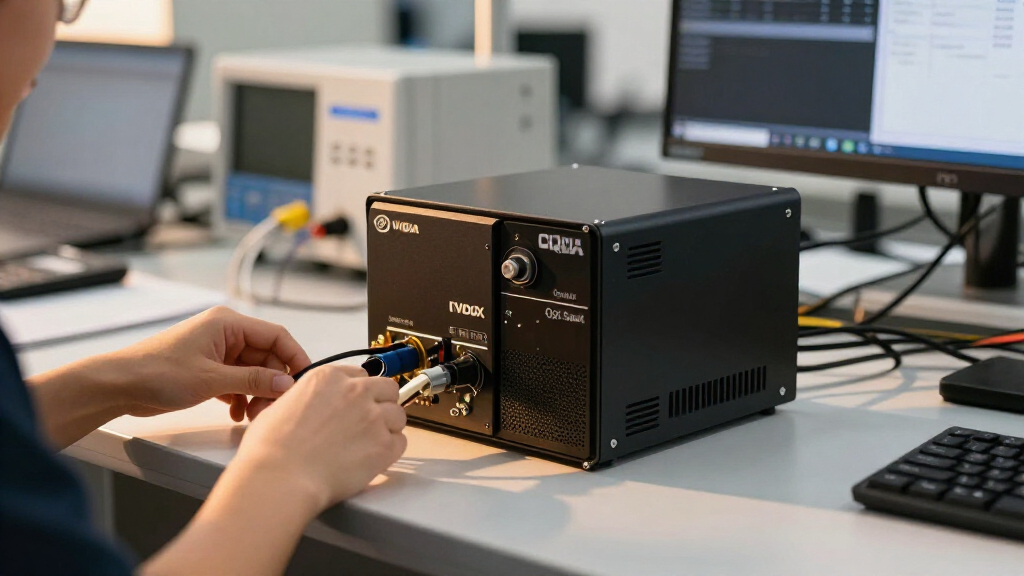
quantum system controller with NVQLink
As an affiliate, we earn on qualifying purchases.
As an affiliate, we earn on qualifying purchases.
Performance Details Still Missing
The announcement does not specify the test setup behind the latency figures, including the exact workload, measurement method, number of runs or whether the results were independently checked. It also does not state which quantum processor or experiment was connected during testing, or report outcomes such as faster calibration, improved error rates or successful real-time error correction on a working quantum system.
It remains unclear when researchers can access the integrated configuration, what hardware and software versions it requires, and whether the same code will transfer without changes across different GPU servers and quantum systems. Qblox and NVIDIA describe those capabilities as part of the platform’s intended use, but the release provides no deployment timeline or independent demonstration data.
GPU-based quantum error correction hardware
As an affiliate, we earn on qualifying purchases.
As an affiliate, we earn on qualifying purchases.
Deployment and Workload Testing
The next useful evidence will be demonstrations that identify the quantum hardware and workloads involved, explain how latency was measured, and show whether GPU-based calibration or decoding improves experimental results. Qblox and NVIDIA have not announced a public release date or a specific next milestone in the material available for this report.
Researchers considering the platform will also need details on access, compatibility and the transition from desktop development to server-scale computing. Until those details and results are available, the reported latency figures establish a company-reported connection between the controller and two NVIDIA GPU platforms, while the broader benefits remain to be demonstrated.
As an affiliate, we earn on qualifying purchases.
Key Questions
What did Qblox announce?
Qblox said it integrated NVIDIA DGX Spark with its quantum system controller using NVQLink, with the goal of supporting real-time hybrid quantum-classical workloads.
What latency did Qblox report?
Qblox reported round-trip latency below 7.2 microseconds on DGX Spark and below 4.0 microseconds on an RTX PRO 6000 Blackwell. The figures are company-reported, and the announcement does not include a detailed test protocol.
What could the integration be used for?
The companies say it is intended to support GPU-accelerated qubit calibration, quantum error-correction decoding and simulation alongside quantum hardware. The announcement does not establish that these uses have already improved a quantum system’s performance.
Can researchers move code from DGX Spark to larger systems?
Qblox and NVIDIA say researchers can develop on DGX Spark using CUDA-Q and carry the same code to GPU servers as systems scale. The release does not describe the range of hardware tested or whether code will run unchanged in every configuration.
Source: rss
Evergreen bestsellers Picks
bestsellers
As an affiliate, we earn on qualifying purchases.