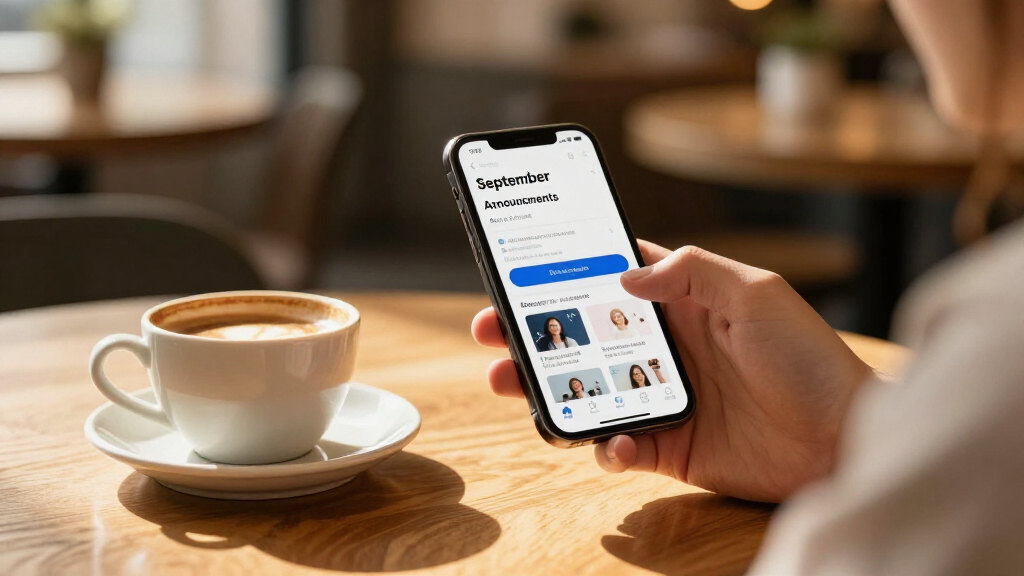

🔍 Read the full analysis: What Did We Announce In AI This September? on ThorstenMeyerAI.com

Get business pricing on tech for your team
- Business-only prices and quantity discounts
- Tax-exempt purchasing
- Multiple users, one account, clear invoices
TL;DR
Google’s October 2 roundup summarized September AI announcements across Gemini models, app integrations, creative tools and research. Gemini 4 Argon and Gemini 3.8 Flash Cyber are restricted to trusted cyber defenders or organizations for now; Google did not provide a wider-release timetable or independent evidence for several performance claims.
Google’s October 2 roundup of its September AI announcements, as described in the original analysis, covered new Gemini models, app integrations, voice and creative tools, and scientific projects. The company said its Gemini 4 Argon and Gemini 3.8 Flash Cyber models are initially limited to trusted cyber defenders or organizations, with no date given for broader access.
Google described Gemini 4 Argon as a frontier model for complex tasks including coding, financial research, legal drafting and cybersecurity defense. The company claims it can produce outputs of up to 1 million tokens and said it is offering early access to trusted cyber defenders through its Fairwind Program. Google said it plans to use tester feedback to refine safeguards before considering wider availability.
The roundup also covered Gemini 3.8 Flash and Flash Cyber. Google said Flash is designed to improve long-running software engineering and multi-step problem solving while retaining the speed and low cost of 3.7 Flash. Flash Cyber is, like Argon’s cybersecurity capabilities, restricted to trusted organizations through Fairwind. The recap did not include benchmark results to independently assess these claims.
Other September announcements spanned consumer and developer services. Google said Gemini 3.8 Live audio models are available through Google AI Studio and the Gemini API, as well as in Search Live, Gemini Live and Google Workspace. It also listed prompted text-to-speech tools, the music-generation model Lyria 3.5, and Gemini app connections for services including Airtable, Linear, Adobe, Peloton and Experian. The roundup included interactive study materials and short video summaries in Gemini Notebook, an experimental group version of the CC assistant, Googlebook pre-orders, and a Gemini app for Windows.
AI Moves Into More Workflows
The announcements show Google placing AI features across consumer apps, developer tools and research, while keeping the cybersecurity-focused models under restricted testing. For users, additions such as connected services, voice models and creative tools could bring more tasks into familiar Google products. Their practical value will depend on actual availability, performance and how linked service data is handled.
The distinction between a product announcement and broad availability matters. Some features are described as available through named products or APIs; others remain experimental or limited to selected testers. The roundup does not establish that every announced feature is available to every user, account tier or region. Nor does it independently verify Google’s descriptions of model performance or safety.
For cybersecurity, the phased access program is the central issue. Google says testing and safeguard refinement will precede any expansion for Argon, but the roundup provides no evaluation results showing how those protections perform. That leaves readers with the company’s stated release approach, rather than independently assessed evidence about the model’s capabilities or the effectiveness of its safeguards.
As an affiliate, we earn on qualifying purchases.
September’s Mix of Releases
Google’s recap combines announcements at different stages: model releases, features added to existing services, experimental previews and research projects. That makes the list a snapshot of the company’s activity, not a single launch with one availability date. Google framed the roundup as part of its ongoing reporting on AI work, spanning products as well as research and infrastructure.
Alongside Gemini and consumer product updates, the company cited AlphaGenome Atlas, methane monitoring from space and Project Suncatcher, an effort to test machine-learning hardware in orbit. The material supplied in the recap did not report detailed findings or completion dates for those projects. The announcement list therefore reflects a broad range of work, but does not provide the same level of evidence or deployment detail for every item.
Google’s own descriptions distinguish general product rollouts from restricted or experimental efforts. It identified CC for groups as an experimental preview and said cyber-focused capabilities are being tested with trusted participants. That status is relevant when reading the recap: inclusion in an announcement does not by itself mean general access.
“Safely releasing frontier capabilities at this level requires a phased approach.”
— Google, in its September roundup
voice-to-text transcription device
As an affiliate, we earn on qualifying purchases.
As an affiliate, we earn on qualifying purchases.
Access and Evidence Still Pending
Google did not say when Argon or Flash Cyber might reach wider audiences, how many testers are involved, or which criteria will determine whether access expands. The recap also did not include benchmark data supporting its claims about reasoning, coding or speech performance, or independent evaluations of the models’ safeguards.
It is also unclear from the roundup which connected apps and voice features are available across regions and account tiers, and what information is shared when users link services. For the research projects it cited—including methane monitoring and orbital hardware tests—the material provided no measurements, results or completion timelines. Those details may emerge in later updates, but they were not established in this recap.
As an affiliate, we earn on qualifying purchases.
Wider Access Depends on Testing
Google said it will collect feedback from trusted testers and refine safeguards before expanding Argon access to developers, businesses and consumers. It gave no timetable for that step. Flash Cyber remains limited to trusted organizations, with no wider-release date announced in the recap.
Further updates would clarify model availability, regional access and account requirements, as well as how Google evaluates performance and safeguards. Results or milestones for the cited science and hardware projects would also help show what has advanced beyond the announcement stage. Until those details are published, the confirmed position is that Google has described the work and, for some models, begun a controlled rollout—not that broad access or independent validation has been established.
cybersecurity AI software for organizations
As an affiliate, we earn on qualifying purchases.
As an affiliate, we earn on qualifying purchases.
Key Questions
What did Google announce in its September AI roundup?
Google’s October 2 recap listed Gemini models, app integrations, voice and creative tools, study features and research projects. The announcements ranged from product features to experimental and restricted-access programs.
Can the public use Gemini 4 Argon now?
Google said Argon is initially available to trusted cyber defenders through its Fairwind Program. The company did not announce a date for access by developers, businesses or consumers more broadly.
What is the status of Gemini 3.8 Flash Cyber?
Google described Flash Cyber as available to trusted organizations through Fairwind. Its roundup did not provide a timetable for a wider rollout.
Did Google provide independent proof of the models’ performance claims?
The roundup described Google’s claims about coding, problem solving, speed, cost and output length, but did not include benchmark results or independent evaluations to verify them.
What remains unknown about the other September projects?
The recap did not specify availability for every feature by region or account type, details about data sharing for linked apps, or results and timelines for projects such as methane monitoring and Project Suncatcher.
Primary source: Google AI · via ThorstenMeyerAI.com
Halloween Picks
halloween
As an affiliate, we earn on qualifying purchases.