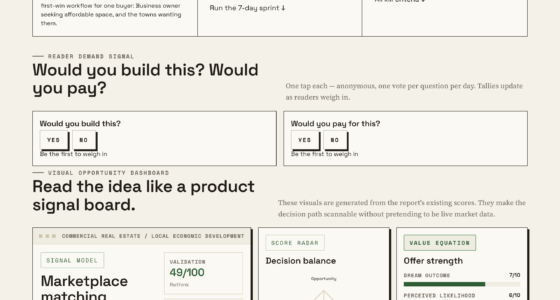
📊 Full opportunity report: Give Young Learners A Realistic Taste Of Different Careers on IdeaNavigator AI — validation score, market gap, and execution plan.

Get business pricing on tech for your team
- Business-only prices and quantity discounts
- Tax-exempt purchasing
- Multiple users, one account, clear invoices
TL;DR

IdeaNavigator AI proposes that Indiana school districts pilot realistic job simulations to give students career exposure and help coordinators document work-based-learning hours. The proposal is not a reported launch or approved program: whether districts accept simulation hours and fund a service remains untested.
IdeaNavigator AI has proposed a one-semester pilot of career simulations for Indiana high school students, aimed at helping districts provide work-based-learning experiences and record student hours. The proposal targets career and technical education (CTE) and work-based-learning coordinators, but there is no confirmation that districts have adopted the program or that the state will count its simulations toward diploma requirements.
IdeaNavigator AI’s proposal recommends approaching three Indiana districts that opted into the state’s new diploma early and offering each a free semester using five simulations. The proposal says each experience would be reviewed by a local employer, either in a short live session or asynchronously. It recommends tracking student completion, the hours districts accept toward diploma seals and whether coordinators commit budget for the following school year.
According to the proposal, the product would eventually include 20 job simulations based on work tasks, with examples such as medical assisting, heating and air conditioning, bookkeeping, logistics coordination and paralegal work. Students would complete practical assignments, and an employer would review their work. The proposed coordinator tools include hour logs, rubric results and an export for a state training-plan template.
The proposal suggests an annual district license priced per enrolled high school student, with paid options for simulations developed alongside local employers. These are design and pricing suggestions, not a launched product, confirmed contract or independently validated market. The proposal identifies no districts, participating employers, student results or costs.
Give Young Learners a Realistic Taste of Different Careers
IdeaNavigator AI proposes a one-semester pilot of job simulations for Indiana high school students. District adoption, accepted hours and funding remain unconfirmed.
What students would try
Practical tasks would offer career exposure, with a local employer reviewing student work.
Medical assisting
A proposed simulation built around practical job tasks.
Heating and air conditioning
Students would try work without needing a full workplace placement.
Bookkeeping
A proposed task-based experience reviewed by an employer.
Logistics coordination
One of the career areas named for the proposed simulation library.
The district test
The pilot would check whether the experience works for students and fits school requirements.
Students try five proposed job experiences.
A local employer checks work live or asynchronously.
Coordinators track completion, credited hours and documentation.
Districts consider whether to budget for the following school year.
Diploma hours need verification
Indiana’s new diploma applies to the class of 2029; districts could opt in starting in the 2025–26 school year.
| Diploma seal | Work-based learning hours | What remains unclear |
|---|---|---|
| One seal | 75 | Which simulated experiences qualify |
| Another seal | 150 | What evidence schools must keep |
A useful template is not approval
The state Digital Resource Hub launched on October 6, 2026 and includes a training-plan template.
- Organize hour logs and rubric results
- Export records in the template’s format
- Whether districts or the state accept simulation hours
- Whether a brief employer review meets the sustained-interaction standard
Testing Career Hours in Practice
IdeaNavigator AI’s proposal describes two linked challenges: schools may have difficulty finding enough employers to host teenagers, and students can make education or career choices with little opportunity to try the work. The proposal says those barriers may be more pronounced in rural areas and white-collar occupations, where local placements can be limited. It suggests simulations could give students structured exposure to job tasks without requiring a full workplace placement for every experience.
For districts, the practical test is not simply whether students enjoy the activities. Coordinators would need to know whether the experience qualifies for required hours, whether documentation meets state expectations and whether the program reduces placement and record-keeping burdens. State acceptance of the hours is a central question: a useful classroom activity may not satisfy a formal work-based-learning requirement.
The proposal recommends an employer check-in, citing Indiana’s definition as requiring sustained interaction with industry professionals. That could make employer review more relevant than a standalone video or self-paced exercise, but the proposal does not establish that a brief review would meet the state’s standard.
Products Worth Considering

Amazon Kindle Paperwhite (12th Generation, 2024), 16GB, 7-Inch Display, Raspberry

Logitech MX Master 4 Ergonomic Wireless Mouse with Haptic Feedback, Graphite

Bose TV Speaker Compact Soundbar with Bluetooth and HDMI-ARC, Black
As an affiliate, we earn on qualifying purchases.
Indiana’s Diploma and Documentation
Indiana approved a new diploma in December 2024. It applies to the class of 2029, while districts could opt in beginning in the 2025-26 school year. According to IdeaNavigator AI’s proposal, two diploma seals require 75 or 150 hours of work-based learning, and qualifying hours may include simulated experiences. The proposal notes that the wording leaves room for interpretation about which simulations qualify and what evidence schools must keep.
The proposal also points to a Digital Resource Hub launched by the state on October 6, 2026, which includes a training-plan template for students in qualifying work-based learning. IdeaNavigator AI suggests its product export records in a format matched to that template. The template could help schools organize documentation, but matching its format would not by itself establish that the state approves a particular simulation or counts its hours.
Against that policy backdrop, IdeaNavigator AI recommends beginning with a narrow district-coordinator workflow rather than building a broad career exploration platform. The proposal says a five-simulation trial would let districts check the administrative process and employer involvement before considering a larger library or annual license.
Hours, Approval and Demand
No pilot results are available, and IdeaNavigator AI’s proposal does not say that any district has agreed to take part. It remains unknown how many hours a district or state reviewer would credit for a simulation, what evidence would be required, or whether a short employer check-in meets the definition of sustained industry interaction. Those decisions could determine whether the concept supports diploma requirements or serves only as supplementary career exploration.
Other open questions include the time and cost of creating realistic task files, how employers would be recruited and compensated, how students’ work would be assessed, and whether schools can fit the activities into existing schedules. The suggested per-student license and custom-development add-ons are proposed revenue options; IdeaNavigator AI provides no pricing, budget commitments or evidence of willingness to pay.
A Three-District Pilot Proposal
IdeaNavigator AI recommends contacting three early-adopting Indiana districts and offering a free one-semester trial of five simulations, each reviewed by a local employer. The proposal says the test would need to establish what districts count as qualifying work-based-learning hours and how the activities fit the state’s training-plan documentation.
After the semester, the proposal suggests measuring student completion, hours accepted toward diploma seals and coordinators’ willingness to budget for the next school year. No schedule for recruitment, pilot start or results has been announced. Until districts and state requirements are checked, the idea remains a proposal rather than a confirmed education program.
Source: IdeaNavigator AI
Key Questions
Has Indiana launched a student job-simulation program?
No. IdeaNavigator AI describes a proposal for a district pilot; the available information does not confirm a state program, product launch or participating schools.
Could simulations count toward Indiana diploma hours?
The proposal says qualifying work-based learning may include simulated experiences. It is not clear which activities or hours districts will accept, or whether a brief employer review meets state requirements.
What would students do in the proposed pilot?
According to IdeaNavigator AI’s proposal, students would complete five job simulations built around practical tasks, with a local employer reviewing their work. Suggested career areas include medical assisting, HVAC, bookkeeping, logistics and paralegal work.
How would the pilot be evaluated?
IdeaNavigator AI recommends measuring student completion, hours accepted toward diploma seals and district budget commitments for the next school year. No results have been reported.
Source: IdeaNavigator AI