📊 Full opportunity report: Best Quiet Case Fans + the Airflow Setup That Actually Works on ThorstenMeyerAI.com — validation score, market gap, and execution plan.

Get business pricing on tech for your team
- Business-only prices and quantity discounts
- Tax-exempt purchasing
- Multiple users, one account, clear invoices
TL;DR
This article identifies the best quiet case fans for 2026 and explains the airflow setup that ensures optimal cooling with minimal noise. It emphasizes large, slow-moving fans and proper placement for a silent, efficient system.
In 2026, the most effective way to build a quiet, high-performance PC is to use large, slow-moving fans combined with a carefully planned airflow setup, according to recent expert reviews and testing.
The guide recommends using 140mm fans over 120mm for quieter operation, as larger fans move the same amount of air at lower RPMs, reducing noise. The Noctua NF-A12x25 and NF-A14 are highlighted as the top engineered fans, offering high airflow and near-silent operation at high reliability. For budget-conscious builders, Arctic P12 Pro and P14 fans provide nearly comparable performance at a fraction of the cost, making them the best value options. For silent environments, be quiet! Silent Wings 4 fans are preferred due to their extremely low noise levels. When cooling radiators, static-pressure fans like the Arctic P12 Pro and Noctua NF-F12 are recommended to push air through dense heatsinks efficiently. Proper placement and fan tuning are emphasized as crucial to achieving a balance of cooling and silence, with larger fans running on flat, low curves to minimize mechanical noise. The article underscores that moving more air slowly is the key principle for quiet, effective cooling, especially in high-power AI workstations.Best quiet case fans
+ the airflow that works.
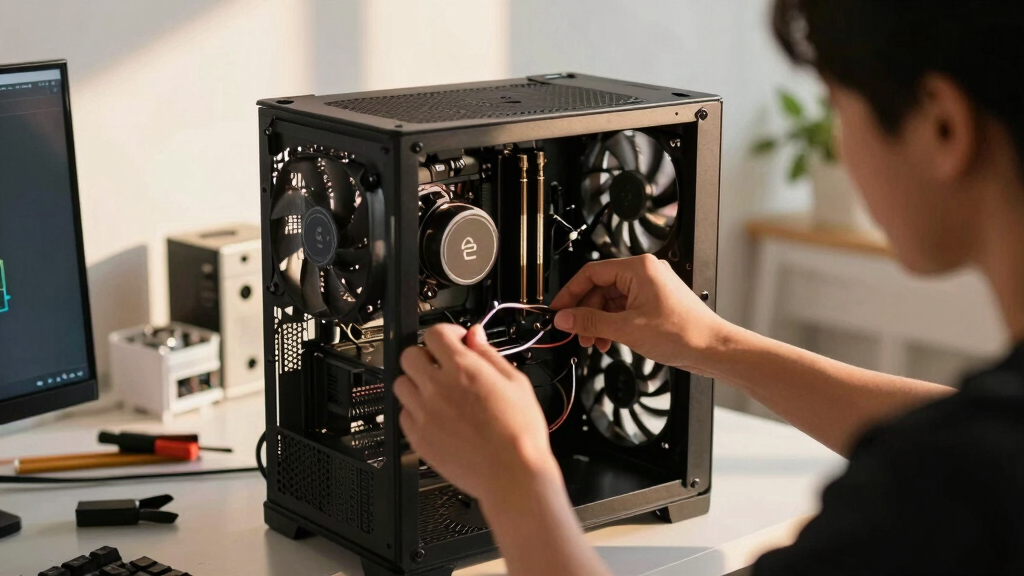
The best fan won’t help if it’s pointed the wrong way. The whole recipe: big fans, running slowly, in a clean front-to-back path, with slightly more intake than exhaust. Build a config in Part 2 and watch the pressure balance respond.
Why Proper Fan Choice and Airflow Are Critical for Quiet Workstations
Choosing the right fans and airflow configuration directly impacts the noise levels and thermal performance of high-end workstations. Using larger fans at lower RPMs can significantly reduce noise without sacrificing cooling, which is vital for professional environments and long-term reliability. Proper airflow setup ensures components stay cool, prolonging hardware lifespan and maintaining stable performance in demanding AI workloads. As noise reduction becomes increasingly important in shared or office spaces, these optimized configurations allow users to operate powerful systems quietly and efficiently.
As an affiliate, we earn on qualifying purchases.
Advances in Fan Design and Airflow Strategies in 2026
Recent years have seen significant improvements in fan engineering, with brands like Noctua, Arctic, and be quiet! leading the way. The emphasis has shifted toward larger, slower fans that move the same or more air at lower RPMs, drastically reducing noise. Prior to 2026, many builders relied on smaller fans or high-speed fans that generated more noise. The current consensus favors a balanced approach: large fans for case intake/exhaust and static-pressure fans for radiators and dense heatsinks. This approach aligns with the latest research and testing, which shows that moving more air slowly is the most effective method for quiet, high-performance cooling.
"Using larger fans at lower speeds is the most effective way to keep a high-performance workstation quiet without sacrificing cooling."
— Thorsten Meyer, expert reviewer
As an affiliate, we earn on qualifying purchases.
Remaining Questions About Long-Term Reliability and Compatibility
While the recommended fans are widely tested and praised, long-term reliability data for some newer models in continuous operation is still emerging. Compatibility with all case sizes and airflow configurations may vary depending on specific builds, and user tuning can influence performance outcomes. Further testing is needed to confirm the optimal setup for different hardware and ambient conditions.
As an affiliate, we earn on qualifying purchases.
Next Steps for Builders and Manufacturers in 2026
Manufacturers are expected to release updated fan models with even better noise and airflow characteristics, while builders should experiment with fan placement and tuning to optimize their specific systems. Future developments may include smarter fan controllers and more customizable airflow solutions, further enhancing quiet operation for high-performance workstations. Users are advised to stay informed about new releases and community-tested configurations for best results.
static pressure case fans for radiators
As an affiliate, we earn on qualifying purchases.
As an affiliate, we earn on qualifying purchases.
Key Questions
Why are larger fans better for quiet operation?
Larger fans move the same amount of air at lower RPMs, which produces less mechanical noise and airflow turbulence, resulting in quieter operation without compromising cooling performance.
Can I use smaller fans and still keep my system quiet?
While possible, smaller fans generally need to run at higher speeds to achieve similar airflow, which increases noise. Using larger fans is more effective for quiet, sustained cooling.
What is the best fan for radiator cooling in a liquid-cooled system?
Static-pressure fans like the Arctic P12 Pro and Noctua NF-F12 are recommended, as they can push air through dense radiator fins efficiently while maintaining low noise levels.
How important is fan placement in achieving quiet operation?
Fan placement and airflow direction are critical. Properly positioning intake and exhaust fans to create a smooth, continuous airflow path minimizes turbulence and noise, enhancing overall silence.
Source: ThorstenMeyerAI.com
Halloween Picks
halloween
As an affiliate, we earn on qualifying purchases.